What Is SAP MDM? Understanding SAP Master Data Management
Learn what SAP MDM is, how it manages enterprise master data, its key features and benefits, and how organizations can approach modern MDM strategies.
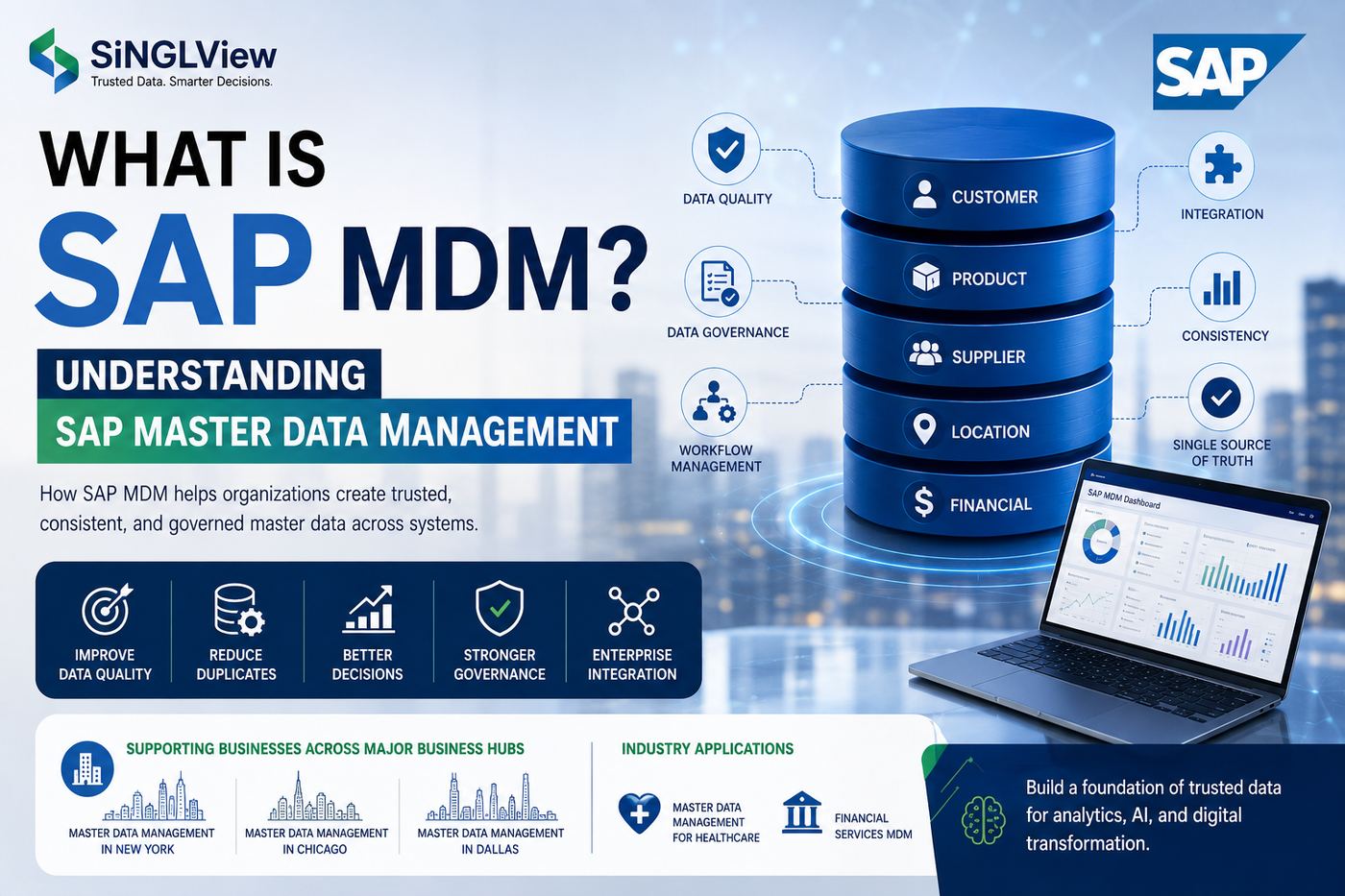
Understanding SAP Master Data Management, How It Works, Its Benefits, Use Cases, and Role in Modern Enterprise Data Management
Large organizations manage thousands or even millions of customer records, products, suppliers, materials, locations, and other business-critical information across different systems. When this information is inconsistent, duplicated, or outdated, it can affect reporting, operational efficiency, customer experiences, and business decisions.
This is where SAP MDM comes into the picture. SAP Master Data Management helps organizations consolidate and manage important master data so that information remains more consistent across SAP and non-SAP business systems.
For organizations evaluating Master Data Management Solutions, understanding what SAP MDM does, where it fits, and how it supports data quality and governance is an important first step. In this guide, we explain what SAP MDM is, how it works, why organizations use it, and how it fits into a modern enterprise data strategy.
What Is SAP MDM?
SAP MDM (SAP Master Data Management) is a data management solution designed to help organizations consolidate, manage, and maintain important master data across different business systems.
Master data represents core business entities that are repeatedly used across an organization. Depending on the business, this can include:
Customer information
Product and material data
Supplier records
Employee information
Location data
Financial master data
For example, a customer may appear in a CRM system, ERP platform, billing application, and reporting environment. If each system contains different versions of that customer's information, the organization may struggle to determine which record is accurate.
SAP MDM addresses this challenge by helping organizations bring master data together, identify inconsistencies, improve data quality, and maintain more reliable business information.
The overall objective is to establish consistent master data that can be used across enterprise applications and business processes.
Why Do Organizations Need SAP MDM?
As organizations grow, their technology environments usually become more complex. Different departments may adopt applications for customer management, finance, procurement, sales, supply chains, and other business functions.
Each application may create and maintain its own data.
Over time, this can result in:
Duplicate customer records
Inconsistent product information
Conflicting supplier details
Different naming conventions
Incomplete business records
Outdated information
Inconsistent reporting
For example, a company might have one customer recorded as ABC Industries Ltd. in one system and ABC Industries in another. These records may represent the same organization, but without proper matching and management, they can be treated as separate entities.
SAP MDM helps organizations address these challenges by consolidating information and establishing processes for managing critical master data.
How Does SAP MDM Work?
SAP MDM works by bringing master data from different sources into a structured environment where the information can be consolidated, reviewed, standardized, and managed.
A simplified process looks like this:
1. Collect Data From Multiple Sources
Master data is gathered from different enterprise applications and systems.
These sources may include:
ERP systems
CRM platforms
Databases
Supply-chain applications
Legacy systems
External data sources
The goal is to bring relevant information together so that it can be evaluated consistently.
2. Consolidate the Information
Once data is collected, records from different sources can be compared and consolidated.
This helps organizations identify where multiple systems contain information about the same customer, product, supplier, or other business entity.
3. Clean and Standardize Data
Data may contain formatting differences, missing information, inconsistent naming conventions, or incorrect values.
Data-quality processes can help clean and standardize these records before they are used across the organization.
4. Match Duplicate Records
Matching processes help identify records that may refer to the same business entity.
Reducing duplicate records is important because duplicate information can affect reporting, customer management, procurement, and other operational processes.
5. Apply Governance Rules
Master data needs clear rules for ownership, validation, approval, and maintenance.
This is where SAP MDM can work alongside broader Data Governance practices.
6. Distribute Trusted Data
After master data has been consolidated and improved, the information can be shared with connected business applications.
This helps different teams and systems work with more consistent information.
What Is Master Data in SAP?
Master data is information about core business entities that remains relatively stable compared with transactional data.
For example, a sales transaction is transactional data, while the customer involved in that transaction is master data.
Common examples of SAP master data include:
Customer Master Data
Customer information can include names, addresses, contact details, classifications, and other attributes.
Accurate customer data helps organizations support sales, service, billing, reporting, and customer experience processes.
Product and Material Master Data
Manufacturers and retailers often manage extensive product or material information.
This may include product descriptions, categories, specifications, units, and other attributes.
Supplier Master Data
Supplier information may include company details, addresses, payment information, classifications, and procurement-related attributes.
Location Master Data
Organizations with multiple offices, stores, plants, warehouses, or facilities need consistent location information across their systems.
Financial Master Data
Financial master data supports accounting, reporting, planning, and other financial processes.
Managing these domains consistently is an important part of enterprise data management.
Key Features of SAP MDM
SAP MDM provides several capabilities that help organizations manage business-critical master data.
Centralized Master Data Management
A centralized approach provides greater visibility into important business information.
Instead of allowing separate departments to maintain disconnected versions of the same records, organizations can establish a more consistent master-data environment.
Data Consolidation
Data consolidation brings information from multiple systems together.
This makes it easier to compare records, identify inconsistencies, and establish reliable master information.
Data Quality Management
Data quality is essential for effective master-data management.
Cleansing, validation, standardization, and matching processes help organizations improve the accuracy and consistency of important records.
Data Governance Support
Master data needs clear rules and accountability.
Organizations can establish policies around data ownership, approval, validation, and maintenance as part of their broader governance strategy.
Workflow Management
Master data often needs to pass through review and approval processes before it becomes available across business systems.
Workflows can help organizations manage these changes in a structured way.
Enterprise Integration
Master data needs to move between different applications.
Integration capabilities help connect MDM processes with ERP, CRM, analytics, and other enterprise systems.
Benefits of SAP MDM
Organizations implement SAP MDM to solve practical business problems associated with fragmented and inconsistent data.
Better Data Quality
Data cleansing, validation, and standardization can reduce errors and inconsistencies in business-critical records.
Fewer Duplicate Records
Matching and consolidation capabilities help identify duplicate customer, product, and supplier records.
More Consistent Reporting
When reports use standardized master data, organizations can reduce discrepancies between departments and systems.
Stronger Data Governance
Clear ownership, approval processes, and data standards provide greater control over how master data is created and maintained.
Improved Operational Efficiency
Employees spend less time searching for information, correcting records, or reconciling conflicting data.
Better Business Decisions
Decision-makers can work with more consistent information when important business data is properly managed.
A More Reliable Source of Truth
One of the main goals of Master Data Management is to establish trusted information that can be shared across business processes and applications.
SAP MDM and Data Governance: How Do They Work Together?
SAP MDM and Data Governance are closely connected, but they serve different purposes.
Data Governance establishes the policies, standards, ownership, and responsibilities that determine how data should be managed.
SAP MDM provides capabilities for managing and maintaining master data according to those requirements.
For example:
Data Governance can define customer-data standards.
MDM can apply those standards to customer records.
Governance can assign ownership of supplier data.
MDM workflows can support supplier-data approval.
Governance can establish data-quality requirements.
MDM can help identify records that do not meet those requirements.
Together, they create a more structured approach to enterprise data management.
Who Can Benefit From SAP MDM?
SAP MDM is particularly relevant to organizations with complex data environments and multiple business applications.
It can be useful for organizations that:
Manage large volumes of master data
Operate across multiple locations
Use several enterprise applications
Experience duplicate or inconsistent records
Need stronger data-quality processes
Want to improve reporting consistency
Need better control over data ownership
Are undertaking digital transformation
Depend heavily on SAP environments
Large enterprises may benefit significantly because the number of systems, departments, and data relationships makes manual data management increasingly difficult.
Common SAP MDM Use Cases
Customer Data Consolidation
Organizations can consolidate customer records from different systems to create a more consistent customer view.
This can support customer-service operations, reporting, and Customer 360 initiatives.
Product and Material Management
Companies with large product or material catalogs can standardize information across departments and systems.
This can be particularly useful for manufacturers, distributors, and retailers.
Supplier Data Management
Consistent supplier information can help procurement teams reduce duplicate records and improve supplier-related processes.
Enterprise Reporting
Standardized master data provides a stronger foundation for enterprise reporting and analytics.
When departments use consistent customer, product, and supplier information, reports are less likely to produce conflicting results.
Compliance and Risk Management
Organizations in regulated industries often need stronger controls over data ownership, quality, access, and maintenance.
A structured MDM approach can support these broader data-management requirements.
Where Is SAP MDM Used?
SAP MDM can be relevant across industries where organizations manage large amounts of interconnected business information.
Manufacturing
Manufacturers often manage complex product, material, supplier, plant, and location data.
Consistent master data can support procurement, production, inventory, and reporting processes.
Retail
Retail organizations need accurate product, customer, supplier, and location information across physical and digital channels.
Banking and Financial Services
Financial organizations manage large volumes of customer, account, product, and reference information.
Consistent data is important for reporting, risk management, customer operations, and regulatory requirements.
Healthcare
Healthcare organizations manage information related to patients, providers, facilities, products, and other entities.
Reliable data management can help support operational efficiency and consistent information across connected systems.
Consumer Goods
Consumer-goods organizations often operate across multiple markets and manage extensive product, supplier, and customer information.
Regional Data Management Needs
Organizations operating across major business hubs such as New York may manage large volumes of customer, supplier, product, and financial data across multiple systems. For businesses exploring Master Data Management in New York, a structured MDM approach can help improve consistency across enterprise applications while supporting reporting, governance, and operational efficiency.
SAP MDM and Modern Data Management
Enterprise data management has evolved significantly with the growth of cloud computing, real-time integration, analytics, and artificial intelligence.
Organizations today increasingly need MDM capabilities that can work within broader data ecosystems.
Important considerations may include:
Cloud environments
Real-time integration
Automated data matching
Data-quality monitoring
Data governance
Analytics
Artificial intelligence
Scalable enterprise architectures
This means organizations evaluating SAP Data Management approaches should look beyond individual systems and consider how master data fits into their complete enterprise data strategy.
For organizations evaluating Master Data Management in Chicago, factors such as integration with existing enterprise applications, data quality requirements, scalability, and governance capabilities can influence the choice of an MDM platform. The right approach should align with both current operational needs and future data initiatives.
Similarly, businesses considering Master Data Management in Dallas may prioritize reliable data integration, centralized governance, and consistent master records across geographically distributed teams and business systems. These capabilities become increasingly important as organizations expand their use of analytics and AI.
The right approach depends on the organization's existing technology environment, business requirements, data challenges, and long-term goals.
SAP MDM and AI
Artificial Intelligence depends on reliable data.
When customer, product, supplier, or other master data contains duplicates, missing information, or inconsistencies, AI systems and analytics applications may produce unreliable results.
This makes master data quality an important consideration for organizations developing AI initiatives.
A strong MDM strategy can help organizations prepare business data for:
AI applications
Machine learning
Predictive analytics
Business intelligence
Automated decision-making
Advanced reporting
By improving consistency and governance, organizations can create a stronger foundation for using data in modern AI and analytics environments.
SAP MDM vs. Modern MDM Platforms
SAP MDM can be an important part of an organization's data strategy, particularly for enterprises operating complex SAP environments.
However, organizations evaluating an MDM platform should consider their broader requirements rather than selecting technology based only on their existing systems.
Important evaluation factors include:
Integration capabilities
Scalability
Data-quality functionality
Governance support
Cloud readiness
AI capabilities
Workflow management
Business requirements
Existing enterprise architecture
For some organizations, extending an existing SAP environment may be appropriate. Others may evaluate newer MDM approaches based on their integration, cloud, automation, and AI requirements.
The objective should always be to create a data-management environment that supports the organization's long-term business strategy.
How to Choose the Right MDM Approach
Before implementing or modernizing an MDM program, organizations should understand the business problems they are trying to solve.
Identify Critical Data Domains
Determine which types of master data have the greatest impact on operations.
This could include customer, product, supplier, location, or financial information.
Understand Existing Data Problems
Identify duplicate records, incomplete information, inconsistent formats, and conflicting values across systems.
Define Data Ownership
Determine who is responsible for creating, approving, maintaining, and correcting important business data.
Establish Data Quality Standards
Define what accurate and complete data means for each master-data domain.
Review Integration Requirements
Understand which systems need to provide or consume master data.
Consider Future Requirements
Organizations should also consider future cloud adoption, analytics, AI, regulatory requirements, and business expansion.
A clear strategy helps organizations determine whether SAP MDM or another modern MDM approach is the right fit.
What Should Organizations Look for in Modern MDM Solutions?
The requirements for MDM continue to evolve as organizations adopt more applications and data-driven technologies.
A modern MDM solution should ideally support the organization's need for:
Data Quality: Tools and processes for identifying and correcting inaccurate or incomplete information.
Data Governance: Clear policies, ownership, workflows, and accountability.
Integration: The ability to work with multiple enterprise applications and data sources.
Scalability: Support for growing data volumes, users, systems, and business operations.
Automation: Reduced manual effort for matching, validation, workflows, and data maintenance.
AI Readiness: A strong data foundation that can support analytics and artificial intelligence initiatives.
These capabilities help organizations move from fragmented data management toward a more connected and trusted data environment.