
What Is ETL? The Process Behind Trusted Business Data
Learn what ETL is and how the Extract, Transform, and Load process helps organizations integrate data, improve data quality, and support MDM, analytics, and AI.
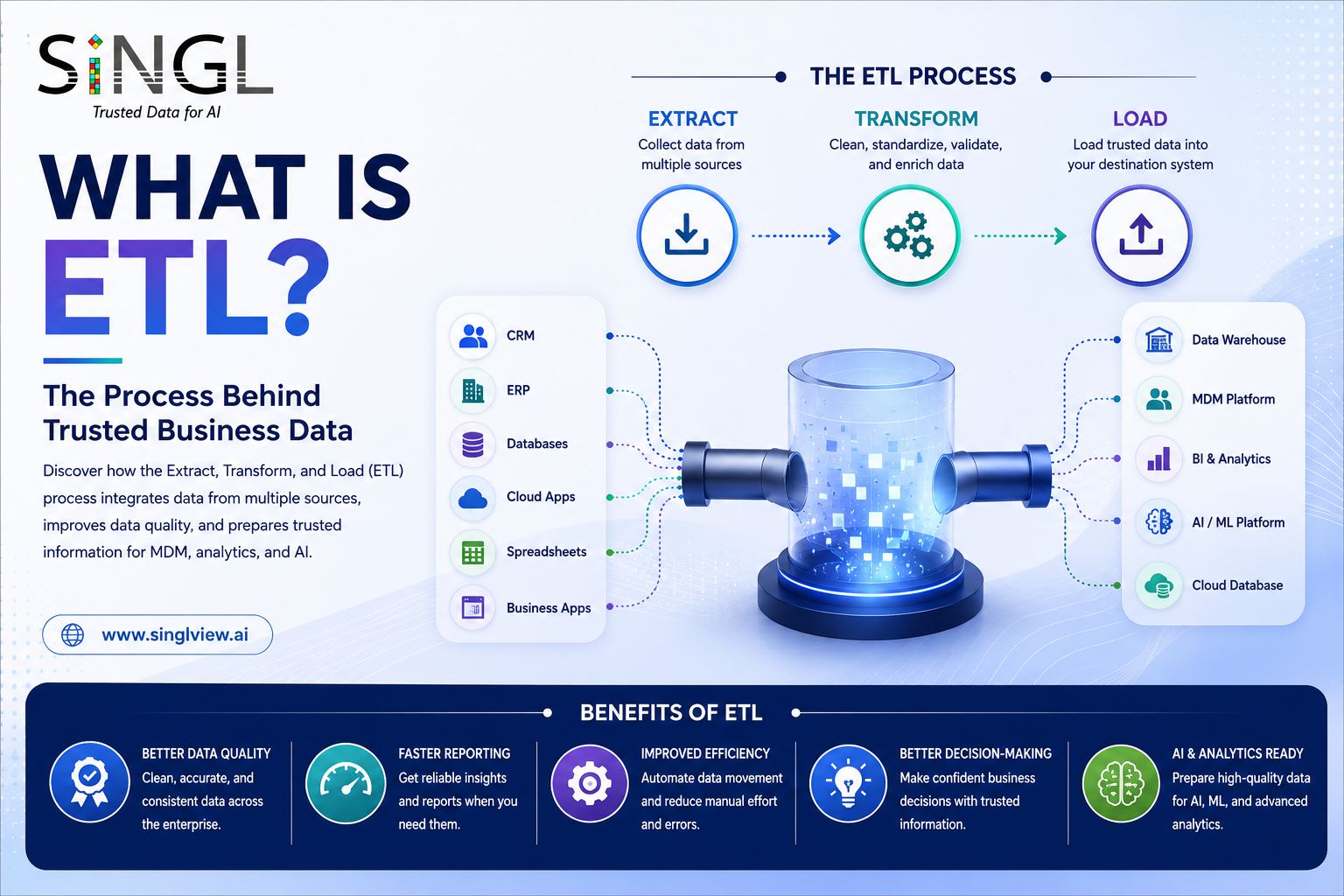
Understanding Extract, Transform, and Load in Data Integration
Organizations collect data from many different sources, including customer databases, CRM systems, ERP applications, websites, and cloud platforms. However, this information is often stored in different formats and locations, making it difficult to use effectively across the business.
Before organizations can analyze, govern, or manage this information, the data needs to be collected, cleaned, standardized, and organized. This is especially important as modern Enterprise Data Management environments continue to grow in complexity.
This is where ETL comes in.
What is ETL? ETL stands for Extract, Transform, and Load. It is a fundamental Data Integration process that gathers data from multiple sources, converts it into a consistent and usable format, and loads it into a destination system such as a data warehouse, Master Data Management platform, analytics solution, or cloud environment.
What Does ETL Stand For?
The Extract Transform Load process consists of three main stages that help organizations move and prepare data for business use.
Extract
The first stage of the ETL process is Extract, where data is collected from different sources.
These sources may include:
CRM systems
ERP applications
Databases
Cloud applications
Spreadsheets
Websites and digital platforms
Business software
The goal is to gather the required information, regardless of where it is stored. This creates the foundation for effective Data Integration across the organization.
Transform
After the data is extracted, it moves to the Transform stage.
During this step, the information is cleaned, standardized, validated, and converted into a consistent format. This stage plays a critical role in improving Data Quality before the information is used for reporting, analytics, or operational processes.
Common transformation tasks include:
Removing duplicate records
Correcting formatting errors
Standardizing data values
Validating data quality
Applying business rules
Combining data from multiple sources
By transforming raw information into a consistent structure, organizations can create more reliable and trusted business data.
Load
The final stage is Load, where the transformed data is transferred into a destination system.
This could include:
A data warehouse
A Master Data Management platform
A Business Intelligence solution
An analytics platform
A cloud database
Once the data is loaded, it becomes available for reporting, analysis, operational processes, and other business activities.
Together, these three stages form the complete ETL process and provide a structured approach to managing data across different systems.
Why Is ETL Important?
Organizations rely on data to make informed decisions, understand customers, manage operations, and plan for future growth.
However, when information comes from multiple systems without proper standardization, it can result in inaccurate reports, duplicate records, and inconsistent business processes.
ETL helps organizations:
Combine data from multiple sources
Improve Data Quality
Standardize business information
Reduce manual data processing
Support accurate reporting
Improve Business Intelligence
Prepare data for analytics and AI
By creating consistent and usable information, ETL helps businesses gain more value from their data and strengthen their overall Enterprise Data Management strategy.
How Does ETL Support Master Data Management?
The relationship between ETL and MDM is an important part of enterprise data management.
Master Data Management depends on information from multiple systems. Before customer, product, supplier, or location data can be used to create trusted master records, it often needs to be collected and prepared.
ETL supports this process by extracting information from different systems, transforming it according to defined standards, and loading it into an MDM environment.
For example:
ETL extracts customer data from CRM and ERP systems.
It transforms the information by correcting errors and standardizing formats.
The prepared data is loaded into the MDM platform.
The MDM solution then helps create and manage trusted master records.
This combination of ETL and MDM helps organizations reduce inconsistencies and build a stronger foundation for trusted enterprise data.
Modern Master Data Management Solutions can use integrated data pipelines and automation to support this process across multiple business domains.
ETL in Data Warehousing
One of the most common applications of ETL is ETL in Data Warehousing.
Organizations often collect information from operational systems that were not originally designed for reporting or analytics. ETL helps move this information into a centralized data warehouse where it can be analyzed more effectively.
For example, sales, finance, customer, and operational data can be extracted from different systems, transformed into a consistent structure, and loaded into a data warehouse.
This allows Business Intelligence teams and decision-makers to work with more accurate and consistent information.
As a result, ETL in Data Warehousing plays an important role in creating reliable reporting and analytics environments.
Benefits of ETL
Organizations use ETL because it provides several important advantages for Data Integration and Enterprise Data Management.
Better Data Quality
Cleaning, validating, and standardizing information helps improve Data Quality across business systems.
Accurate data reduces errors and provides a more reliable foundation for reporting and decision-making.
Faster Reporting and Business Intelligence
When information from multiple systems is prepared and organized, reporting becomes faster and more reliable.
ETL helps provide consistent data for dashboards, analytics platforms, and Business Intelligence initiatives.
Improved Operational Efficiency
The ETL process automates data movement and transformation, reducing the amount of manual work required to prepare information.
This helps teams spend less time correcting data and more time focusing on valuable business activities.
Better Decision-Making
Reliable information supports better business decisions.
When leaders and teams can access consistent data, they can use analytics and reports with greater confidence.
Support for AI and Analytics
Artificial Intelligence and advanced analytics depend on well-prepared data.
AI Data Integration requires organizations to bring information together from multiple sources while maintaining consistency and quality. ETL helps prepare this information for machine learning models, predictive analytics, dashboards, and AI-driven applications.
ETL Use Cases Across Industries
ETL is used across many industries and business environments.
Common ETL use cases include:
Data warehousing
Master Data Management
Business Intelligence
Customer analytics
Financial reporting
Cloud data migration
Regulatory reporting
AI and machine learning initiatives
For organizations investing in Master Data Management for Healthcare, ETL can help bring together information from multiple clinical, operational, and administrative systems before it is standardized and prepared for trusted data management.
Large organizations often operate across multiple offices, business units, and technology environments. For example, a company looking to improve Master Data Management in New York may need to integrate data from local business operations with enterprise systems used across other regions. ETL helps create a consistent flow of information between these systems.
These use cases demonstrate how ETL supports organizations that need to manage growing volumes of data across multiple systems and locations.
ETL vs. ELT
While ETL and ELT are both Data Integration methods, they differ in when the transformation takes place.
The choice between ETL and ELT depends on an organization's data architecture, business requirements, technology environment, and long-term data strategy.
The Role of ETL in Modern Enterprise Data Management
As organizations adopt cloud platforms, analytics, AI, and automation, Data Integration has become increasingly important.
Businesses need to connect information from legacy applications, cloud systems, operational platforms, and external data sources. The ETL process provides a structured way to move and prepare this information.
When combined with Master Data Management Solutions, data governance, and modern analytics platforms, ETL can help organizations create a stronger and more connected data ecosystem.
The goal is not simply to move data from one system to another. Effective Enterprise Data Management requires organizations to ensure that information is accurate, consistent, accessible, and ready to support business operations.