What Is MDM Architecture? A Simple Guide to Master Data Management Architecture
Understand MDM architecture, its key components, common architecture styles, and how it helps organizations create trusted, governed, and connected enterprise data.
Understanding the Foundation of a Master Data Management System
Managing business data is no longer as simple as storing information in a single database. Today, organizations collect customer, product, supplier, location, and employee data from multiple applications, cloud platforms, and business systems. As this information grows, maintaining consistency and accuracy becomes increasingly difficult.
This is where Master Data Management (MDM) helps. An MDM solution brings together data from different sources, improves its quality, and creates a trusted version that can be used across the organization. The way these processes, systems, and technologies work together is known as MDM Architecture.
Understanding MDM Architecture helps organizations build a reliable foundation for data governance, analytics, AI, and digital transformation. A well-planned approach ensures that critical business data can move efficiently between systems while remaining accurate, governed, and accessible.
As enterprises continue to expand across different markets and technology environments, the need for scalable Master Data Management solutions is growing. Organizations exploring Master Data Management in New York and other major business hubs increasingly need architectures that can connect complex systems, support governance, and scale with changing business requirements.
What Is MDM Architecture?
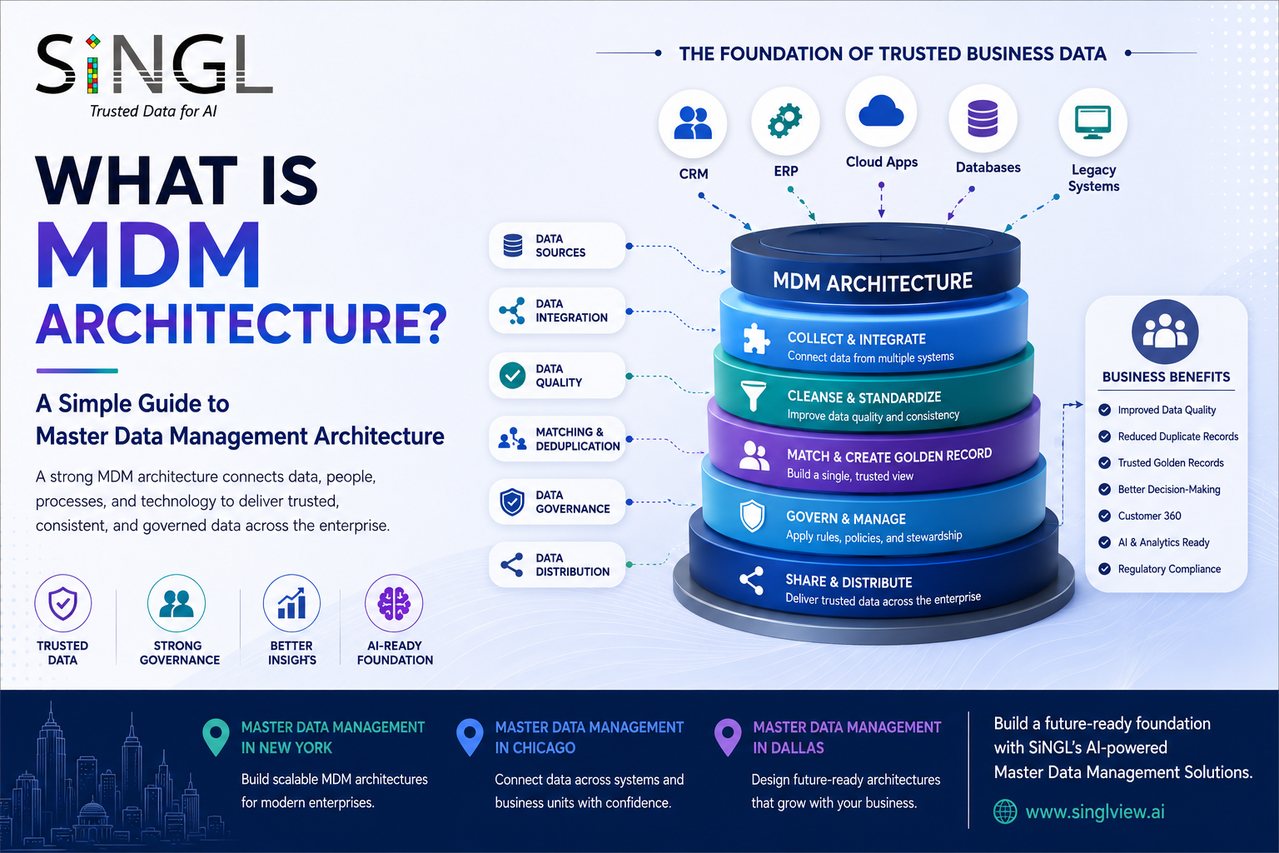
MDM Architecture refers to the overall structure of a Master Data Management system. It defines how master data is collected, integrated, matched, governed, managed, and shared across an organization.
A strong Master Data Management Architecture does not focus only on storing information in one place. Instead, it connects multiple data sources, business processes, governance rules, and technologies to create a trusted and consistent view of critical business data.
In simple terms, the architecture acts as the blueprint for how an organization manages its master data throughout its lifecycle.
A well-designed architecture also supports scalability, allowing businesses to expand their data management capabilities as new systems, data domains, and business requirements emerge.
Why Is MDM Architecture Important?
Without a structured architecture, master data can become fragmented across different applications and departments. Customer information may exist in a CRM system, product data in an ERP platform, and supplier records in procurement software.
As a result, organizations may experience:
Duplicate records
Inconsistent customer information
Conflicting business reports
Poor data quality
Compliance challenges
Limited visibility across systems
Inefficient business processes
A strong MDM framework helps organizations address these challenges by establishing clear processes for managing and governing critical data.
Instead of allowing every system to maintain its own disconnected version of information, the architecture helps create a trusted and consistent data foundation that can support enterprise-wide operations.
For large and growing enterprises, particularly organizations evaluating Master Data Management in Chicago, a structured MDM architecture can help connect information across departments, business units, and technology platforms without creating additional data silos
Key Components of an MDM Architecture
Although every organization has different business and technology requirements, most MDM architectures include several important components.
Data Sources
Master data usually originates from multiple business applications and systems.
These may include:
CRM systems
ERP platforms
Marketing applications
Finance systems
HR software
Supplier systems
Cloud applications
Legacy databases
The first responsibility of an MDM Architecture is to connect these different sources and create a structured approach to managing the information they contain.
Data Integration
Once data is collected from different systems, it must be connected and exchanged efficiently. This is where Data Integration plays an important role.
Integration processes allow information from CRM, ERP, cloud platforms, databases, and other applications to flow into the MDM environment. This helps reduce data silos and creates a more connected view of enterprise information.
A strong integration layer also ensures that updates to master data can be shared with relevant downstream systems.
Data Quality Management
Accurate information is the foundation of successful Master Data Management. For this reason, MDM design usually includes processes that help identify and improve poor-quality data.
These processes may include:
Data profiling
Data cleansing
Standardization
Validation
Enrichment
Error correction
By improving data quality before information is used across the business, organizations can reduce reporting errors and improve confidence in their data.
Matching and Deduplication
Organizations often have multiple records representing the same customer, supplier, product, or business entity.
For example, the same customer may appear differently across multiple systems because of spelling variations, incomplete details, or different data formats.
Matching and deduplication capabilities help identify these records and connect them together. The result can be a trusted Golden Record that represents the most accurate and complete version of that business entity.
This Golden Record can then serve as a reliable reference across connected applications.
Data Governance
Creating accurate data is only one part of the process. Organizations also need clear rules to maintain its quality over time.
This is where Data Governance becomes an essential component of MDM architecture.
Governance processes may define:
Data ownership
Data stewardship responsibilities
Approval workflows
Business rules
Quality standards
Access controls
Policies for creating and updating records
These controls help ensure that master data remains accurate, consistent, and accountable throughout the organization.
Data Distribution
Once master data has been validated and governed, it needs to be shared with other business systems.
The data distribution layer ensures that trusted information can flow from the MDM platform to applications such as CRM systems, ERP platforms, analytics tools, e-commerce systems, and cloud applications.
This helps different departments work with consistent information rather than maintaining disconnected versions of the same data.
Common MDM Architecture Styles
Organizations can choose from different architecture styles depending on their business needs, existing systems, governance requirements, and data complexity.
Registry Architecture
Registry architecture links records from different source systems without replacing the original data.
It provides a way to identify relationships between records and improve visibility across systems while allowing existing applications to remain operational.
This approach can be useful when organizations need a consolidated view without centralizing all master data into one operational system.
Consolidation Architecture
Consolidation architecture collects data from multiple systems and combines it into a central MDM environment.
The data is cleaned, matched, and standardized to create trusted master records. These records are often used for reporting, analytics, and business intelligence.
This architecture is particularly useful when organizations need a reliable enterprise-wide view of critical data.
Coexistence Architecture
In a coexistence model, master data is managed both within the MDM platform and across connected operational systems.
The MDM platform acts as an important governance and synchronization layer while allowing business applications to continue participating in the creation and management of data.
This approach provides greater flexibility for organizations with complex enterprise environments.
Centralized Architecture
A centralized approach uses the MDM platform as the primary system for creating and managing master data.
Business users and applications interact with the central platform, which maintains the trusted version of important business entities.
This model can provide stronger governance and consistency, particularly when organizations want greater control over how master data is created and maintained.
Each approach has different advantages, and the right choice depends on the organization's overall MDM design, existing technology environment, and long-term data strategy.
How MDM Architecture Supports Customer 360
One important use of Master Data Management is creating a complete and connected understanding of customers.
Customer information may be distributed across sales systems, websites, customer support platforms, marketing tools, and financial applications. Without a structured architecture, these records can remain disconnected.
An effective MDM architecture can bring these records together and create a more complete Customer 360 view.
This allows organizations to better understand customer interactions, preferences, relationships, and history. As a result, teams can improve customer service, personalize engagement, and make more informed business decisions.
How MDM Architecture Supports AI and MDM Initiatives
The relationship between AI and MDM is becoming increasingly important as organizations invest in analytics, automation, machine learning, and AI-driven decision-making.
AI systems depend on the quality of the information they receive. If data is incomplete, duplicated, inconsistent, or poorly governed, the resulting insights may also be unreliable.
A well-designed MDM architecture helps establish trusted and governed data that can support AI initiatives. By improving consistency and reducing duplication, organizations can create a stronger foundation for analytics, automation, and intelligent applications.
As AI adoption continues to grow, the role of Enterprise MDM is expanding from basic data management to becoming a critical part of the broader enterprise data strategy.
Choosing the Right MDM Architecture
There is no single architecture that works for every organization.
The right approach depends on several factors, including:
Business goals
Existing systems and applications
Number of data domains
Data complexity
Integration requirements
Data Governance needs
Regulatory requirements
Scalability and future growth
Some organizations may begin with a consolidation model to improve reporting and data visibility. Others may require a coexistence or centralized model to support more complex operational requirements.
The key is to choose an architecture that aligns with both current business needs and future growth plans.
When evaluating Master Data Management Solutions, organizations should consider how effectively the platform can integrate with existing systems, support governance processes, manage multiple data domains, and scale as enterprise data grows.
The architecture requirements may also vary based on the scale and complexity of an organization's operations. Businesses exploring Master Data Management in Dallas, for example, may need an approach that supports multiple data sources, cloud applications, governance requirements, and future expansion.
Benefits of a Well-Designed MDM Architecture
A strong MDM architecture can provide value across multiple areas of the organization.
Improved Data Quality
Standardization, validation, and cleansing processes help improve the accuracy and consistency of master data.
Reduced Duplicate Records
Matching capabilities identify duplicate records and help create a trusted Golden Record for important business entities.
Stronger Data Governance
Clear ownership, workflows, and business rules help organizations maintain data quality over time.
Better Customer and Business Insights
Connected and trusted data provides a more complete understanding of customers, products, suppliers, and other business entities.
Improved Reporting and Analytics
When departments work with consistent information, reporting becomes more accurate and reliable.
Greater Operational Efficiency
Employees spend less time searching for information, correcting errors, and resolving duplicate records.
Support for Customer 360 and Enterprise Initiatives
A connected data foundation supports broader initiatives such as Customer 360, digital transformation, analytics, and AI.
Scalability for Future Growth
A flexible architecture allows organizations to add new systems, data domains, and capabilities as business requirements evolve.
MDM Architecture as the Foundation of Enterprise MDM
As organizations adopt more cloud applications, digital platforms, and AI technologies, managing data through disconnected systems becomes increasingly difficult.
A structured Enterprise MDM approach provides a framework for connecting these systems while maintaining consistent governance and data quality.
The architecture acts as the foundation that connects people, processes, policies, and technology. It ensures that master data is not simply stored but actively managed throughout its lifecycle.
This becomes particularly important as organizations expand into new markets, add new business units, or introduce additional data sources.