
What Is Product MDM? Why It Matters for Modern Businesses
Learn what Product MDM is, how it improves product data quality, and why trusted product information matters for better operations, customer experiences, analytics, and digital transformation.
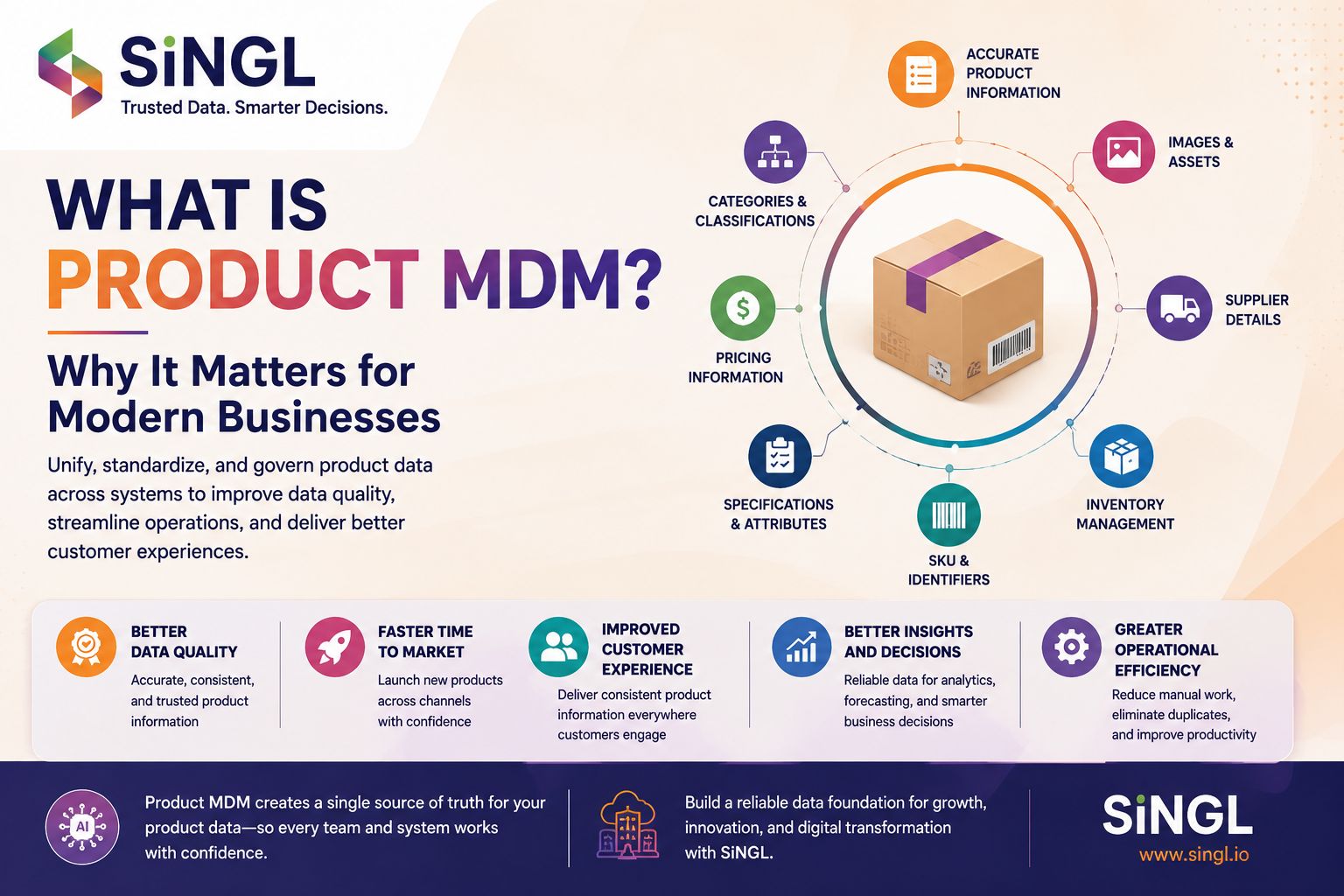
Understanding How Product Master Data Management Improves Data Quality
Every product has important information associated with it, including its name, description, specifications, pricing, category, supplier details, and inventory attributes. Different teams such as sales, marketing, procurement, operations, finance, and customer support rely on this information every day.
As organizations expand, product information is often stored across ERP systems, CRM platforms, supplier databases, e-commerce applications, inventory systems, and other business applications. When these systems are not synchronized, the same product can appear differently across the organization, creating duplicate records, inaccurate information, and operational delays.
This is where Product Master Data Management (Product MDM) becomes important. Product MDM provides a structured approach to collecting, standardizing, governing, and distributing trusted product information across connected systems.
By creating a reliable source of product information, organizations can improve data quality, streamline operations, support better decision-making, and provide customers with more consistent product experiences.
What Is Product MDM?
Product MDM is a specialized area of Master Data Management focused on managing critical product information throughout its lifecycle.
It brings product information together from multiple sources, identifies inconsistencies and duplicate records, standardizes important attributes, and creates a trusted product record that can be shared across business applications.
For example, a single product may have different names, descriptions, categories, or specifications in an ERP system and an e-commerce platform. Product MDM helps reconcile this information so that teams can work with a consistent version of the product.
The broader goal of Product Master Data Management is to establish a single source of truth for product information while making that information accessible to the systems and teams that need it.
What Types of Product Data Does Product MDM Manage?
Product information goes far beyond a product name and description. Depending on the organization and industry, Product MDM can manage many different attributes.
Common examples include:
Product names and descriptions
SKUs and product identifiers
Product categories and hierarchies
Product specifications
Dimensions and weights
Pricing information
Supplier information
Packaging details
Product images and digital assets
Inventory-related attributes
Regulatory information
Product lifecycle status
Managing these attributes consistently helps organizations create complete and reliable product records.
For businesses with large product catalogs, having standardized information becomes especially important because even small inconsistencies can affect sales, operations, reporting, and customer experiences.
Why Is Product MDM Important?
Product information is used throughout the entire product lifecycle.
Sales teams need accurate information to answer customer questions. Marketing teams require consistent descriptions and attributes for campaigns and catalogs. Procurement teams depend on reliable specifications when working with suppliers, while operations teams need accurate information to manage inventory and fulfillment.
Without an effective product data strategy, organizations may experience:
Duplicate product records
Inconsistent product descriptions
Incorrect pricing information
Missing product specifications
Inventory mismatches
Poor search and filtering experiences
Reporting inconsistencies
Delays in launching new products
Product MDM addresses these challenges by establishing consistent processes for managing product information across systems.
The result is a more reliable data foundation that supports both operational and customer-facing activities.
Product MDM vs. Master Data Management
Product MDM is part of the broader discipline of Master Data Management.
Master Data Management can cover several important data domains, including customers, products, suppliers, employees, locations, and other business entities. Product MDM, however, focuses specifically on product-related information.
For example, an organization may use an enterprise-wide MDM strategy to manage customer, supplier, and product information. Within that strategy, Product MDM can provide the capabilities needed to maintain accurate and consistent product master data.
How Does Product MDM Work?
Product MDM follows a structured process for collecting, improving, governing, and distributing product information.
1. Collects Product Data
Product information may originate from ERP platforms, inventory systems, supplier databases, e-commerce platforms, CRM applications, spreadsheets, and other sources.
Product MDM brings this information together so that organizations can establish a consolidated view of their product data.
2. Standardizes Product Information
Different systems may store the same product using different formats, naming conventions, units, or categories.
Product MDM standardizes these attributes according to defined business rules. This helps ensure that product information remains consistent across departments and applications.
For example, one system might use abbreviations while another uses full product names. Standardization creates a consistent format that can be used throughout the organization.
3. Matches and Removes Duplicate Records
Organizations may have multiple records representing the same product.
Product MDM uses matching and deduplication processes to identify these records and determine which information should be retained as the trusted version.
This reduces duplication and improves overall Data Quality Management.
4. Creates a Golden Record
After product information has been matched, standardized, validated, and enriched, Product MDM can create a Golden Record.
A Golden Record represents the trusted version of a product and serves as a reliable reference for connected systems.
Instead of allowing different applications to maintain conflicting versions of the same product, the Golden Record provides a consistent foundation for sharing product information across the organization.
5. Governs Product Information
Product data needs to remain accurate after the initial record is created.
Data governance processes can define ownership, approval workflows, business rules, validation requirements, and responsibilities for maintaining product information.
This makes Data Governance an important part of Product MDM.
6. Synchronizes Product Data
Once product information has been validated and governed, it can be distributed to connected business applications.
This allows e-commerce platforms, ERP systems, inventory applications, catalogs, and other systems to work with consistent product information.
Benefits of Product MDM
A well-implemented Product MDM strategy can provide benefits across multiple areas of an organization.
Better Product Data Quality
Product MDM helps identify duplicate, incomplete, outdated, and inconsistent product information.
By standardizing and validating product records, organizations can establish more accurate product data across their systems.
Faster Product Launches
Launching a new product often requires information to be prepared for multiple teams and systems.
When product information is managed through a centralized and governed process, organizations can reduce manual data preparation and make new product information available more efficiently.
This can help shorten the time required to introduce products across digital and physical channels.
Improved Customer Experience
Customers expect accurate product information wherever they interact with a business.
A customer may view a product on a website, compare it through a mobile application, read information in a digital catalog, and eventually purchase it through another channel.
Product MDM helps maintain consistency across these touchpoints, reducing confusion and improving customer confidence.
Better Decision-Making
Reliable product information supports accurate reporting, forecasting, inventory planning, and business analysis.
When decision-makers can trust the underlying product data, they can evaluate product performance and business trends with greater confidence.
Greater Operational Efficiency
Employees can spend significant amounts of time correcting product information, resolving duplicates, or searching for the correct version of a product record.
Product MDM reduces these manual activities by creating standardized processes and trusted information.
This allows teams to focus more on business-critical activities
Stronger Data Governance
Product MDM provides a structured way to define who owns product information, how changes are approved, and which standards must be followed.
This helps organizations maintain product data quality as information changes throughout the product lifecycle.
Common Product MDM Use Cases
Product MDM can support a variety of business processes.
E-commerce Product Catalogs
E-commerce businesses often manage thousands or even millions of product records.
Product MDM helps ensure that product descriptions, specifications, categories, pricing attributes, and other information remain consistent across digital channels.
New Product Introduction
When a new product is introduced, information must often be shared across procurement, marketing, sales, operations, and digital platforms.
Product MDM can provide a governed process for creating and distributing this information.
Supplier Data Management
Product information often comes from suppliers and external partners.
Product MDM can help standardize and validate supplier-provided information before it becomes part of the organization's trusted product data.
Omnichannel Product Information
Organizations selling through websites, mobile applications, marketplaces, catalogs, and physical stores need consistent product information across every channel.
Product MDM helps provide a common product data foundation for these experiences.
Product Analytics
Accurate product records make it easier to analyze product performance, sales trends, inventory levels, and other business metrics.
Product MDM Across Different Industries
Product MDM is valuable across industries where organizations manage complex product catalogs, specifications, or product-related information.
Retail and E-commerce
Retailers need accurate product descriptions, categories, attributes, pricing information, and digital content across multiple sales channels.
Product MDM can help create consistent catalog information and improve the customer shopping experience.
Manufacturing
Manufacturers often manage complex products with detailed specifications, components, materials, and supplier relationships.
Product MDM helps maintain consistent product information across engineering, procurement, production, and distribution processes.
Healthcare and Pharmaceuticals
Healthcare organizations and pharmaceutical businesses manage products that may require detailed specifications, classifications, regulatory attributes, and supplier information.
A broader Healthcare MDM strategy can help organizations manage multiple data domains, while Product MDM can focus specifically on reliable product and item information.
Financial Services
Financial institutions manage complex offerings, services, reference information, and customer-related data across multiple applications.
While product information differs from traditional retail product catalogs, Financial Services MDM can support broader enterprise data consistency and governance requirements.
Consumer Goods
Consumer goods companies often distribute products across retailers, distributors, marketplaces, and direct-to-consumer channels.
Consistent product information is therefore essential for maintaining accurate catalogs and supporting effective product experiences.
How Product MDM Supports AI and Analytics
AI and analytics initiatives depend on reliable data.
If product records contain duplicate, incomplete, or inconsistent information, analytical models may produce misleading results.
Product MDM helps create a trusted foundation for initiatives such as:
Product recommendations
Demand forecasting
Inventory optimization
Product performance analysis
Pricing analytics
Automated product categorization
AI-powered search
Business intelligence
For organizations investing in AI, improving product data quality is therefore an important step toward building reliable data-driven applications.
Product MDM and Digital Transformation
Digital transformation often involves connecting applications, introducing new sales channels, moving workloads to the cloud, and adopting automation and AI.
All of these initiatives depend on reliable enterprise information.
Product MDM provides a consistent product data foundation that can connect ERP systems, e-commerce platforms, supplier applications, analytics environments, and other business technologies.
As part of broader Enterprise Data Management, Product MDM can help organizations reduce data silos and establish more reliable information flows across the business.
How to Choose the Right Product MDM Approach
Organizations should consider their business requirements before selecting a Product MDM platform or strategy.
Important considerations include:
Data Volume and Complexity
Organizations with large and complex product catalogs may require more advanced capabilities for matching, standardization, enrichment, and governance.
Integration Requirements
The solution should be able to work with the organization's existing ERP, CRM, e-commerce, supplier, inventory, and analytics environments.
Data Governance
Organizations should consider whether the platform supports business rules, workflows, stewardship, approvals, and accountability.
Scalability
The Product MDM approach should be capable of supporting future product growth, additional data sources, new business units, and expanding digital channels.
Automation and AI Capabilities
As businesses increasingly use AI and automation, organizations may also evaluate MDM platforms based on their ability to automate data quality processes and support modern analytics initiatives.
Choosing the right approach ultimately depends on the organization's data landscape, business objectives, technology environment, and long-term strategy.
Product MDM as Part of a Broader MDM Strategy
Product information rarely exists in isolation.
A product may be associated with a supplier, customer, location, employee, asset, or financial process. These relationships become increasingly important as organizations move toward connected enterprise data.
For this reason, Product MDM can serve as one component of a broader Master Data Management Solutions strategy.
Organizations can begin by solving specific product data challenges and gradually connect Product MDM with other master data domains as their requirements evolve.
This approach can help create a more connected and trusted enterprise data environment