What Is Multi-Domain MDM? A Smarter Way to Manage Enterprise Data
Learn how Multi-Domain MDM connects customer, product, supplier, location, and other enterprise data to improve data quality, governance, and decision-making.
Understanding How Multi-Domain Master Data Management Connects Enterprise Data
Organizations rely on many types of business data to run their operations. Customer information, product details, supplier records, employee data, financial information, and location data all play an important role in daily decision-making.
As businesses grow, however, this information is often stored across CRM platforms, ERP systems, HR applications, procurement tools, cloud applications, and other enterprise systems. When these sources are managed separately, maintaining consistent and accurate information becomes increasingly difficult.
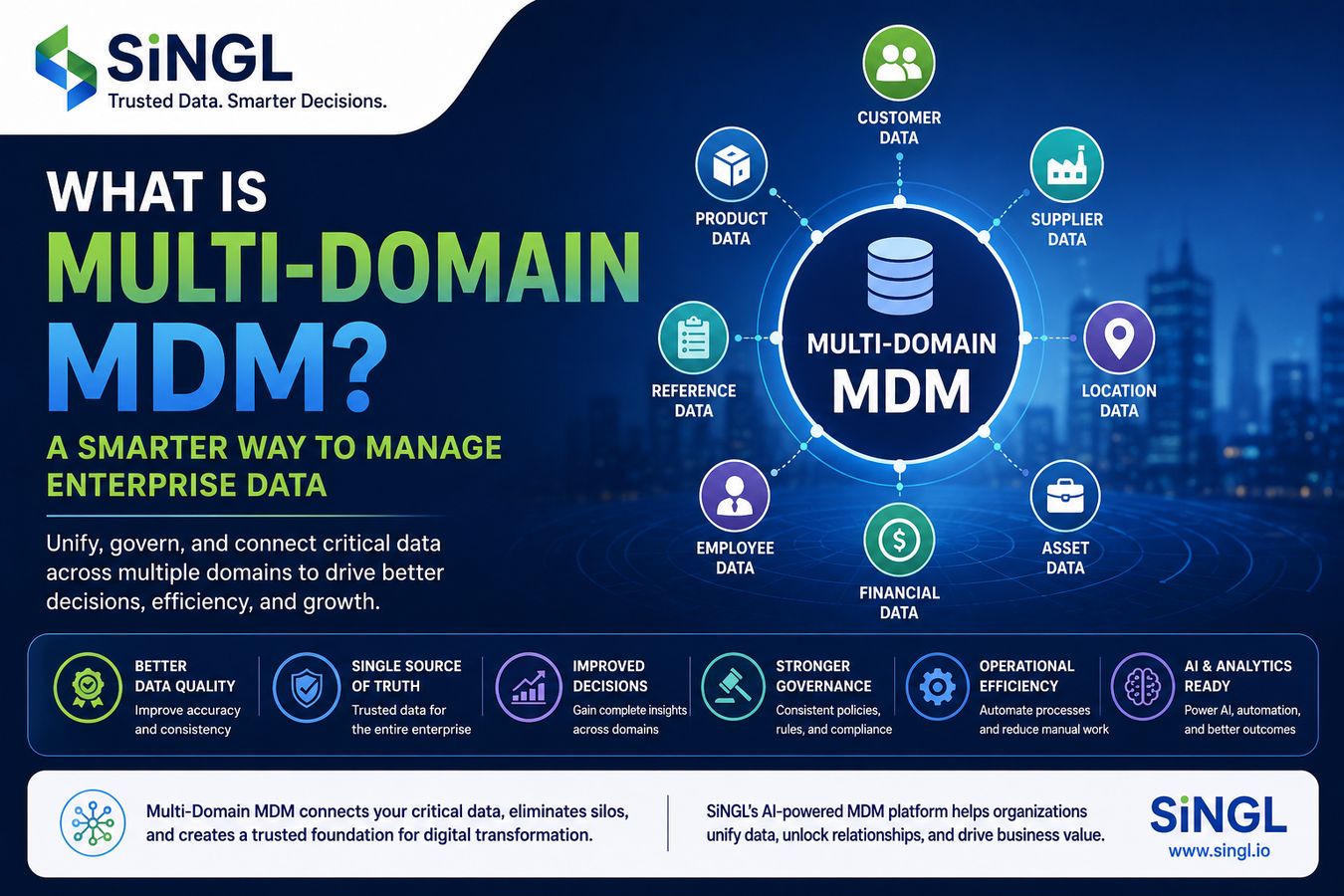
This is where Multi-Domain Master Data Management (Multi-Domain MDM) can help. It enables organizations to manage multiple types of master data within a connected framework, helping teams improve data quality, strengthen governance, understand relationships between business entities, and build a more reliable foundation for analytics and AI.
For organizations evaluating Master Data Management Solutions, a multi-domain approach can be especially valuable when customer, product, supplier, location, and other critical data need to work together rather than remain isolate
What Is Multi-Domain MDM?
Multi-Domain MDM is an approach to Master Data Management that allows organizations to manage multiple master data domains through a unified solution.
Instead of maintaining separate processes for customer data, product information, supplier records, employee data, or locations, organizations can manage these domains within a connected MDM environment.
The goal is not simply to store information in one place. Multi-Domain MDM helps organizations standardize, match, govern, and connect critical data so that teams can work with consistent and trusted information.
For example, a company may connect a customer with their orders, products, sales region, and associated business location. These relationships can provide a more complete view of how different parts of the organization interact.
What Are Data Domains?
A data domain is a category of important business information that is shared across an organization.
Common master data domains include:
Customer data
Product data
Supplier data
Employee data
Location data
Asset data
Financial reference data
Each domain supports different business functions, but these domains are rarely completely independent.
A customer may purchase a product from a particular supplier through a specific business location. Similarly, an employee may be associated with a department, location, or business unit.
Managing these relationships alongside the individual domains allows organizations to gain a more connected understanding of their business data.
Why Is Multi-Domain MDM Important?
Many organizations initially address data quality problems within one area, such as customer or product data. As their data management needs grow, however, they often discover that business information is interconnected.
Managing each domain separately can create additional data silos and make it harder to understand relationships between different types of information.
Multi-Domain MDM provides a broader approach by bringing related domains under a common framework.
Without a coordinated approach, organizations may experience:
Duplicate records across systems
Inconsistent business information
Conflicting data between departments
Limited visibility into data relationships
Reporting inaccuracies
Weak data governance
Manual data management processes
Operational inefficiencies
By managing multiple domains together, organizations can establish consistent standards and create trusted data that can be used across business processes.
How Does Multi-Domain MDM Work?
A Multi-Domain MDM approach typically involves several connected steps.
1. Integrate Data from Multiple Sources
The first step is bringing information together from the systems where it originates.
These may include CRM and ERP platforms, HR applications, procurement systems, finance applications, cloud services, databases, and other enterprise sources.
Integration allows organizations to create a broader view of their master data without requiring every department to maintain completely separate records.
2. Standardize Information
Data collected from different systems may use different formats, naming conventions, or values.
Standardization creates common rules for how information should be represented. For example, product names, addresses, customer classifications, or supplier details can be formatted consistently.
This makes information easier to compare, share, and analyze.
3. Match and Remove Duplicate Records
Organizations may have multiple records representing the same customer, supplier, product, or location.
Matching and deduplication processes help identify these records and determine which information should be treated as the trusted master record.
This improves data quality and reduces the risk of different teams working with conflicting information.
4. Connect Related Data
One of the major advantages of Multi-Domain MDM is the ability to understand relationships between domains.
For example:
A customer can be connected to their orders and products.
A product can be connected to its suppliers.
A supplier can be associated with business locations.
An employee can be linked to a department and location.
These relationships provide context that may not be visible when every domain is managed independently.
5. Apply Data Governance
Governance establishes the policies, ownership, rules, and workflows used to maintain master data.
Organizations can define who is responsible for particular data, how changes are approved, and what quality standards need to be followed.
Applying governance consistently across domains helps maintain trusted information over time.
6. Share Trusted Data Across the Organization
Once information has been integrated, standardized, matched, and governed, trusted master data can be made available to downstream systems and business teams.
This creates a reliable foundation for operational processes, reporting, analytics, customer experiences, and AI initiatives.
Key Benefits of Multi-Domain MDM
Organizations that implement Multi-Domain MDM can gain several important benefits.
Better Data Quality
Managing multiple domains through a common approach helps organizations identify inconsistencies, standardize information, and reduce duplicate records.
As a result, teams can work with more accurate and reliable business information.
A Single Source of Truth
A well-managed MDM environment helps establish trusted master records that can be shared across departments and systems.
Instead of different teams maintaining conflicting versions of the same information, they can work from governed master data.
Improved Business Decisions
Connected data provides greater context for decision-makers.
For example, combining customer, product, supplier, and location information can help leaders understand relationships that may be difficult to identify when data is stored in isolated systems.
Stronger Data Governance
Multi-Domain MDM allows organizations to apply governance policies across multiple types of master data.
Clear ownership, workflows, validation rules, and stewardship processes help maintain accountability and data quality.
Increased Operational Efficiency
Employees often spend considerable time searching for information, correcting records, and resolving data inconsistencies.
By improving data consistency and automating parts of the data management process, Multi-Domain MDM can reduce this manual effort and support more efficient operations.
Better Support for AI and Analytics
AI and advanced analytics depend on reliable data.
When customer, product, supplier, location, and other critical information is incomplete or inconsistent, analytics and AI initiatives may produce less reliable results.
Multi-Domain MDM provides a connected and governed data foundation that can support more effective analytics, machine learning, and AI initiatives.
Who Uses Multi-Domain MDM?
Multi-Domain MDM is particularly useful for organizations that manage large volumes of interconnected business data across multiple departments and systems.
Common industries include:
Manufacturing
Retail and e-commerce
Banking and financial services
Healthcare
Insurance
Telecommunications
Government
Consumer goods
The specific implementation depends on the organization's data landscape and business priorities.
For example, a healthcare organization may need to connect patient, provider, facility, and location information. In contrast, a financial organization may place greater emphasis on customers, accounts, products, branches, and regulatory data.
This is why organizations often evaluate specialized approaches such as Healthcare MDM or Financial Services MDM alongside their broader enterprise data strategy.
Multi-Domain MDM in Healthcare
Healthcare organizations manage complex information across hospitals, clinics, providers, patients, facilities, medical services, and other systems.
When this information is fragmented, it can be difficult to maintain consistent records across the organization.
Healthcare MDM can help bring related healthcare data domains together, improve consistency, and support stronger governance.
For example, connecting provider, facility, location, and patient-related information can help organizations build a more reliable view of their operational data.
The exact domains and governance requirements depend on the organization's healthcare environment, regulatory obligations, and technology landscape.
Multi-Domain MDM in Financial Services
Financial organizations often manage large volumes of customer, account, product, branch, employee, and reference data.
Data inconsistencies can affect reporting, customer service, risk management, and regulatory processes.
Financial Services MDM provides an approach for managing these interconnected data domains while supporting consistent governance and data quality.
For financial institutions, connecting customer information with accounts, products, locations, and other relevant business entities can provide greater context for operational and analytical processes.
Multi-Domain MDM Across Different Business Environments
Organizations operating in different markets may have different systems, regulatory requirements, business processes, and data sources.
For example, businesses exploring Master Data Management in New York may need to integrate information across a diverse mix of enterprise applications and business units. The underlying requirement remains the same: establish accurate and connected master data that can support business operations.
Similarly, organizations considering Master Data Management in Chicago may need to coordinate information across multiple locations, departments, and technology environments. A multi-domain approach can help bring these interconnected records into a more consistent data framework.
Businesses evaluating Master Data Management in Dallas may also have complex customer, supplier, product, location, and operational data requirements. Multi-Domain MDM can provide a scalable approach for managing these relationships as the organization grows.
These examples illustrate why MDM strategies should be designed around actual business and data requirements rather than simply the organization's geographic location.
Multi-Domain MDM vs. Single-Domain MDM
Both approaches can improve master data quality, but their scope is different.
For example, an organization may initially implement customer MDM to address duplicate customer records. As the business matures, it may need to connect customer information with products, suppliers, locations, or other domains.
At that stage, Multi-Domain MDM can provide a broader framework for managing these interconnected data requirements.
When Should an Organization Consider Multi-Domain MDM?
Multi-Domain MDM may be worth considering when an organization experiences several interconnected data challenges.
Common indicators include:
Multiple systems contain overlapping master data.
Different departments maintain conflicting records.
Customer, product, supplier, or location data is duplicated.
Data governance is inconsistent across business units.
Reporting requires significant manual data preparation.
Business teams lack visibility into relationships between data domains.
The organization is expanding through mergers, acquisitions, or new markets.
AI and analytics initiatives require more reliable enterprise data.
The right timing depends on the organization's data maturity, business objectives, technology environment, and governance capabilities.
How Multi-Domain MDM Supports AI and Analytics
Modern analytics and AI initiatives require more than large amounts of data. They require data that is accurate, consistent, connected, and properly governed.
Consider an organization analyzing customer behavior. If customer records are duplicated or product information is inconsistent, the resulting analysis may not accurately represent the business.
Multi-Domain MDM helps address this challenge by connecting related data domains and establishing trusted master records.
This can give analytics teams and AI applications access to better-structured enterprise information while helping organizations maintain stronger control over how critical data is managed.
What to Consider When Choosing a Multi-Domain MDM Platform
Organizations evaluating Multi-Domain MDM platforms should look beyond the number of data domains supported.
Important considerations include:
Data Integration
The platform should be able to connect with the organization's existing applications, databases, cloud services, and other data sources.
Data Quality
Look for capabilities that support profiling, validation, standardization, matching, and deduplication.
Governance
The solution should support data ownership, stewardship, business rules, approval workflows, and governance policies.
Scalability
As organizations grow, the MDM platform should be able to accommodate additional data volumes, domains, users, and business requirements.
Relationship Management
The ability to understand relationships between customers, products, suppliers, locations, and other entities is particularly important in a multi-domain environment.
AI and Analytics Readiness
Organizations should also consider whether the platform can provide trusted, connected data for analytics, automation, and AI initiatives.
Choosing the right Master Data Management Solutions therefore requires a balance between current business requirements and long-term data strategy.