What Is Informatica MDM? How It Helps Manage Enterprise Data
Learn what Informatica MDM is, how it manages enterprise data, its key features and benefits, and how it supports data quality, governance, analytics, and AI.
What Is Informatica MDM? How It Helps Manage Enterprise Data
Understanding Informatica Master Data Management
As organizations collect data from multiple business applications, keeping that information accurate and consistent becomes increasingly challenging. Customer records, product information, supplier data, and other business-critical information are often spread across CRM platforms, ERP systems, cloud applications, and legacy databases.
Without proper management, duplicate records, inconsistent information, and disconnected data can affect reporting, customer experiences, operational efficiency, and business decisions. Organizations therefore need a structured approach to creating and maintaining trusted data across their technology environment.
This is where Master Data Management Solutions can play an important role. Informatica MDM is one approach organizations use to consolidate, standardize, govern, and maintain critical master data across the enterprise.
In this guide, we explain what Informatica MDM is, how it works, its key capabilities, common use cases, and the factors organizations should consider when evaluating an MDM strategy.
What Is Informatica MDM?
Informatica MDM is a Master Data Management solution designed to help organizations manage, govern, and maintain critical business data across multiple systems.
It brings information together from different sources, identifies inconsistencies and duplicate records, and helps create a trusted view of important business entities.
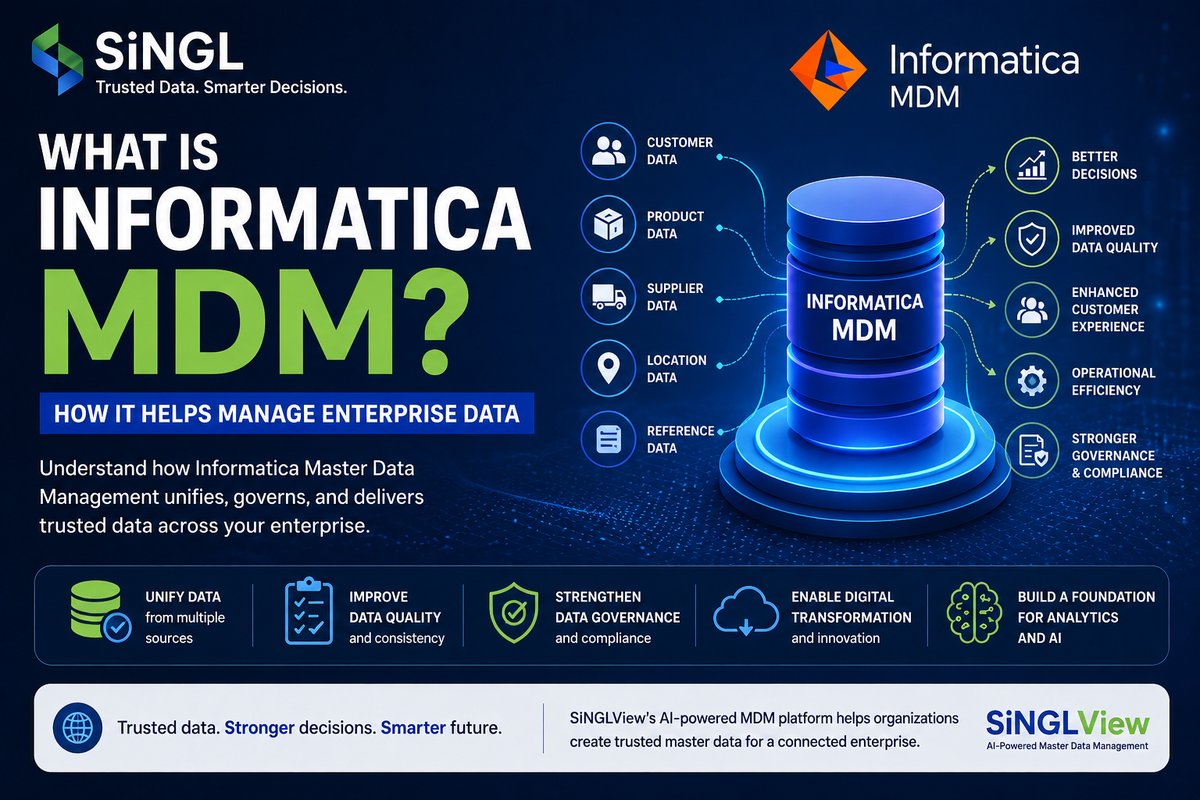
Informatica MDM can be used to manage data domains such as:
Customer data
Product information
Supplier data
Location data
Reference data
The objective is to improve data quality and consistency while making reliable information available to the systems and teams that depend on it.
Why Do Organizations Use Informatica MDM?
As businesses grow, they typically add more applications to support different departments and business functions.
For example, customer information may exist in a CRM system, product information may be maintained in an ERP platform, and supplier records may be stored in procurement applications. When these systems are not properly connected, the same business entity can appear differently across multiple platforms.
This can result in:
Duplicate customer records
Conflicting product information
Data silos
Reporting inaccuracies
Manual data correction
Compliance challenges
Inefficient business processes
An MDM approach helps organizations establish consistent master records and distribute trusted information across connected systems.
How Does Informatica MDM Work?
Informatica MDM typically works by bringing master data from multiple sources into a structured environment where it can be analyzed, standardized, matched, governed, and maintained.
A simplified process includes several stages.
1. Data Collection
Data is gathered from enterprise applications, databases, cloud platforms, and other relevant sources.
2. Data Standardization
Information is standardized so that similar records follow consistent formats and business rules.
3. Data Matching
Records representing the same customer, product, supplier, or other entity can be identified even when information varies between systems.
4. Deduplication
Duplicate records can be identified and consolidated to reduce unnecessary or conflicting information.
5. Governance and Stewardship
Business rules, workflows, ownership, and stewardship processes help organizations maintain data quality over time.
6. Distribution of Trusted Data
Once master data has been consolidated and governed, trusted information can be shared with connected business applications and downstream processes.
This process helps transform fragmented information into more reliable enterprise data.
Key Features of Informatica MDM
Informatica MDM provides several capabilities that can support enterprise data management.
Multi-Domain Data Management
Organizations can manage multiple master data domains within a broader MDM environment.
These may include customers, products, suppliers, locations, and other important business entities.
Managing these domains together can provide a more connected view of enterprise information.
Data Integration
Enterprise data often originates from many different systems.
MDM integration capabilities help bring information together from these sources so organizations can identify inconsistencies and establish more consistent master records.
Data Matching and Deduplication
Duplicate records can make business data difficult to trust.
Matching and deduplication capabilities help identify records that may represent the same entity and support the creation of more reliable master records.
Data Governance
Trusted data requires more than technology.
Governance processes help organizations establish business rules, ownership responsibilities, approval processes, and standards for maintaining master data.
Data Quality Management
Data quality capabilities help organizations identify and address issues such as incomplete, inconsistent, or incorrectly formatted information.
Improving quality at the master-data level can help downstream systems work with more reliable information.
Workflow and Data Stewardship
Data stewards and business teams may need to review, approve, or correct information.
Workflow capabilities can help formalize these activities and create greater accountability around important data changes.
Benefits of Informatica MDM
Organizations implementing an MDM strategy can achieve several business benefits.
Improved Data Quality
Consistent and validated master data can reduce errors and inconsistencies across business applications.
Better Decision-Making
Reliable data gives business teams a stronger foundation for reporting, analytics, and strategic planning.
Stronger Data Governance
Clearly defined rules, ownership, and stewardship processes help organizations maintain data quality over time.
Increased Operational Efficiency
Employees spend less time searching for information, correcting records, or manually reconciling data between systems.
Better Customer Experiences
A more complete and consistent view of customer information can help sales, marketing, and service teams provide more consistent interactions.
Support for Digital Transformation
Trusted data is increasingly important for cloud modernization, automation, analytics, AI, and other digital initiatives.
Common Use Cases for Informatica MDM
Organizations can apply MDM to several business scenarios.
Customer Data Management
Businesses can consolidate customer information from different applications to create a more consistent customer view.
Product Data Management
Manufacturers, retailers, and distributors can use trusted product information across sales, supply chain, ecommerce, and operational systems.
Supplier Data Management
Organizations can consolidate supplier records and improve consistency across procurement and supply chain processes.
Customer 360
A unified customer record can help organizations understand interactions across multiple channels and business functions.
Enterprise Data Governance
MDM can support governance initiatives by providing processes for managing ownership, quality, standards, and data stewardship.
Data Migration and Modernization
When organizations migrate from legacy systems to modern platforms, trusted master data can help reduce inconsistencies during the transition.
Industries That Use Informatica MDM
Different industries have different master data requirements, but the underlying need for accurate and consistent information remains similar.
Banking and Financial Services
Financial institutions manage large volumes of customer, account, product, and regulatory information.
A Financial Services MDM strategy can help organizations improve consistency across business systems while supporting governance and regulatory requirements.
Healthcare
Healthcare organizations manage patient, provider, facility, product, and other critical information across complex systems.
Healthcare MDM can help establish more consistent data across clinical, administrative, operational, and business environments.
Manufacturing
Manufacturers may need to manage product, supplier, material, location, and customer data across plants, supply chains, and enterprise applications.
Retail
Retail organizations rely heavily on consistent product, customer, supplier, and location information across stores, ecommerce platforms, and supply chain systems.
Insurance
Insurers manage customer, policy, product, broker, and claims-related information across multiple applications.
Telecommunications
Telecommunications companies can use MDM to manage customer, product, service, and location data across complex technology environments.
Informatica MDM and Regional Enterprise Data Needs
Enterprise data requirements can also vary according to an organization's size, operating model, regulatory environment, and technology landscape.
For organizations researching Master Data Management in New York, the priority may be maintaining consistent customer, financial, and operational information across a large and highly connected business environment.
Companies evaluating Master Data Management in Chicago may similarly need to connect information across departments, business applications, suppliers, and regional operations while maintaining consistent data standards.
For businesses considering Master Data Management in Dallas, scalability and integration can become important considerations when data is distributed across growing operations, cloud platforms, and enterprise applications.
The technology may differ from one organization to another, but the fundamental objective remains the same: create trusted data that business teams can confidently use.
Informatica MDM and Modern Data Management
Enterprise data management has evolved significantly as organizations adopt cloud platforms, artificial intelligence, advanced analytics, automation, and real-time applications.
As a result, organizations evaluating an MDM strategy may consider factors such as:
Cloud readiness
Scalability
Integration capabilities
Data quality automation
Governance
AI capabilities
Data matching
Workflow automation
Ease of implementation
The right approach depends on an organization's existing technology environment, business objectives, data maturity, and long-term strategy.
Informatica MDM vs. Modern MDM Platforms
Informatica MDM is one approach to managing enterprise master data, but organizations today have a broader range of technologies to consider.
Modern MDM platforms increasingly combine data integration, data quality, governance, automation, artificial intelligence, and advanced matching capabilities within a unified environment.
When evaluating different platforms, businesses should therefore look beyond individual features.
Important questions include:
Can the platform scale with the organization?
Can it integrate with existing applications?
How effectively does it manage data quality?
Does it support governance and stewardship?
Can it automate repetitive data-management activities?
Does it support cloud and modern data architectures?
Can it provide a strong foundation for analytics and AI?
This broader evaluation helps organizations select an MDM approach that fits both current requirements and future business needs.
How MDM Supports AI and Analytics
AI and analytics are only as reliable as the data behind them.
If customer, product, supplier, or other master data contains duplicates and inconsistencies, analytical outputs can become difficult to trust.
Master Data Management helps address this challenge by creating more consistent and governed information before it is used by analytics platforms, reporting systems, and AI applications.
As organizations expand their AI initiatives, trusted master data can therefore become an important part of their broader data strategy.
What Should Organizations Consider Before Choosing an MDM Platform?
Choosing an MDM platform should begin with business requirements rather than technology alone.
Organizations should consider:
Business Requirements
Identify which data domains and business processes require better management.
Data Maturity
Understand the current state of data quality, governance, integration, and stewardship.
Integration Needs
Evaluate how easily the platform can connect with existing CRM, ERP, cloud, database, and analytics environments.
Scalability
The solution should be capable of supporting increasing data volumes, domains, users, and business requirements.
Governance
Consider whether the platform supports the organization's data ownership, stewardship, quality, and compliance requirements.
Future Readiness
Organizations should also evaluate whether the platform can support future initiatives involving cloud modernization, automation, analytics, and AI.