
What Is Customer MDM? A Complete Guide to Customer Master Data Management
Learn what Customer MDM is, how it creates a trusted Customer 360 view, and how organizations improve data quality, governance, customer experiences, analytics, and AI with unified customer data.
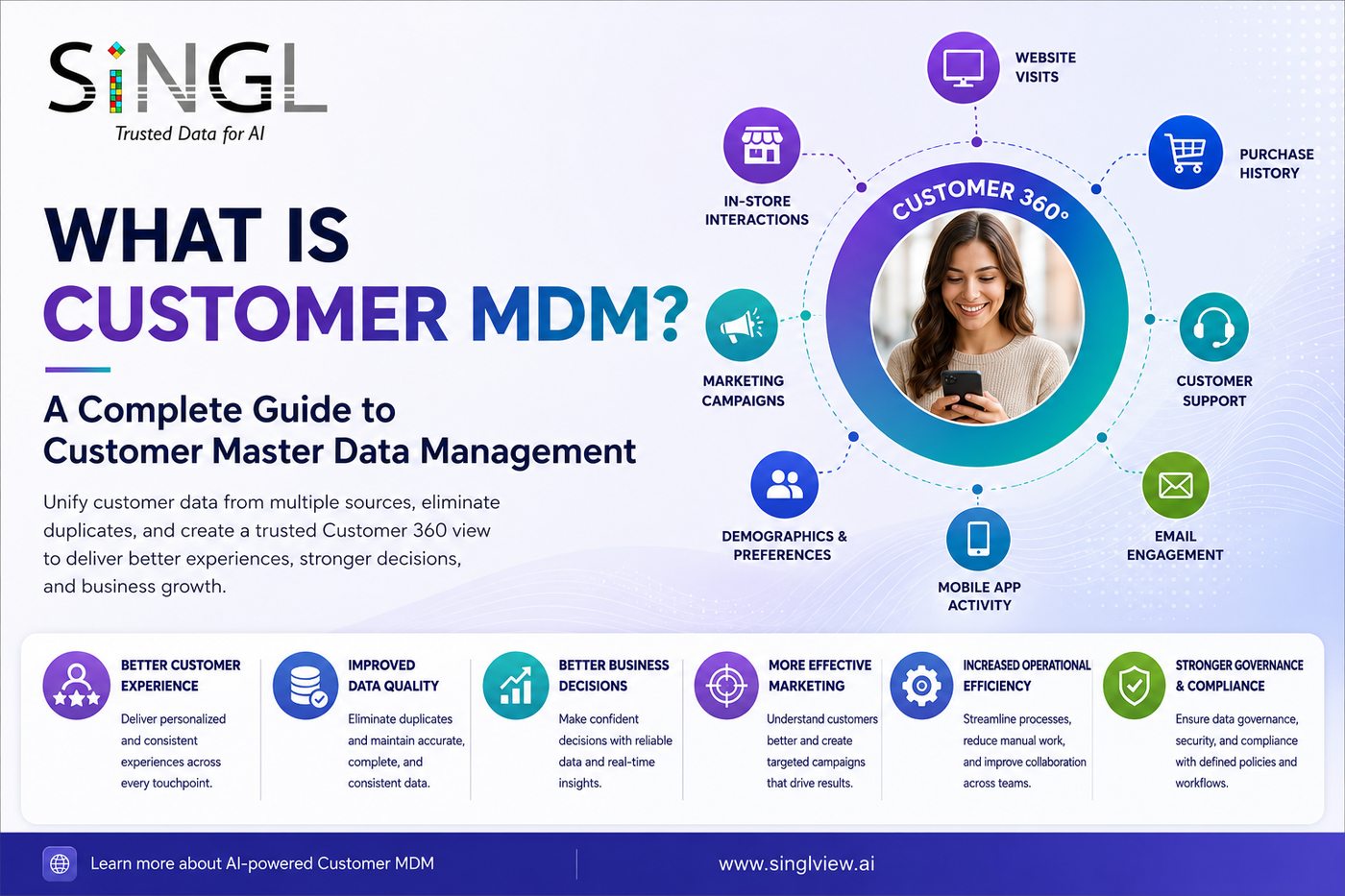
Customers interact with businesses through websites, mobile applications, physical stores, customer support teams, social media, and marketing campaigns. Every interaction generates valuable information, but this data is often distributed across CRM platforms, ERP systems, e-commerce applications, marketing tools, and other business systems.
As organizations grow, maintaining a consistent view of customers becomes increasingly difficult. Duplicate records, outdated contact information, incomplete profiles, and disconnected customer interactions can affect everything from customer service to business reporting.
This is where Customer Master Data Management (Customer MDM) becomes valuable. Customer MDM helps organizations bring customer information together, improve data quality, connect related records, and create a trusted view of each customer.
What Is Customer MDM?
Customer MDM is a specialized approach to Master Data Management that focuses on managing and governing customer information across an organization.
It collects customer data from multiple systems, validates and standardizes the information, identifies duplicate records, and creates a trusted customer profile. Instead of allowing every application to maintain a different version of a customer, MDM establishes a consistent reference that can be shared across connected systems.
The result is a more reliable foundation for customer service, marketing, sales, analytics, reporting, and other business processes.
What Customer Data Can MDM Manage?
Depending on the organization's requirements, Customer MDM can manage information such as:
Customer names and contact details
Addresses and locations
Customer identifiers
Account information
Demographic information
Customer relationships
Transaction-related information
Communication preferences
Service and interaction history
Customer classifications
The objective is not simply to store more information. Instead, the goal is to ensure that critical customer information is accurate, consistent, connected, and governed.
Why Is Customer MDM Important?
Customer information is one of the most widely shared types of enterprise data. Sales, marketing, finance, customer support, operations, and leadership teams may all depend on the same customer information for different purposes.
Without a structured data management approach, the same customer can appear as several different records across business systems. This creates uncertainty and makes it difficult for employees to understand which information is accurate.
Common customer data challenges include:
Duplicate customer records
Inconsistent contact information
Missing customer attributes
Outdated records
Fragmented customer histories
Inaccurate reporting
Inefficient marketing campaigns
Poor cross-channel experiences
Customer MDM addresses these problems by creating consistent and trusted customer information that can be used throughout the organization.
How Does Customer MDM Work?
Customer MDM typically follows several stages to transform fragmented customer information into trusted master data.
1. Collect Customer Data
Customer information is gathered from multiple sources, including CRM systems, websites, e-commerce platforms, customer support applications, sales systems, marketing platforms, and enterprise databases.
Bringing these sources together provides a broader view of the information an organization already has.
2. Validate and Standardize Customer Data
Customer information may follow different formats across applications. One system might use a complete state name, while another uses an abbreviation. Similarly, phone numbers, addresses, names, and other attributes may be stored differently.
MDM applies validation and standardization rules so that customer information follows consistent formats and quality standards.
3. Match Duplicate Records
Matching is an important part of Customer MDM.
For example, one system might contain "John Smith", while another contains "Jonathan Smith" with the same email address or other identifying information. Matching processes can determine whether these records represent the same individual.
This helps reduce duplicate records without relying entirely on manual data cleanup.
4. Create a Golden Record
After customer information has been matched, validated, and consolidated, organizations can create a Golden Record.
A Golden Record represents the most trusted and complete version of a customer's master information. It becomes a reliable reference for connected applications and business teams.
5. Govern and Maintain Customer Data
Customer data needs to remain accurate after the initial consolidation.
Data governance policies, ownership rules, approval workflows, stewardship processes, and quality monitoring help organizations maintain trusted customer information over time.
6. Share Trusted Data Across Systems
Once customer information has been governed and approved, trusted records can be shared with connected business applications.
This allows departments to work from consistent customer information instead of repeatedly creating or correcting records independently.
Benefits of Customer MDM
Customer MDM provides value beyond simply removing duplicate records. It can improve how an organization manages customer relationships, operates internal processes, and uses data for decision-making.
Better Customer Experience
Employees can access more complete and reliable customer information when assisting customers.
For example, a support representative may be able to understand previous interactions, account information, preferences, and relevant customer details without searching through several disconnected applications.
This can make service faster, more consistent, and more personalized.
Improved Customer Data Quality
Customer MDM helps identify duplicate, incomplete, inconsistent, and outdated information.
By applying standardization and data quality rules, organizations can establish more reliable customer records and reduce the amount of manual correction required.
Better Business Decisions
Business leaders rely on customer information for reporting, forecasting, segmentation, and strategic planning.
When customer data is fragmented, reports may produce conflicting results. A trusted customer data foundation makes analytics more reliable and helps decision-makers work with consistent information.
More Effective Marketing
Marketing teams need accurate customer information to create meaningful segments and targeted campaigns.
A unified customer profile can help organizations understand customer relationships across channels and reduce the risk of sending irrelevant or duplicate communications.
Increased Operational Efficiency
Employees often spend significant time correcting records, searching for customer information, and resolving inconsistencies between systems.
Customer MDM reduces these repetitive tasks by providing governed and standardized master data that can be reused across business processes.
Stronger Data Governance and Compliance
Customer information often needs to be managed according to internal policies and industry regulations.
Customer MDM supports governance by establishing ownership, validation rules, workflows, and accountability around important customer records.
Customer MDM and Customer 360
One of the most important applications of Customer MDM is creating a Customer 360 view.
Customer 360 brings relevant information from multiple systems together so that an organization can understand a customer through a unified profile rather than viewing isolated records.
For example, a Customer 360 profile could connect:
Customer identity
Purchase history
Service interactions
Marketing engagement
Account information
Preferences
Related accounts
Digital interactions
This connected perspective helps teams understand customer needs and deliver more consistent experiences across different touchpoints.
Importantly, Customer 360 is not simply a dashboard. It depends on reliable underlying data. Customer MDM provides the governance, matching, standardization, and data quality capabilities required to make that unified view trustworthy.
Common Customer MDM Use Cases
Customer MDM can support a wide range of business processes.
Customer Data Consolidation
Organizations can consolidate customer information from CRM, ERP, e-commerce, support, and marketing systems into a consistent master record.
Personalization
Accurate customer information helps businesses create more relevant experiences across digital and physical channels.
Marketing Campaign Management
Marketing teams can use trusted customer profiles to improve segmentation and reduce duplicate or inaccurate campaign targeting.
Customer Service
Support teams can gain a more complete understanding of customer history, helping them resolve issues more efficiently.
Analytics and Reporting
Consistent customer data improves the reliability of reports, dashboards, segmentation, and business analytics.
Mergers and Acquisitions
When organizations combine systems after a merger or acquisition, customer records may exist in several formats.
MDM can help identify duplicates, reconcile information, and establish consistent customer records across the combined organization.
Customer MDM for Banking and Financial Services
Customer information is particularly important in banking and financial services because organizations may manage relationships across multiple products, accounts, branches, digital channels, and business units.
Financial Services MDM can help connect customer information across these environments while supporting data quality, governance, and regulatory requirements.
A trusted customer profile can also support better reporting, customer service, risk-related processes, and personalized financial experiences.
Customer MDM for Healthcare
Healthcare organizations often manage information across hospitals, clinics, laboratories, pharmacies, insurance systems, and digital healthcare platforms.
In these environments, accurate identity and relationship information is essential.
Healthcare MDM can help organizations establish consistent patient and customer records across connected systems, reduce duplicate identities, and improve the reliability of information used by administrative and operational teams.
Customer MDM Across Different Business Locations
Large organizations may operate across multiple regional markets, and their data environments can differ by location. Customer MDM can provide a consistent data management framework while allowing organizations to account for regional systems, processes, and business requirements.
For organizations exploring Master Data Management in New York, the focus may include connecting customer information across financial services, healthcare, retail, and other highly distributed business environments while maintaining consistent data standards.
Similarly, businesses evaluating Master Data Management in Chicago may need to manage customer and operational information across multiple locations, applications, and business units while maintaining a unified enterprise data strategy.
For organizations considering Master Data Management in Dallas, MDM can provide a structured way to manage customer information across growing operations, connected applications, and different business functions without allowing data silos to expand.
The important consideration is not simply where an organization operates. The broader objective is to establish trusted data that can be governed consistently across the enterprise.
Industries That Use Customer MDM
Customer MDM can be valuable in almost any industry where customer information is distributed across multiple applications.
Common examples include:
Banking and Financial Services
Healthcare
Insurance
Retail and E-commerce
Telecommunications
Manufacturing
Hospitality
Government
Consumer Goods
The specific implementation varies by industry, but the underlying requirement remains similar: organizations need accurate customer information that can be trusted across business processes.
How Customer MDM Supports AI
Artificial Intelligence depends heavily on the quality of the data used to train models, generate insights, and support automated decisions.
If customer records are duplicated, incomplete, or inconsistent, AI systems may work with an inaccurate representation of the customer.
Customer MDM creates a stronger data foundation by improving identity resolution, standardization, completeness, and governance.
This can support applications such as:
Customer segmentation
Personalized recommendations
Predictive analytics
Customer churn analysis
Marketing optimization
AI-powered customer service
Automated decision support
As organizations adopt AI more broadly, trusted customer master data becomes an increasingly important part of their data strategy.
Customer MDM vs. Traditional Customer Data Management
Traditional customer data management often involves individual applications maintaining their own customer records.
While this approach may work for smaller environments, it can become difficult to manage as organizations add more systems, channels, and business units.
Customer MDM therefore moves data management from isolated application-level processes toward a coordinated enterprise approach.
What Should Businesses Consider When Choosing Customer MDM?
Choosing a Customer MDM solution requires more than comparing individual features.
Organizations should consider how the platform fits into their existing technology environment and long-term data strategy.
Important considerations include:
Data Integration
The solution should be able to connect with the organization's important CRM, ERP, cloud, legacy, and business applications.
Data Quality and Matching
Effective matching, deduplication, validation, and standardization capabilities are essential for creating trusted customer records.
Governance
Organizations should evaluate whether the platform supports data ownership, stewardship, workflows, policies, and ongoing quality management.
Customer 360 Capabilities
If Customer 360 is a major objective, businesses should assess how effectively the platform connects customer information and relationships across systems.
Scalability
The solution should be able to support growing data volumes, additional applications, new business units, and changing business requirements.
AI and Analytics Readiness
Organizations should also consider whether the MDM platform can provide trusted data for analytics, automation, and future AI initiatives.
Security and Compliance
Customer information is sensitive business data. Appropriate access controls, governance mechanisms, and compliance capabilities should therefore be part of the evaluation.
Customer MDM and the Future of Enterprise Data
Customer data management is becoming more complex as businesses add digital channels, cloud applications, AI systems, and connected customer experiences.
At the same time, customers expect organizations to recognize them consistently across every interaction.
This makes trusted customer data increasingly important.
A modern MDM strategy can help organizations move from fragmented customer records toward a connected data foundation that supports Customer 360, analytics, automation, AI, and digital transformation.
The goal is not simply to create another data repository. It is to make important customer information trusted, governed, connected, and useful across the enterprise.