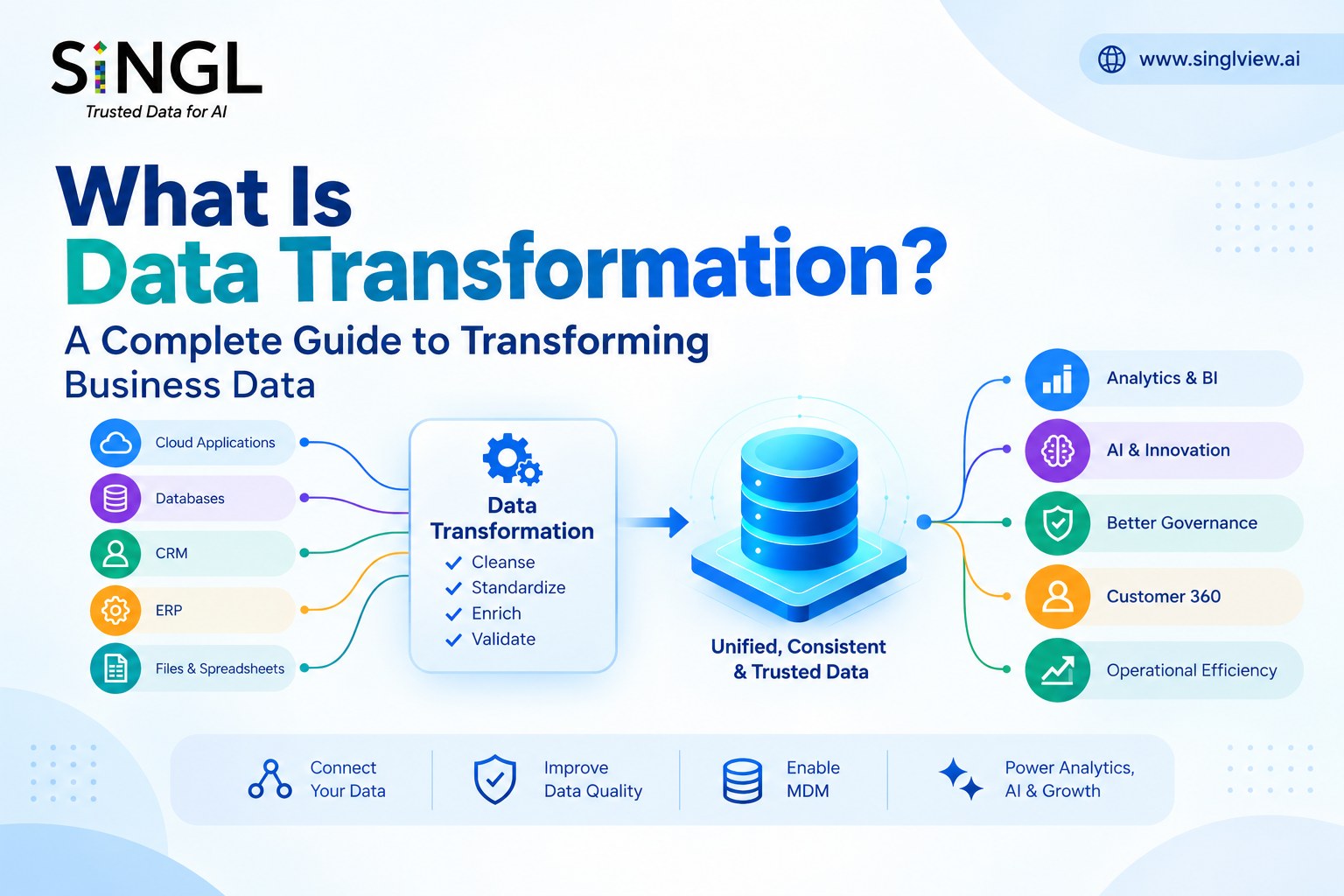
What Is Data Transformation? A Complete Guide to Transforming Business Data
Understand what data transformation is, how it works, and why it matters for data integration, MDM, analytics, reporting, and AI. Learn the key techniques, benefits, and best practices for turning raw business data into consistent, trusted, and usable information.
What Is Data Transformation?
Businesses collect data from many different sources, including CRM platforms, ERP systems, databases, cloud applications, spreadsheets, websites, and third-party systems. However, this information is rarely stored in exactly the same format.
One system may store a customer's name as John Smith, while another may store it as SMITH, JOHN. Similarly, dates, addresses, product codes, currencies, and other business information can follow different standards across systems.
Data transformation is the process of changing data from its original format or structure into a standardized format that can be used effectively by another system, application, database, analytics platform, or business process.
In simple terms, data transformation makes data consistent, usable, and ready for its intended purpose.
It is an important part of data integration, ETL, analytics, Master Data Management (MDM), reporting, and AI initiatives.
What Does Data Transformation Mean?
Data transformation involves modifying data so that it meets specific technical, business, or analytical requirements.
For example, an organization may collect customer information from five different systems. Each system could use different formats for names, phone numbers, addresses, or customer IDs.
During transformation, these differences can be addressed through processes such as:
Standardizing formats
Removing unnecessary characters
Converting data types
Correcting inconsistent values
Combining fields
Splitting fields
Applying business rules
Validating information
Removing or identifying duplicates
The objective is not simply to change data. Instead, the goal is to make data more consistent, meaningful, and useful.
Why Is Data Transformation Important?
Raw data is not always immediately suitable for business use.
When information comes from multiple sources, inconsistencies can make it difficult to compare records, generate accurate reports, or create a unified customer or product view.
Data transformation helps organizations establish a common structure across their information.
For example, consider these customer records:
These records may represent the same customer. Transformation can standardize the values so that downstream systems can interpret and compare them more effectively.
This becomes particularly important when organizations want to create a single trusted view of business data.
How Does the Data Transformation Process Work?
Although transformation workflows differ between organizations, a typical process includes several stages.
1. Understand the Source Data
The first step is understanding where the data comes from and how it is structured.
Organizations may examine:
Data formats
Field names
Data types
Missing values
Duplicate records
Business rules
Data quality issues
Relationships between datasets
This assessment helps determine what transformations are required.
2. Define Transformation Rules
Next, organizations establish rules for how the source data should be changed.
For example:
Convert all dates to one standard format.
Standardize country names.
Remove unnecessary spaces.
Convert text to uppercase or lowercase where appropriate.
Standardize phone numbers.
Map different product categories to a common classification.
These rules help ensure that transformation happens consistently rather than manually.
3. Clean and Standardize the Data
The transformation process can then address inconsistencies in the source data.
For example:
Before transformation
USA
U.S.
United States
United States of America
After transformation
United States
Similarly, different date formats can be converted into a single organizational standard.
Standardization makes data easier to compare, analyze, integrate, and manage.
4. Validate the Transformed Data
Transformation should not introduce new problems.
Therefore, organizations validate the results against defined rules and quality requirements.
Validation may check:
Required fields
Valid data types
Acceptable values
Duplicate records
Data relationships
Business rules
Formatting requirements
This helps ensure that transformed data is reliable before it moves into another system.
5. Load or Deliver the Data
Once transformation and validation are complete, the resulting data can be delivered to its destination.
Depending on the use case, the destination could be:
A data warehouse
Data lake
MDM platform
CRM system
Analytics platform
Cloud database
Business intelligence solution
AI or machine learning environment
Common Data Transformation Techniques
Organizations use different techniques depending on the type and purpose of their data.
Data Standardization
Standardization converts inconsistent values into a common format.
For example, different representations of a state, country, date, or product category can be mapped to an agreed organizational standard.
This is particularly useful when information from several applications needs to work together.
Data Cleansing
Data cleansing identifies and corrects inaccurate, incomplete, outdated, or improperly formatted information.
For example, transformation can remove unnecessary spaces, correct formatting problems, or identify invalid values.
However, cleansing and transformation are related rather than identical. Transformation changes data according to defined requirements, while cleansing focuses specifically on improving data quality.
Data Type Conversion
Different systems may use different data types.
A transformation process can convert:
Text into numbers
Strings into dates
Integers into decimals
Different date formats into a standard format
This allows systems to process information correctly.
Data Mapping
Data mapping establishes relationships between fields in different systems.
For example:
Customer_Name in one application may correspond to Full_Name in another.
Mapping allows information from different sources to be aligned before integration.
Data Aggregation
Aggregation combines multiple records or values into a summarized result.
For example, individual sales transactions can be transformed into monthly or regional sales totals for reporting.
Data Splitting and Merging
Transformation can also modify the structure of information.
A single field such as:
John Smith
could be separated into:
First Name: John
Last Name: Smith
Conversely, separate fields can be combined when a target system requires one unified field.
Data Filtering
Not every record needs to be transferred to every destination.
Transformation workflows can apply business rules to filter information based on criteria such as:
Location
Status
Customer type
Product category
Date
Transaction value
This helps deliver only the information required by a particular system or process.
Data Transformation and Data Integration
Data transformation is often discussed together with data integration, but they are not the same thing.
Data integration is the broader process of connecting and combining information from different sources.
Data transformation is one of the activities that can take place within that integration process.
For example, an organization may connect data from its CRM, ERP, website, and cloud applications. Integration establishes the connections, while transformation ensures that the information coming from those systems follows compatible formats and business rules.
This distinction is important because simply connecting systems does not automatically make their data consistent.
Data Transformation in ETL and ELT
Data transformation is also a central part of both ETL and ELT workflows.
ETL: Extract, Transform, Load
In ETL, data is:
Extracted from source systems.
Transformed into the required format.
Loaded into the target system.
Transformation happens before the data reaches the destination.
ELT: Extract, Load, Transform
In ELT, data is:
Extracted from source systems.
Loaded into the target environment.
Transformed within that environment.
Modern cloud data platforms often support this approach because they can provide substantial processing capacity.
Therefore, the main difference is where and when transformation occurs.
How Data Transformation Supports Master Data Management
Data transformation is especially important in Master Data Management (MDM).
MDM brings together critical business information such as customers, products, suppliers, locations, and other entities from multiple systems.
However, the information entering an MDM environment may have different structures and formats.
Transformation helps prepare this information before it is matched, governed, and distributed.
For example, customer data from a CRM system may use one address format while information from an ERP system uses another. Transformation can standardize these values so that the MDM system has a better foundation for matching and creating trusted master records.
Organizations looking for scalable Master Data Management Solutions can therefore benefit from transformation capabilities that work alongside data integration and data quality processes.
Data Transformation for Different Industries
The need for transformation varies depending on the industry and the type of information being managed.
Financial Services
Financial organizations often work with information coming from banking systems, customer platforms, investment applications, transaction systems, and external sources.
Data transformation can help standardize financial and customer information before it is used for reporting, analytics, governance, or MDM.
For organizations managing complex financial data environments, Financial Services MDM can help support trusted and connected master data across business processes.
Healthcare
Healthcare organizations manage information across hospitals, clinical applications, patient systems, laboratories, insurance platforms, and other sources.
Different systems may represent patient, provider, facility, and healthcare-related information differently. Transformation can help create consistent structures that support integration and downstream data management.
Healthcare organizations exploring MDM for these requirements can consider Healthcare MDM as part of a broader data management strategy.
Data Transformation and Data Quality
Data transformation and data quality are closely connected.
Poor-quality source data can create problems even after transformation. Therefore, transformation workflows often include quality checks that identify incomplete, invalid, inconsistent, or duplicate information.
For example, changing every phone number into the same format does not fix a phone number that is fundamentally incorrect.
This is why organizations should consider transformation as part of a broader data quality strategy rather than treating it as a formatting exercise.
A strong approach combines:
Data profiling
Data cleansing
Standardization
Validation
Matching
Deduplication
Governance
Together, these processes help organizations create more trustworthy data.
Data Transformation in Different Business Environments
The complexity of transformation often increases as organizations expand their technology landscape.
A growing enterprise may have multiple CRM platforms, ERP systems, cloud applications, regional databases, and legacy systems. Each may have its own data structures and standards.
For organizations pursuing Master Data Management in New York, transformation can help align information across complex enterprise systems and business operations.
Similarly, organizations pursuing Master Data Management in Chicago may use data transformation as part of broader integration and data quality initiatives when information comes from multiple applications.
In another enterprise environment, Master Data Management in Dallas may involve connecting data across business units, applications, and operational systems, making standardized transformation rules important for maintaining consistency.
The key point is that location does not change what data transformation means. The transformation requirements are determined by the organization's systems, data structures, business rules, and goals.
Benefits of Data Transformation
A well-designed data transformation process can provide several business benefits.
1. Improved Data Consistency
Standardized information is easier to compare and use across systems.
2. Better Data Quality
Transformation can identify and correct many formatting and structural inconsistencies.
3. Easier Data Integration
Compatible data structures make it easier for different applications to exchange information.
4. More Reliable Reporting
Analytics and reporting become more useful when underlying information follows consistent standards.
5. Reduced Manual Work
Automated transformation rules reduce repetitive data preparation tasks.
6. Better MDM Outcomes
Consistent input data supports matching, deduplication, governance, and trusted master records.
7. Stronger Analytics and AI
Analytics and AI systems depend on data that is structured, consistent, and fit for purpose. Transformation helps prepare information for these workloads.
What Happens Without Data Transformation?
Without appropriate transformation, organizations can face several challenges.
Different systems may contain conflicting versions of the same information. Reports may show different results depending on which source is used.
Teams may also spend significant time manually cleaning spreadsheets or reconciling records between applications.
Over time, these problems can affect:
Business reporting
Customer experience
Operational efficiency
Data governance
Compliance
Analytics
AI initiatives
Therefore, transformation is an important part of building a reliable data ecosystem.
Data Transformation vs. Data Cleansing
These concepts are sometimes used interchangeably, but there is an important difference.
Data transformation changes data from one structure, format, or representation into another according to specific requirements.
Data cleansing focuses on identifying and correcting inaccurate, incomplete, inconsistent, or invalid information.
For example, converting a date from 09/09/2026 to 2026-09-09 is a transformation.
Removing an invalid or incorrectly entered date is a data quality or cleansing activity.
In real-world data workflows, both processes often work together.
Data Transformation vs. Data Conversion
Data conversion is generally focused on changing data from one technical format or representation to another.
For example, converting a CSV file into another structured format can be considered data conversion.
Data transformation is broader. It can involve changing values, structures, formats, relationships, and applying business rules to make data suitable for a particular purpose.
As a result, conversion can be one component of a larger transformation workflow.
Best Practices for Data Transformation
Organizations can improve transformation outcomes by following a structured approach.
Understand Business Requirements
Transformation rules should be based on how the organization actually intends to use the data.
Profile Source Data
Understand the quality, structure, and inconsistencies of source information before creating transformation rules.
Create Standard Definitions
Establish consistent definitions for important fields, entities, codes, and business terms.
Automate Repetitive Transformations
Where possible, use repeatable workflows instead of manual data preparation.
Validate Results
Transformation should always be followed by appropriate quality and validation checks.
Document Transformation Rules
Documenting mappings and rules makes workflows easier to maintain and audit.
Monitor Data Quality
Data transformation should not be treated as a one-time activity. As source systems change, transformation rules may need to evolve.
Is Data Transformation Necessary for Every Organization?
Not every organization needs the same level of transformation.
If a business operates a small number of systems using consistent data structures, relatively simple transformations may be sufficient.
However, transformation becomes increasingly important when an organization has:
Multiple data sources
Legacy applications
Cloud and on-premises systems
Different regional systems
Large data volumes
Complex business rules
MDM requirements
Analytics and AI initiatives
The right approach depends on the organization's data environment and business objectives.