Is MDM Part of Data Engineering? Understanding the Relationship Between MDM and Data Engineering
Explore how MDM and data engineering work together to improve data quality, governance, integration, analytics, and AI across modern enterprises.
How Master Data Management and Data Engineering Work Together
Modern organizations depend on data engineering to collect, move, process, and prepare data from different sources. At the same time, they need reliable master data to ensure that customers, products, suppliers, locations, and other critical business entities are represented consistently across systems.
This often leads to an important question: Is MDM part of data engineering?
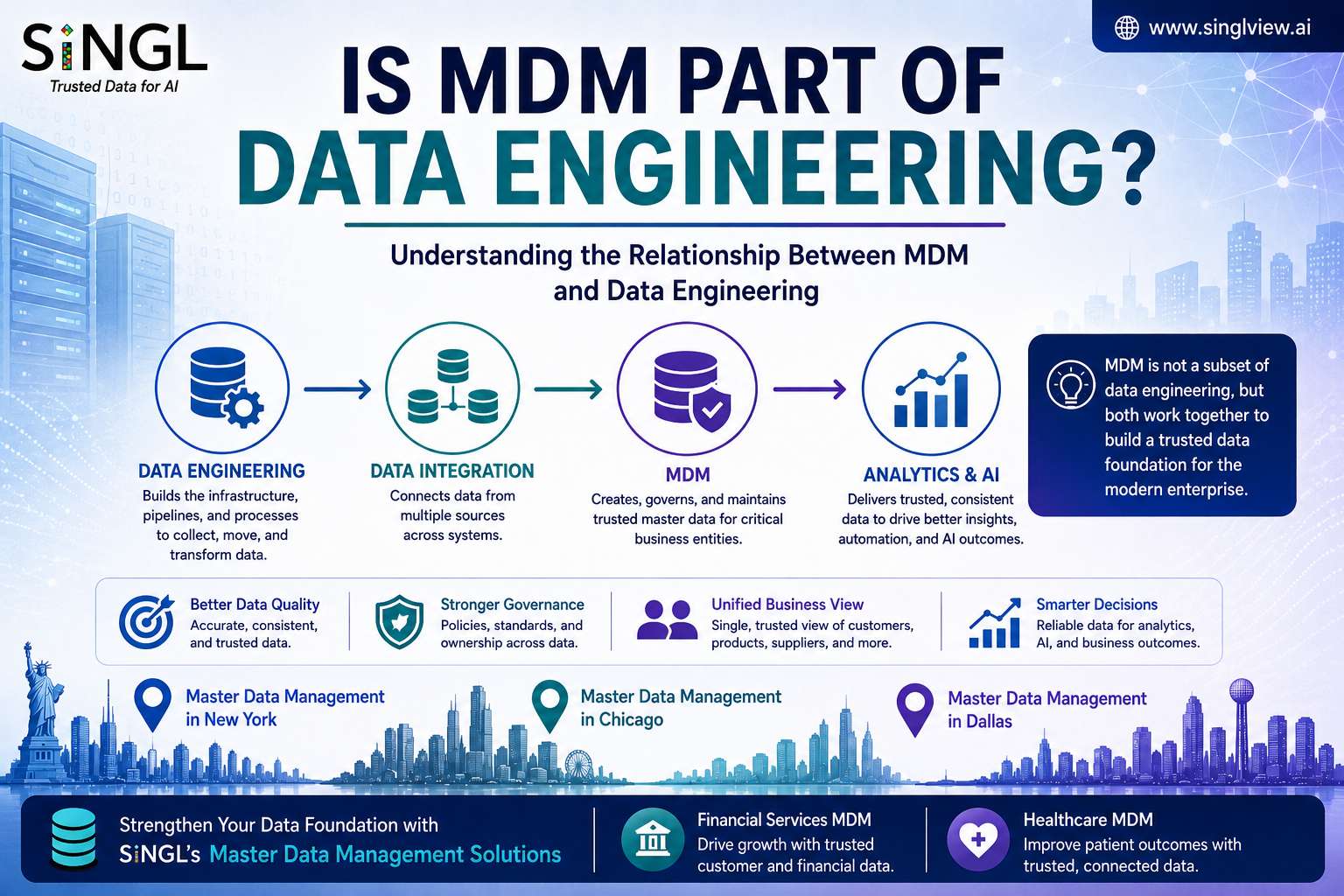
The short answer is not exactly. Master Data Management (MDM) and data engineering are closely connected disciplines, but they have different primary purposes. Data engineering focuses on building the technical infrastructure and pipelines that move and process data, while MDM focuses on creating, governing, maintaining, and distributing trusted master data.
Understanding where these disciplines overlap can help organizations build a stronger data architecture and make better use of analytics, AI, and digital transformation initiatives.
What Is Data Engineering?
Data engineering is the discipline of designing and maintaining the systems that collect, process, store, and deliver data.
Data engineers typically work with:
Data pipelines
Databases
Data warehouses
Data lakes
Cloud platforms
ETL and ELT processes
APIs and integrations
Data transformation frameworks
For example, a data engineer may build a pipeline that extracts customer information from a CRM system, transforms it into a standardized format, and loads it into a cloud data warehouse.
The primary goal is to make data available, accessible, scalable, and usable for downstream applications.
What Is Master Data Management?
Master Data Management is a discipline focused on creating and maintaining trusted information about an organization's most important business entities.
These entities may include:
Customers
Products
Suppliers
Employees
Locations
Financial entities
An MDM platform brings information from different systems together, applies data quality and governance rules, identifies duplicate records, and helps create a trusted version of the data.
This trusted version is often called a Golden Record.
The goal of MDM is not simply to move data from one system to another. Instead, it is to ensure that critical business data is accurate, consistent, governed, and trusted wherever it is used.
So, Is MDM Part of Data Engineering?
MDM is not a subset of data engineering, although the two areas frequently work together.
Think of the difference this way:
Data engineering builds the roads through which data travels. MDM helps ensure that the important information traveling across those roads is accurate, standardized, governed, and trusted.
A data engineering team may build an integration pipeline that moves customer records between systems. An MDM solution can then match those records, identify duplicates, apply business rules, establish trusted values, and distribute the mastered information back to relevant applications.
Therefore, MDM and data engineering are complementary rather than interchangeable.
MDM vs. Data Engineering
In practice, organizations often need both capabilities to create a reliable enterprise data environment.
Where MDM and Data Engineering Overlap
Although their responsibilities differ, MDM and data engineering interact at several important points.
1. Data Integration
Data engineering creates pipelines and integrations that connect systems.
MDM uses these connections to bring customer, product, supplier, or other master data into a central mastering environment.
For example, customer records may come from a CRM, ERP, e-commerce platform, and customer service application. Data engineering helps connect these sources, while MDM helps determine how those records should be combined and governed.
2. Data Transformation
Data engineers frequently transform information before delivering it to a destination system.
MDM also requires standardization, but the objective is different. MDM transformation may involve standardizing customer addresses, product classifications, names, identifiers, or other business attributes according to defined organizational rules.
This distinction is important because technical transformation and business data mastering are not the same thing.
3. Data Quality
Data engineering pipelines may perform technical validation and transformation checks.
MDM extends data quality into the business context by applying rules around completeness, consistency, uniqueness, validity, and accuracy.
For example, a pipeline may check whether a field contains a valid value, while an MDM solution may determine whether two records actually represent the same customer.
4. Data Distribution
After master data has been validated and mastered, it needs to reach the systems that depend on it.
Data engineering and integration technologies can help distribute this information to applications, data warehouses, analytics platforms, and other destinations.
This creates a connected flow between data ingestion, data processing, data mastering, and data consumption.
How Data Engineers Work With MDM Platforms
Data engineers can play an important role in implementing and supporting an MDM environment.
Their responsibilities may include:
Connecting Source Systems
Data engineers can develop pipelines, APIs, and integrations that bring information from different enterprise systems into the MDM platform.
Building Data Pipelines
They may create automated workflows for ingesting and distributing master data.
Supporting Data Transformation
Data engineering teams can help convert data into structures and formats required by the MDM environment.
Managing Cloud Infrastructure
Modern MDM platforms may operate across cloud environments, requiring engineering expertise around scalability, security, integration, and performance.
Supporting Downstream Systems
Once data has been mastered, engineers can help deliver trusted information to data warehouses, analytics platforms, applications, and other systems.
What Does an MDM Team Typically Handle?
While responsibilities vary between organizations, MDM teams often focus on areas such as:
Master data models
Business rules
Data governance
Matching and deduplication
Golden Records
Data stewardship
Approval workflows
Data quality rules
Survivorship rules
Master data hierarchies
Data ownership
These responsibilities require an understanding of both technology and business processes.
That is why successful MDM initiatives often involve collaboration between data engineers, data architects, business teams, data stewards, and governance professionals.
MDM, Data Engineering, and Data Governance
Data governance is another important part of this relationship.
Data engineering determines how data is technically collected and processed. MDM helps manage the consistency and quality of critical master data, while governance establishes policies around ownership, access, standards, and accountability.
Together, these disciplines create a more reliable data ecosystem.
For example, an organization may define a rule stating that customer information must have a unique identifier and approved address format. Data engineering can help implement the technical pipeline, while MDM can apply matching and mastering rules, and governance can define who owns and approves the data.
How MDM Supports Modern Data Architecture
Modern enterprises rarely operate from a single application.
A typical organization may have:
CRM → ERP → E-commerce → Customer Support → Data Warehouse → Analytics → AI
Each system may contain overlapping information.
Without proper management, the same customer or product can appear differently across these platforms. MDM helps create consistency around important business entities, while data engineering provides the infrastructure needed to connect these environments.
This is particularly important for organizations pursuing cloud modernization, Customer 360, analytics, and AI initiatives.
Is MDM More Related to Data Engineering or Data Governance?
MDM sits at the intersection of data management, data governance, integration, and technology.
It has a strong technical component because MDM platforms need integrations, APIs, data pipelines, databases, and processing capabilities. However, MDM also has a significant business and governance component because organizations must define what constitutes trusted data and who is responsible for maintaining it.
Therefore, it would be inaccurate to describe MDM as simply another branch of data engineering.
A better way to view it is:
Data engineering enables data to move and be processed, while MDM helps organizations make critical business data trustworthy and consistent.
MDM and Data Engineering in Different Business Environments
The relationship between these disciplines can look different depending on the organization's size, industry, and technology environment.
For enterprises exploring Master Data Management in New York, MDM may need to integrate information across large technology environments, multiple business units, and numerous operational applications.
Organizations evaluating Master Data Management in Chicago may similarly use MDM alongside data engineering to connect systems while maintaining consistent customer, product, or supplier information.
For businesses considering Master Data Management in Dallas, the focus may also include creating scalable data foundations that support operational applications, analytics, governance, and future AI initiatives.
The important point is that the location does not change the fundamental relationship: MDM and data engineering solve different problems but work better together.
MDM in Financial Services
Financial institutions often manage highly sensitive customer, account, product, and organizational information across numerous systems.
Data engineering helps connect these systems and build reliable data pipelines. MDM can then help establish consistent customer and business entity information while supporting governance and data quality requirements.
This combination can be particularly valuable for organizations implementing Financial Services MDM, where trusted data plays an important role in reporting, customer management, risk processes, analytics, and regulatory initiatives.
MDM in Healthcare
Healthcare organizations also manage complex data environments involving patients, providers, facilities, products, and other entities.
Data engineering can help integrate information from different applications and platforms. MDM can help establish consistent identities and trusted master records across these environments.
Healthcare MDM can therefore support initiatives such as patient data consistency, provider information management, analytics, and connected healthcare operations.
How MDM Supports AI and Analytics
AI systems are only as reliable as the data they receive.
If an organization has multiple duplicate customer records or inconsistent product information, analytics and AI models may produce incomplete or misleading results.
Data engineering helps make data available to AI and analytics platforms. MDM adds another layer by helping ensure that critical business entities are consistently represented.
This makes the combination especially valuable for organizations building AI-ready data architectures.
Do You Need Both MDM and Data Engineering?
For many large organizations, the answer is yes.
However, the extent of each capability depends on the organization's data landscape.
A company with relatively simple systems may have straightforward integration requirements. A large enterprise with multiple CRMs, ERPs, cloud applications, data warehouses, and regional systems may require sophisticated engineering pipelines alongside an enterprise MDM strategy.
The two capabilities should therefore be evaluated based on the organization's:
Data complexity
Number of source systems
Data quality challenges
Governance requirements
Integration architecture
Analytics needs
AI strategy
Business objectives
How Master Data Management Solutions Fit Into the Data Ecosystem
Modern Master Data Management Solutions are designed to work as part of a broader enterprise data architecture rather than operating in isolation.
They can connect with existing applications, integration platforms, data warehouses, analytics environments, and cloud systems.
This allows organizations to combine the technical capabilities of data engineering with the business-focused capabilities of MDM.
The result is a data environment where information can move efficiently while critical business data remains consistent and governed