What Is Data Integration? A Complete Guide to Connecting Business Data
Data integration connects information from databases, CRM and ERP systems, cloud applications, APIs, and other business platforms. Learn how data integration works, its key approaches, benefits, relationship with MDM, and how connected data supports analytics, governance, and AI.
Understanding How Data Integration Creates a Connected and Trusted Data Environment
Modern organizations rely on data from many different systems. Customer information may sit in a CRM, financial records in an ERP, product details in separate databases, while marketing, healthcare, and operational teams may use their own applications.
When these systems operate independently, important information can become fragmented. Teams may spend time searching for data, correcting inconsistencies, or manually moving information between applications.
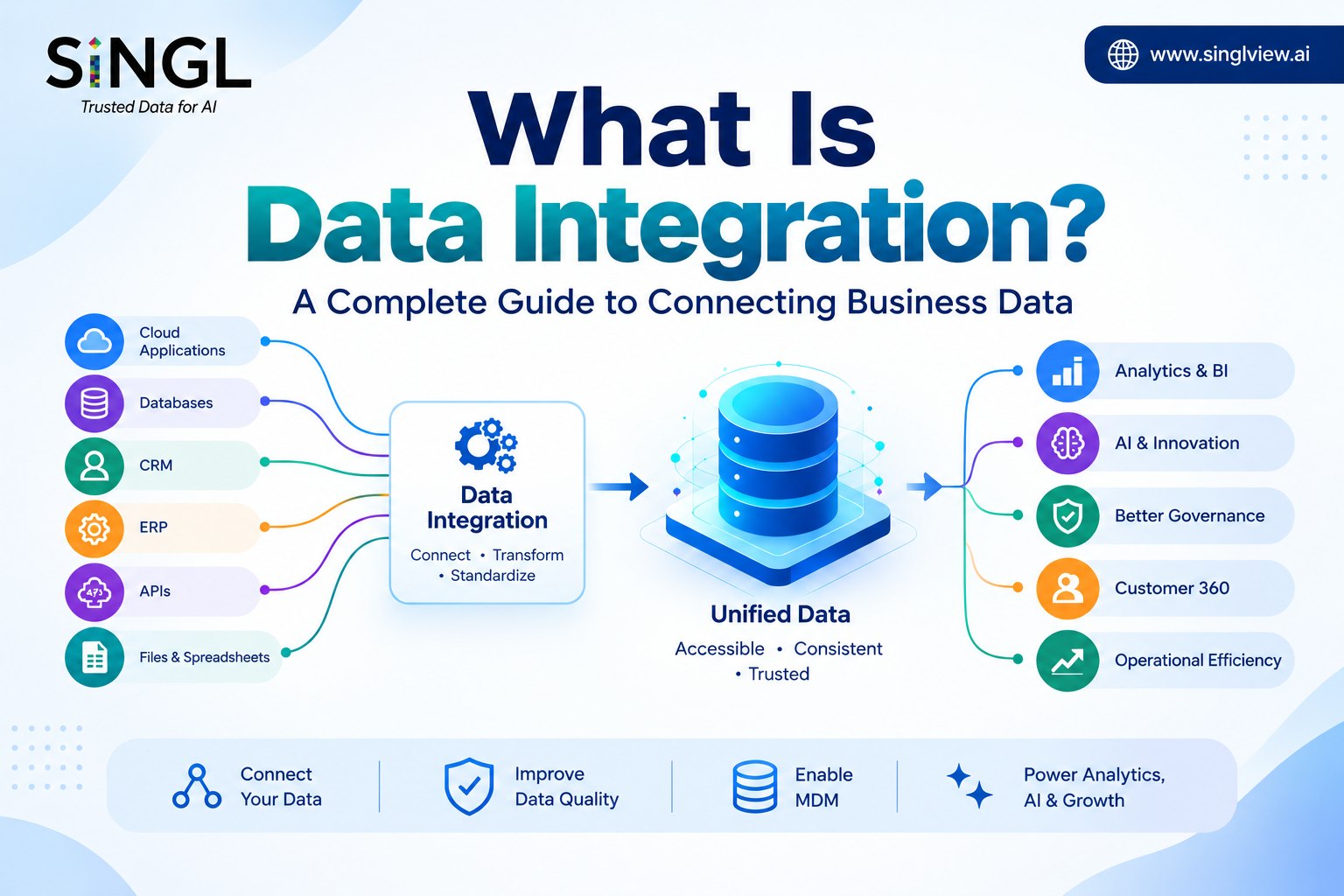
Data integration solves this challenge by connecting data from different sources and making it available where it is needed. It helps organizations bring information together, improve accessibility, reduce data silos, and create a stronger foundation for analytics, Master Data Management (MDM), and AI.
What Is Data Integration?
Data integration is the process of connecting data from multiple sources so that information can be collected, combined, transformed, and delivered to different systems or users.
These sources can include databases, CRM platforms, ERP systems, cloud applications, APIs, spreadsheets, data warehouses, and business applications.
For example, a company may need to connect customer information from its CRM with order data from its ERP and website activity from its e-commerce platform. Data integration allows these systems to exchange information without requiring employees to manually copy data between them.
The goal is to make relevant information available across the organization in a consistent and usable way.
Why Is Data Integration Important?
As businesses adopt more applications and cloud platforms, the amount of data they manage continues to increase. However, simply collecting more data does not automatically make that information useful.
If systems remain disconnected, organizations can experience:
Data silos
Duplicate information
Inconsistent records
Manual data entry
Delayed reporting
Limited visibility across departments
Difficulties supporting analytics and AI
Data integration creates connections between these systems. As a result, organizations can move information more efficiently and give teams access to the data they need.
How Does Data Integration Work?
A typical data integration process involves several stages. The exact architecture can vary depending on the organization's systems, data volume, security requirements, and business objectives.
1. Identify Data Sources
The first step is identifying where important business information exists.
Common data sources include:
CRM systems
ERP platforms
Relational databases
Cloud applications
Data warehouses
APIs
Websites and applications
Spreadsheets
Third-party systems
Understanding these sources helps organizations determine what information needs to be connected.
2. Extract or Access Data
Data is then collected or accessed from the relevant systems.
Depending on the integration method, this may happen through APIs, database connections, file transfers, event streams, or other technologies.
The approach depends on whether the organization needs real-time information, scheduled updates, or large-scale batch processing.
3. Transform and Standardize Data
Data from different systems may follow different formats and structures.
For example, one application may store a country as "United States," while another uses "US." Data integration processes can transform these values into a consistent format before the information is delivered to another system.
Transformation can include formatting, validation, mapping, cleansing, and other preparation activities.
4. Deliver Data to the Destination
After processing, the information is delivered to its destination.
The destination could be another application, data warehouse, analytics platform, cloud database, or MDM platform.
This enables connected systems and teams to work with information without relying entirely on manual data movement.
Common Types of Data Integration
Organizations can use different integration approaches depending on how their data needs to move.
ETL
ETL stands for Extract, Transform, and Load.
Data is extracted from source systems, transformed into the required format, and then loaded into the destination.
ETL is commonly associated with data warehouses and structured data processing. It is particularly useful when organizations need to clean and prepare information before storing it in a target environment.
ELT
ELT stands for Extract, Load, and Transform.
Instead of transforming data before loading, ELT first loads the information into the target environment and performs transformations afterward.
This approach is widely associated with modern cloud data platforms because these environments can provide significant processing capacity for large datasets.
API-Based Integration
APIs allow different applications to communicate and exchange information.
For example, an application may use an API to retrieve customer information from another system. API-based integration is useful when businesses need applications to communicate programmatically.
Real-Time Data Integration
Real-time integration moves information between systems with minimal delay.
This can be useful when current information is important, such as customer transactions, financial operations, inventory updates, or service interactions.
Batch Integration
Batch integration processes data at scheduled intervals rather than continuously.
For example, an organization may move data from several systems every night for reporting and analytics.
Data Integration vs. Master Data Management
Data integration and Master Data Management are closely related, but they are not the same thing.
Data integration focuses on connecting and moving data between systems.
MDM focuses on creating, maintaining, governing, and distributing trusted master data.
For example, an organization may integrate customer data from its CRM, ERP, website, and support platform. MDM can then help identify duplicate customer records, apply business rules, establish a trusted master record, and distribute that information to connected systems.
This distinction is important because simply connecting systems does not automatically make the underlying data accurate or trustworthy.
Organizations looking for comprehensive Master Data Management Solutions can combine integration capabilities with data quality, governance, matching, and master data management processes.
Data Integration and Data Quality
Connecting systems is only one part of building a reliable data environment.
Data coming from different sources may contain:
Missing information
Duplicate records
Different formats
Incorrect values
Outdated information
Conflicting attributes
Data integration can help standardize and prepare information, but organizations may also require dedicated data quality and MDM capabilities to establish trusted master records.
This is particularly important when the same customer, product, supplier, or other business entity appears across multiple systems.
How Data Integration Supports MDM
MDM depends on information from multiple systems. Data integration provides the connections required to bring that information into the MDM environment.
Consider a business that stores customer information in five different applications. Integration can bring the relevant records together, while MDM can match those records, identify duplicates, apply governance rules, and create a trusted customer profile.
The resulting master data can then be distributed back to business applications.
This creates a continuous relationship between integration, data quality, governance, and master data management.
Benefits of Data Integration
A well-designed data integration strategy can provide several business benefits.
Reduced Data Silos
Integration connects systems that previously operated independently. Teams can access information from multiple sources without relying on isolated databases.
Better Data Accessibility
Employees and applications can access relevant information more easily when systems are connected.
Improved Operational Efficiency
Automated data movement reduces repetitive manual processes and minimizes the risk of errors caused by manual data entry.
Faster Reporting and Analytics
When information is available across connected systems, organizations can bring data together for reporting, business intelligence, and analysis.
Better Decision-Making
Connected and accessible information gives decision-makers a broader view of business operations.
Stronger Foundation for AI
AI applications depend on reliable and accessible data. Data integration helps bring information together so it can be prepared for analytics, machine learning, and AI initiatives.
Data Integration Across Different Industries
Data integration is not limited to a particular industry. Organizations use it wherever information is distributed across multiple applications.
Financial Services
Banks, financial institutions, and insurance organizations manage large volumes of customer, account, transaction, and regulatory information.
Integration helps connect these systems, while Financial Services MDM can provide additional capabilities for managing trusted customer and business data.
Healthcare
Healthcare organizations often manage information across electronic health records, clinical systems, billing applications, laboratories, pharmacies, and other platforms.
Connecting these systems can improve information accessibility and support a more consistent view of healthcare data. Organizations can also use Healthcare MDM to establish better control over critical master data.
Retail and E-commerce
Retailers may need to connect customer, product, inventory, order, supplier, and transaction data.
Integration helps different platforms exchange information, supporting more connected operations and customer experiences.
Data Integration in Different Business Locations
The need for connected data is also relevant to organizations operating across different business hubs.
For enterprises exploring Master Data Management in New York, data integration can help connect information across departments, applications, and business operations while supporting a centralized approach to trusted master data.
Similarly, organizations evaluating Master Data Management in Chicago may use integration as part of a broader data strategy that connects operational systems and creates consistent information across business functions.
For companies considering Master Data Management in Dallas, integration can also play an important role in connecting enterprise applications and preparing information for governance, analytics, and master data initiatives.
The technology used may differ between organizations, but the underlying objective remains the same: connect the right data, make it usable, and establish trust in critical business information.
Data Integration and Data Governance
Integration also needs to work alongside data governance.
Without governance, organizations may successfully connect systems but still struggle with questions such as:
Who owns the data?
Which system is authoritative?
Who can access sensitive information?
Which business rules should apply?
How should data quality be measured?
How should changes be approved?
Data governance provides the policies, responsibilities, standards, and controls needed to manage information responsibly.
When integration and governance work together, organizations can create a more controlled and reliable data environment.
Data Integration and AI
AI initiatives require more than large amounts of information. They require data that is accessible, consistent, relevant, and trustworthy.
If information is spread across disconnected systems, AI models and analytics applications may have difficulty accessing a complete view of the business.
Data integration helps bring information together from different sources. MDM and data quality processes can then help ensure that important business entities are represented consistently.
Together, these capabilities can create a stronger data foundation for AI, predictive analytics, automation, and advanced decision-making.
What Is the Difference Between Data Integration and Data Consolidation?
Data integration and data consolidation are related but have different purposes.
Data integration focuses on connecting data across systems and enabling information to move or be accessed between them.
Data consolidation focuses on bringing information from multiple sources into a common location or unified environment.
For example, a company may integrate data between its CRM and ERP systems while also consolidating selected information into a central data warehouse.
MDM can add another layer by helping determine which records represent the same business entity and which information should be treated as trusted master data.
What Should Businesses Consider When Choosing a Data Integration Strategy?
There is no single integration approach that works for every organization.
Businesses should consider:
Existing Technology
Organizations should understand their current databases, applications, APIs, cloud platforms, and legacy systems.
Data Volume
Large datasets may require different technologies and architectures than smaller workloads.
Real-Time Requirements
Some processes require immediate data updates, while others can operate through scheduled batch processing.
Security and Compliance
Sensitive information may require strict controls around access, encryption, monitoring, and data movement.
Data Quality
Integration should be designed alongside data quality processes rather than treating connectivity as the only objective.
Future Scalability
The integration architecture should be capable of supporting new applications, data sources, and business requirements as the organization grows.
Is Data Integration the Same as MDM?
No. Data integration and MDM solve different but complementary problems.
Data integration connects systems and enables information to move between them. MDM focuses on managing critical business entities and creating trusted, governed master data.
An organization can have integration without MDM. However, when businesses need consistent customer, product, supplier, or other master data across many systems, combining integration with MDM can provide a stronger approach.
This is why modern Master Data Management Solutions often work alongside integration technologies rather than replacing them
Final Thoughts
Data integration is an essential part of modern data management. It connects information across databases, applications, cloud platforms, APIs, and business systems so organizations can access and use data more effectively.
However, connectivity alone is not enough. Businesses also need data quality, governance, security, and master data management to ensure that the information being exchanged is accurate and trustworthy.
When these capabilities work together, organizations can reduce data silos, improve operational efficiency, support analytics, strengthen Customer 360 initiatives, and create a reliable foundation for AI.
As enterprise data environments become increasingly complex, data integration provides the connectivity, while MDM provides the trust and control needed to turn connected data into valuable business information.