
What Is Data Engineering? A Complete Guide to Data Engineering
Data engineering builds the infrastructure and pipelines businesses need to collect, process, integrate, and deliver reliable data for analytics, MDM, AI, and everyday operations.
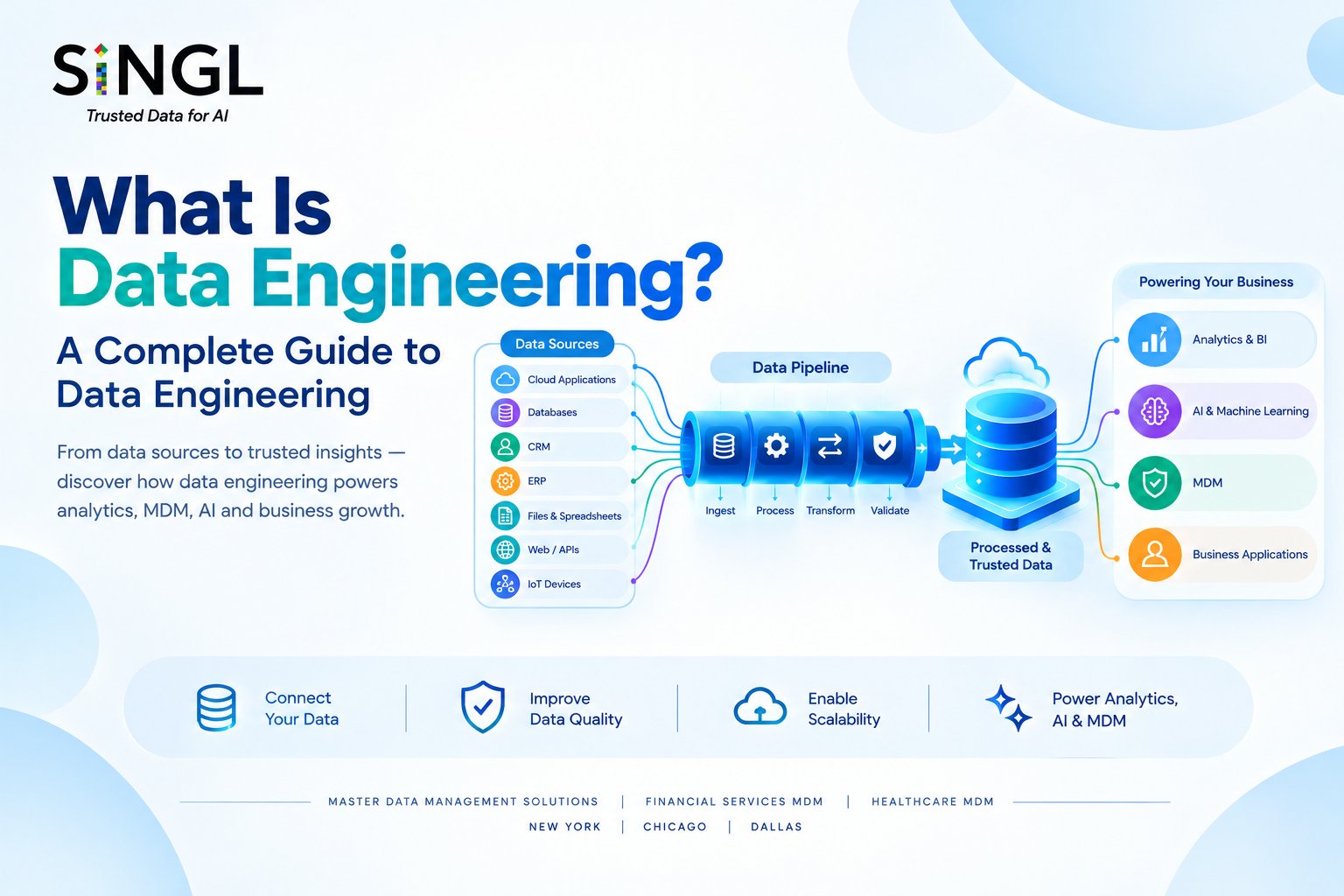
Understanding How Data Is Collected, Processed, and Prepared for Business Use
Modern organizations generate data from countless sources, including CRM platforms, ERP systems, websites, databases, cloud applications, APIs, and business software. However, simply collecting information does not make it useful. Data must be organized, processed, validated, and delivered to the right systems before businesses can use it effectively.
This is where data engineering plays an important role. Data engineering provides the infrastructure, pipelines, and processes needed to move and prepare information for analytics, reporting, artificial intelligence, machine learning, and business operations. When organizations also need to create a trusted and consistent view of critical business data, data engineering can work alongside Master Data Management Solutions to support a stronger enterprise data foundation.
What Is Data Engineering?
Data engineering is the practice of designing, building, and maintaining systems that collect, process, store, transform, and deliver data.
Data engineers create the technical infrastructure that allows organizations to work with information at scale. Their work can involve databases, cloud platforms, data warehouses, data lakes, APIs, ETL and ELT pipelines, streaming technologies, and data integration systems.
The primary objective is to make data available, reliable, consistent, and usable for the people and applications that depend on it.
For example, an organization may collect customer information from its CRM, transaction records from an ERP system, and website activity from digital platforms. Data engineering processes can bring these different datasets together and prepare them for analytics or other business applications.
Why Is Data Engineering Important?
Businesses increasingly depend on data to understand customers, monitor operations, identify opportunities, and make informed decisions.
However, enterprise data is often distributed across multiple systems. Different applications may use different formats, naming conventions, structures, and storage environments.
Without appropriate data engineering, organizations may face:
Data silos
Inconsistent information
Manual data processing
Difficult system integrations
Delayed reporting
Poor data quality
Challenges scaling analytics and AI
A well-designed data engineering environment helps automate data movement and processing while creating a dependable foundation for downstream systems.
How Does Data Engineering Work?
Although architectures differ between organizations, data engineering generally involves several connected stages.
1. Data Ingestion
Data ingestion is the process of collecting information from different sources and bringing it into a data environment.
Common sources include:
CRM systems
ERP applications
Databases
APIs
Cloud applications
Websites
Mobile applications
IoT devices
Files and spreadsheets
Data may be collected through scheduled batch processes or continuously through real-time and streaming systems.
2. Data Storage
After data is collected, it needs to be stored in an environment suitable for its intended purpose.
Organizations may use:
Relational databases
Data warehouses
Data lakes
Cloud storage
Lakehouse platforms
The appropriate storage architecture depends on factors such as data volume, structure, accessibility, performance, security, and business requirements.
3. Data Processing
Raw information often requires processing before it can be used.
Data engineers may create processes to:
Remove duplicate records
Handle missing values
Validate information
Standardize formats
Convert data types
Apply business rules
Combine information from multiple sources
These processes help create datasets that are easier for analysts, applications, and other systems to use.
4. Data Transformation
Data transformation changes information from its original structure into a format suitable for its destination or intended use.
For example, two systems may store customer addresses differently. One may separate city, state, and postal code, while another stores the entire address in one field. Transformation processes can standardize these differences.
ETL and ELT are two common approaches used for transforming data.
5. Data Delivery
After processing, data needs to reach the systems and teams that depend on it.
Destinations may include:
Data warehouses
Data lakes
MDM platforms
Business intelligence systems
Analytics platforms
AI and machine learning environments
Operational applications
Reliable delivery ensures that processed information is available when required.
What Does a Data Engineer Do?
A data engineer is responsible for developing and maintaining the technical systems that support data operations.
Building Data Pipelines
Data engineers create pipelines that automatically move information between different systems and environments.
Managing Data Infrastructure
They work with databases, cloud environments, warehouses, storage platforms, and processing frameworks.
Maintaining Pipeline Reliability
Data engineers monitor pipelines and troubleshoot problems such as failed jobs, missing records, delays, and processing errors.
Supporting Data Quality
They can implement validation, cleansing, standardization, and other technical processes that improve the reliability of data.
Supporting Analytics and AI
Data engineers make prepared information accessible to analysts, data scientists, applications, and AI systems.
Data Engineering vs. Data Science
Data engineering and data science are closely connected, but they address different parts of the data lifecycle.
Data engineering focuses on building the infrastructure and pipelines needed to collect, process, store, and deliver information.
Data science focuses on analyzing information, identifying patterns, developing statistical models, and generating predictions.
For example, a data engineer may build a pipeline that collects customer transactions and prepares them in a data warehouse. A data scientist can then use that dataset to develop a predictive model.
Both functions can therefore contribute to a broader data-driven strategy.
Data Engineering vs. Data Analytics
Data engineering provides much of the technical foundation required for analytics.
Data engineers focus on collecting, processing, integrating, and delivering reliable datasets. Data analysts use those datasets to create reports, dashboards, visualizations, and business insights.
A simplified workflow is:
Data Sources → Data Engineering → Processed Data → Analytics → Business Insights
When data pipelines are reliable and well maintained, analytics teams can spend more time interpreting information rather than manually preparing it.
Data Engineering vs. ETL
ETL is one approach commonly used within data engineering.
ETL stands for Extract, Transform, Load. It involves extracting information from source systems, transforming it, and loading it into a destination.
Data engineering is broader than ETL. It can include:
Pipeline development
Data ingestion
Data storage
Data processing
Data integration
Workflow orchestration
Monitoring
Streaming
Data quality
Infrastructure management
Therefore, ETL can be an important component of data engineering rather than being synonymous with it.
The Role of Data Integration in Data Engineering
Data integration connects information from different applications and systems so that it can be accessed and used together.
This is particularly important for organizations with complex technology environments.
For example, customer information may exist in a CRM, billing application, e-commerce platform, and customer service system. Data engineering pipelines can help move information between these environments while applying the required processing and transformation rules.
Data integration can therefore help reduce silos and support a more connected enterprise data architecture.
How Data Engineering Supports Master Data Management
Master Data Management focuses on managing important business entities such as customers, products, suppliers, employees, and locations.
Data engineering can provide the infrastructure required to bring information from different source systems into an MDM environment.
A typical flow could look like:
CRM + ERP + Business Applications → Data Pipelines → Data Quality → MDM → Trusted Master Data
Once information reaches an MDM platform, additional capabilities such as matching, deduplication, governance, and Golden Record creation can help establish a consistent view of important business entities.
This relationship is particularly relevant for organizations building enterprise-wide data strategies and evaluating Master Data Management Solutions.
Data Engineering and AI
Artificial intelligence depends on access to suitable and reliable data.
AI systems may require information from multiple sources, and that information often needs to be cleaned, transformed, combined, and delivered before it can be used effectively.
Data engineering can support AI initiatives through:
Automated data pipelines
Data preparation
Large-scale data processing
Data integration
Real-time data flows
Training dataset preparation
Scalable storage
Data availability
However, data engineering is only one part of an AI-ready data strategy. Data quality, governance, security, metadata, and master data management are also important.
Data Engineering for Financial Services
Financial institutions manage information across banking systems, customer platforms, transaction applications, risk systems, and regulatory environments.
Data engineering can help connect these sources and prepare information for reporting, analytics, risk management, and operational processes.
For organizations implementing Financial Services MDM, reliable data pipelines can support the movement and preparation of customer, account, product, and other critical information before it is governed and managed as trusted master data.
Data Engineering for Healthcare
Healthcare organizations often work with information from electronic health records, laboratory systems, insurance platforms, clinical applications, and other sources.
Connecting these environments can be challenging because information may differ in structure and format.
Data engineering can help establish pipelines that collect, process, and deliver information to appropriate data environments while supporting applicable security and governance requirements.
For organizations exploring Healthcare MDM, data engineering can provide an important technical layer for bringing information together before master data processes are applied.
Data Engineering in Different Business Environments
Data engineering requirements can vary depending on an organization's technology landscape, data volume, business structure, and operational needs.
Organizations exploring Master Data Management in New York may operate complex enterprise environments with multiple applications, departments, and data sources. Data engineering can help establish reliable connections between these systems.
Similarly, businesses considering Master Data Management in Chicago may need to integrate information across operational and analytical environments while maintaining consistent data flows.
For companies evaluating Master Data Management in Dallas, scalable data engineering can support growing data volumes and help connect information across business applications and centralized data environments.
The underlying architecture should always be determined by the organization's actual data requirements rather than geographic location alone.
Common Data Engineering Technologies
Modern data engineering can involve a broad range of technologies and platforms.
Cloud Platforms
Cloud infrastructure provides scalable computing and storage resources for processing enterprise data.
Data Warehouses
Data warehouses organize structured information for reporting, business intelligence, and analytics.
Data Lakes
Data lakes can store large volumes of structured, semi-structured, and unstructured information.
APIs
APIs allow different applications and services to exchange information programmatically.
Streaming Technologies
Streaming platforms allow organizations to process information continuously as events occur.
ETL and ELT Tools
ETL and ELT technologies help organizations extract, transform, and load information between different environments.
The technology stack should be selected based on business requirements, data architecture, scalability, security, and operational needs.
Benefits of Data Engineering
A well-designed data engineering environment can provide several benefits.
Improved Data Accessibility
Data can be delivered to the teams and applications that need it.
Greater Automation
Automated pipelines reduce repetitive manual data movement and processing.
Better Scalability
Modern architectures can accommodate increasing data volumes and additional sources.
More Reliable Analytics
Consistent data pipelines provide a stronger foundation for reporting and analytical workloads.
Improved Data Quality
Validation and transformation processes can help identify and address common data issues.
AI Readiness
Reliable data infrastructure helps organizations prepare information for AI and machine learning initiatives.
Stronger Enterprise Data Foundation
When data engineering works together with integration, governance, and MDM, organizations can create a more connected and trusted data environment.
Challenges in Data Engineering
Building and maintaining data infrastructure can also present several challenges.
Data Silos
Information distributed across disconnected applications can make integration difficult.
Poor Data Quality
Incomplete, outdated, inconsistent, or duplicate information can affect downstream systems.
Increasing Data Volumes
Growing datasets require scalable infrastructure and efficient processing.
Complex Integrations
Legacy applications, cloud platforms, APIs, and different data formats can make integration challenging.
Security and Governance
Organizations need appropriate controls to protect sensitive information and meet applicable requirements.
Pipeline Reliability
Failed or delayed pipelines can affect analytics, reporting, and business applications.
Addressing these challenges requires appropriate architecture, monitoring, governance, and ongoing maintenance.
What Is the Future of Data Engineering?
Data engineering continues to evolve alongside cloud computing, real-time analytics, automation, and artificial intelligence.
Modern data environments increasingly focus on:
Automated data pipelines
Real-time processing
Cloud-native infrastructure
Data quality automation
Metadata management
Data governance
AI-ready data infrastructure
Scalable integration
Greater workflow automation
As AI adoption expands, organizations will need reliable ways to prepare, manage, and deliver the data that intelligent applications depend on.