What Is a Data Pipeline? A Complete Guide to Data Pipelines
Learn what a data pipeline is, how it moves and transforms data, and why it is essential for data integration, MDM, analytics, and AI.
Understanding How Data Moves, Transforms, and Reaches the Right Systems
Businesses generate data from CRM platforms, ERP systems, websites, cloud applications, databases, spreadsheets, and other digital tools. However, collecting data is only the first step. Organizations also need a reliable way to move, process, transform, and deliver that information where it is needed.
This is where a data pipeline becomes important.
A data pipeline is a structured process that moves data from one or more sources to a destination while performing necessary operations such as transformation, validation, cleansing, and enrichment along the way.
Data pipelines support analytics, reporting, data warehouses, Master Data Management (MDM), artificial intelligence, and many other data-driven business processes. They help organizations make information available in a consistent and usable form without relying entirely on manual data movement.
What Is a Data Pipeline?
A data pipeline is a series of connected processes that automatically moves data from a source to a destination.
The source could be a database, CRM, ERP system, application, API, cloud platform, or file. The destination could be a data warehouse, data lake, MDM platform, analytics environment, or another business application.
Depending on the business requirement, a pipeline may simply move data or may also clean, transform, validate, enrich, and standardize it before delivery.
For example, a customer data pipeline could collect information from a CRM, website, and e-commerce platform, standardize customer attributes, remove duplicate records, and deliver the processed information to an analytics or MDM environment.
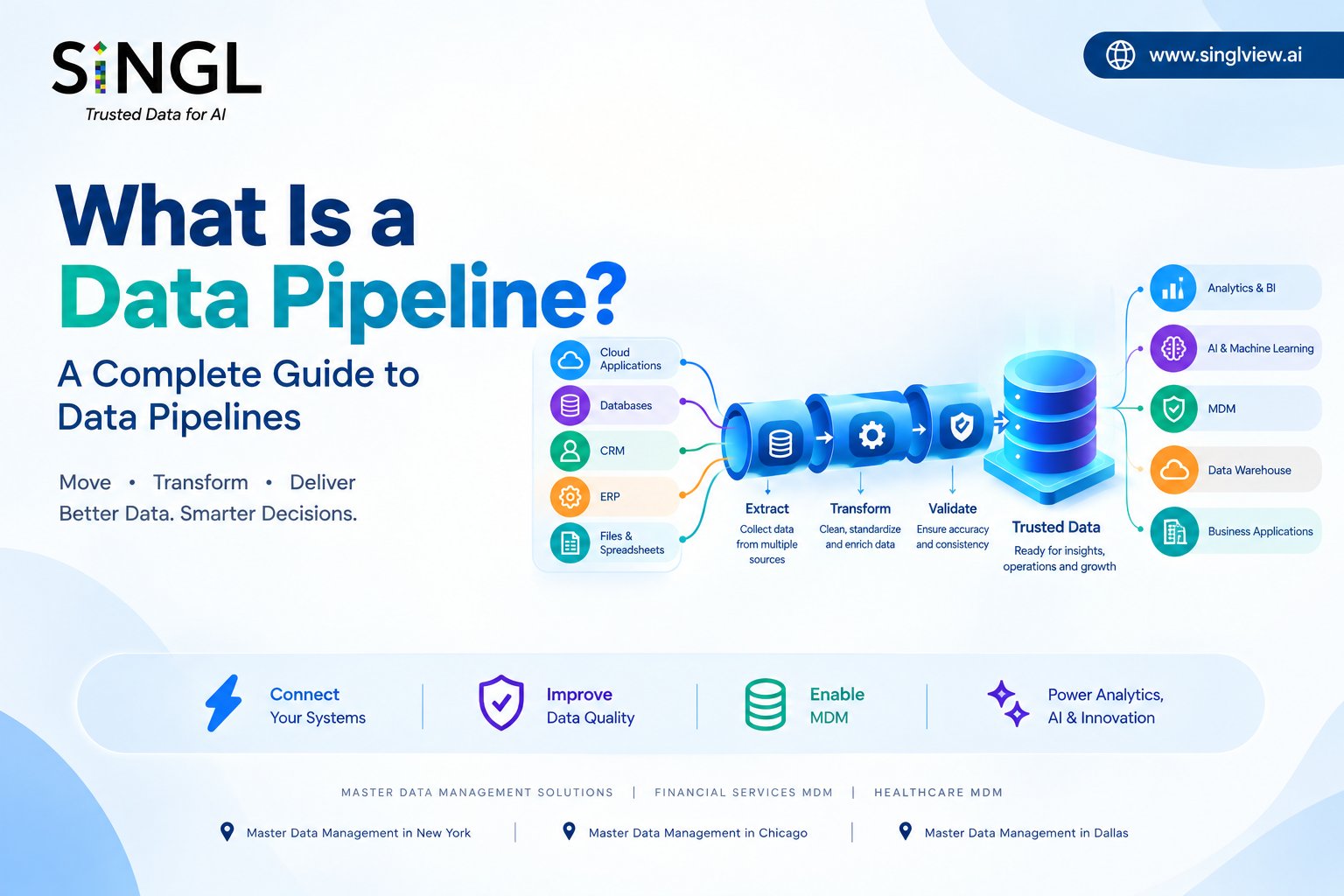
How Does a Data Pipeline Work?
Although pipeline architectures vary, most data pipelines follow several basic stages.
1. Data Collection
The first stage involves collecting data from different sources.
Common sources include:
CRM systems
ERP platforms
Databases
APIs
Cloud applications
Websites
Files and spreadsheets
IoT devices
The pipeline establishes a reliable mechanism for bringing this information into the data processing environment.
2. Data Processing
Once collected, data may need to be cleaned and transformed before it can be used.
Processing activities can include:
Removing duplicate records
Standardizing formats
Validating values
Converting data types
Combining information
Enriching existing records
This stage helps improve the consistency and usability of the information.
3. Data Transformation
Different systems may store the same information in different formats. Transformation converts that information into a structure that the destination system can understand.
For example, one system may store a customer's name as a single field, while another separates first and last names. A pipeline can transform these fields into a standardized structure.
4. Data Delivery
The processed information is then delivered to its destination.
Depending on the architecture, this could be:
A data warehouse
A data lake
An MDM platform
A business intelligence platform
An analytics system
An AI or machine learning environment
The result is a more accessible and usable flow of business data.
Data Pipeline vs. ETL
Data pipelines and ETL are closely related, but they are not exactly the same thing.
ETL stands for Extract, Transform, and Load. It specifically describes an approach where data is extracted from sources, transformed, and then loaded into a target system.
A data pipeline is a broader concept. It describes the overall flow of data between systems and may include ETL, ELT, streaming, validation, monitoring, orchestration, and other processing activities.
In simple terms:
ETL is a data processing approach, while a data pipeline is the broader flow that moves and processes data.
An ETL workflow can therefore be part of a larger data pipeline architecture.
Data Pipelines and Master Data Management
Data pipelines can play an important role in Master Data Management.
MDM requires data from different business systems to be collected, standardized, matched, governed, and distributed. A well-designed pipeline can help move this information efficiently between source systems and an MDM platform.
For example, customer records may come from CRM, billing, e-commerce, and support systems. The pipeline can bring this information together, apply data quality rules, and prepare it for matching and consolidation.
This creates a stronger foundation for trusted master data and initiatives such as Customer 360.
Organizations evaluating Master Data Management Solutions can therefore consider data pipeline capabilities as part of their broader data integration and management architecture.
Why Are Data Pipelines Important?
Modern organizations rarely keep all their information in one system. Data is distributed across applications, departments, databases, and cloud environments.
Without automated data movement, teams may have to manually transfer information between systems. This can increase delays, inconsistencies, and operational effort.
Data pipelines help organizations:
Automate data movement
Reduce manual data handling
Improve data availability
Support consistent data processing
Prepare information for analytics
Connect different business systems
Support MDM and data governance
Enable AI and machine learning initiatives
A reliable pipeline also makes it easier to scale data operations as business requirements increase.
Types of Data Pipelines
Different organizations use different pipeline architectures depending on how quickly data needs to be processed.
Batch Data Pipelines
Batch pipelines process data at scheduled intervals.
For example, an organization may collect sales information throughout the day and process it every night.
Batch processing is useful when information does not need to be available immediately.
Real-Time Data Pipelines
Real-time pipelines process and deliver information with very little delay.
They can be useful for applications such as fraud monitoring, real-time customer interactions, operational dashboards, and transaction monitoring.
Streaming Data Pipelines
Streaming pipelines continuously process data as events occur.
They are commonly used when organizations need to handle continuously generated information from applications, sensors, websites, or transaction systems.
Data Pipelines in Different Industries
Data pipeline requirements can vary significantly by industry.
Financial Services
Financial organizations manage large volumes of customer, transaction, account, and regulatory information. Data pipelines can help connect these sources and prepare information for analytics, reporting, governance, and operational processes.
For organizations implementing Financial Services MDM, reliable data movement is particularly important because trusted customer and financial information may need to be coordinated across multiple systems.
Healthcare
Healthcare organizations work with information from electronic health records, laboratories, insurance systems, clinical applications, and other sources.
Data pipelines can help move and standardize information while supporting analytics and data management initiatives. When combined with appropriate governance and security controls, they can contribute to a stronger foundation for Healthcare MDM.
Enterprise Businesses
Large enterprises often operate across multiple departments and geographic locations. Data pipelines can connect information from finance, sales, marketing, supply chain, customer service, and other business functions.
This is particularly relevant for organizations exploring Master Data Management in New York, where complex enterprise environments may require data to move consistently between multiple applications and business units.
Data Pipelines and AI
AI systems depend on reliable and relevant data.
If data is incomplete, inconsistent, outdated, or duplicated, AI models and analytical systems may produce unreliable results. Data pipelines help prepare information before it reaches these environments.
A pipeline can support AI initiatives by:
Collecting data from multiple sources
Cleaning and standardizing information
Applying validation rules
Moving data into AI platforms
Supporting continuous data flows
Making data available for analytics
However, moving data alone does not guarantee that it is trustworthy. Data quality, governance, metadata, security, and master data management also play important roles.
Data Pipeline vs. Data Integration
Data integration is the broader practice of connecting data from different systems so that it can be accessed and used together.
A data pipeline is one of the mechanisms that can support data integration.
For example, an organization may use pipelines to move customer information from CRM, ERP, e-commerce, and support applications into a centralized environment.
Therefore, data integration describes the broader objective and capability, while a data pipeline represents a structured flow used to move and process data.
Data Pipelines and MDM in Different Business Environments
The need for reliable data movement is not limited to one market or business location.
Organizations considering Master Data Management in Chicago may need to connect information across operational applications, business units, and enterprise data environments.
Similarly, companies looking at Master Data Management in Dallas may use integrated data pipelines to support consistent information across applications, analytics platforms, and centralized data management systems.
The architecture should ultimately be designed around the organization's data sources, business processes, governance requirements, and long-term data strategy rather than location alone.
Benefits of a Well-Designed Data Pipeline
A well-designed data pipeline can provide several business benefits.
Improved Data Accessibility
Data becomes available to the systems and teams that need it without requiring repeated manual transfers.
Better Data Quality
Validation, cleansing, and transformation processes can help identify and address common data quality issues.
Greater Operational Efficiency
Automating repetitive data movement reduces manual work and helps teams focus on higher-value activities.
Faster Analytics
When reliable information reaches analytics environments efficiently, teams can access insights more quickly.
Scalable Data Operations
Modern pipeline architectures can be expanded as data volumes, sources, and business requirements grow.
Stronger Data Foundation
When combined with integration, governance, and MDM capabilities, pipelines can contribute to a more reliable enterprise data ecosystem.
What Should Organizations Consider When Building a Data Pipeline?
A successful data pipeline requires more than simply connecting two systems.
Organizations should consider:
Data sources and destinations
Data volume and frequency
Batch or real-time requirements
Data quality rules
Security and access controls
Monitoring and error handling
Integration requirements
Governance policies
Scalability
Compliance requirements
The pipeline should also be designed to accommodate future changes rather than only addressing today's data requirements.