Use Cases of MDM in Healthcare: How Master Data Management Improves Patient Care
Explore the key use cases of MDM in healthcare, including patient identity management, Patient 360 views, provider data, interoperability, compliance, analytics, and AI readiness.
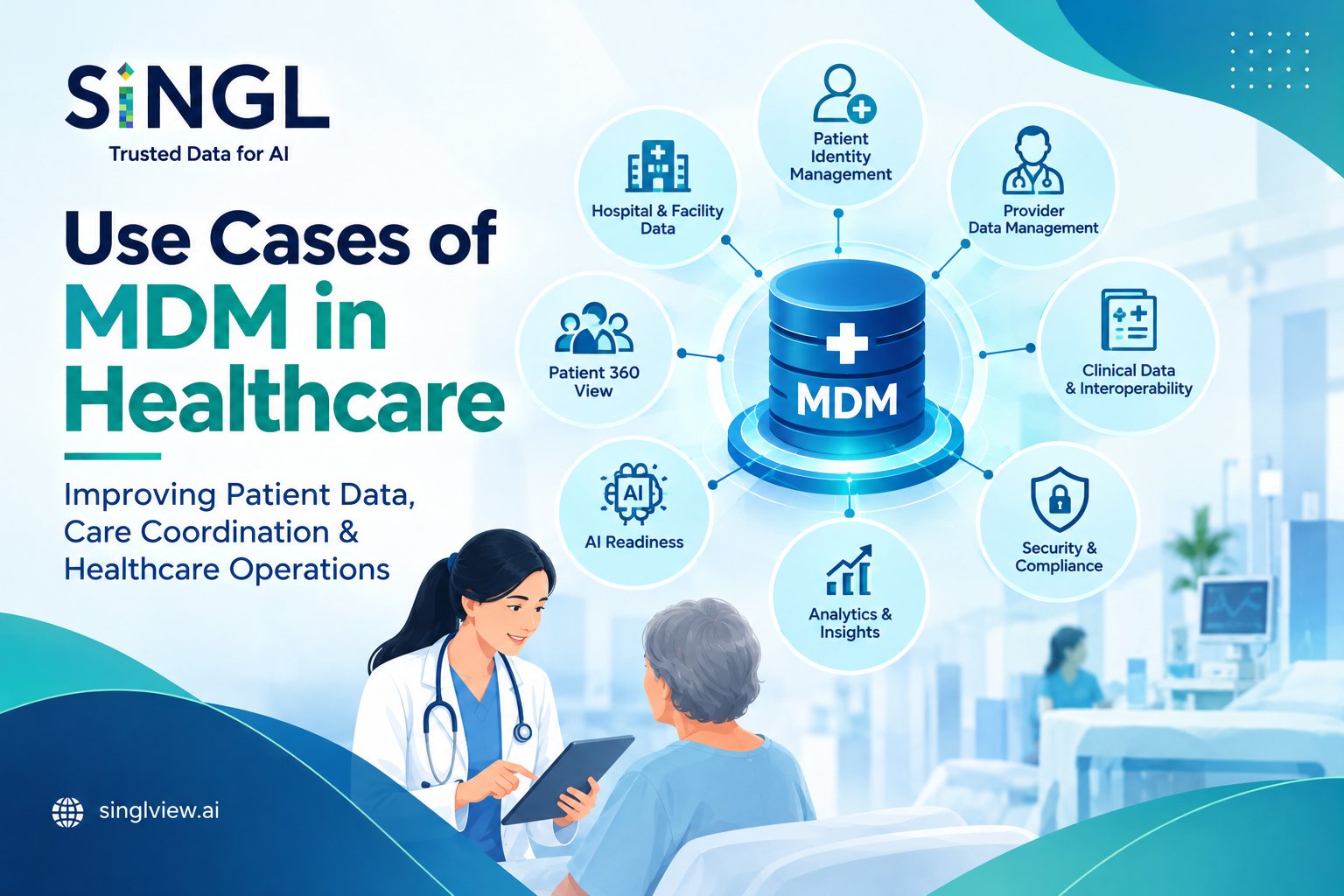
Healthcare organizations generate vast amounts of data every day. Patient registrations, electronic health records (EHRs), laboratory results, prescriptions, insurance claims, physician details, and hospital operations all depend on accurate information. However, when this data is spread across disconnected systems, maintaining consistency becomes difficult.
A patient may have multiple records across hospitals, while a physician's contact information may differ between a scheduling platform and a billing system. These inconsistencies can affect care coordination, reporting, operational efficiency, and the reliability of healthcare analytics.
This is where Master Data Management (MDM) becomes valuable. It helps healthcare organizations identify, standardize, connect, and govern critical information across systems. With a structured MDM strategy, hospitals, clinics, laboratories, insurers, and healthcare networks can establish trusted data that supports better decisions.
This article explores the major use cases of MDM in healthcare, its business benefits, implementation considerations, and how healthcare organizations can build a reliable data foundation for analytics and AI.
What Is Master Data Management in Healthcare?
Master Data Management is the process of creating and maintaining consistent, governed records for important entities across an organization. In healthcare, these entities commonly include patients, healthcare providers, facilities, medical organizations, and certain operational or reference data.
For example, a hospital may store patient information in its EHR, appointment scheduling system, laboratory platform, billing software, and patient engagement application. MDM helps reconcile these records so that authorized systems can use a consistent representation of the same patient.
Depending on the organization's architecture, MDM may create a centralized master record, maintain links between source records, or synchronize approved information across applications. The goal is to provide trusted master data without unnecessarily replacing the clinical systems that healthcare professionals already use.
Organizations exploring Healthcare MDM can use this approach to improve patient identity resolution, provider data quality, interoperability, governance, and enterprise reporting.
Why Does Healthcare Need Master Data Management?
Healthcare data is complex because it comes from multiple departments, technologies, and organizations. Each system may use different formats, naming conventions, identifiers, and data-entry processes.
Without effective data management, healthcare organizations may encounter:
Duplicate patient records across facilities.
Inconsistent physician and provider details.
Incomplete patient profiles.
Conflicting information between clinical and administrative systems.
Difficulties connecting laboratory, pharmacy, insurance, and hospital data.
Inaccurate operational reports and analytics.
Increased manual work for data reconciliation.
Challenges maintaining appropriate access controls and data governance.
Master Data Management helps address these problems by establishing clear data ownership, quality rules, matching processes, and trusted records. The Office of the National Coordinator for Health Information Technology explains that patient matching is essential to linking records across health systems and supporting a comprehensive view of a patient's healthcare information.
1. Patient Identity Management and Duplicate Record Reduction
One of the most important use cases of MDM in healthcare is patient identity management.
Patients may visit multiple departments, specialists, clinics, or hospitals over time. If registration details vary across these encounters, the same person can be represented by several records. Common differences include spelling variations, outdated addresses, changes in phone numbers, and incomplete demographic details.
MDM uses identity resolution and matching rules to identify records that may belong to the same individual. Depending on the organization's policies, records can be linked, reviewed, or consolidated while preserving source information and clinical history.
How it helps
Identifies potential duplicate patient records.
Creates a more complete view of patient information.
Reduces repeated registration and reconciliation work.
Helps authorized care teams locate relevant historical information.
Supports more consistent patient identification across facilities.
Identifies potential duplicate patient records.
Creates a more complete view of patient information.
Reduces repeated registration and reconciliation work.
Helps authorized care teams locate relevant historical information.
Supports more consistent patient identification across facilities.
For example, a patient who visits a hospital emergency department and later attends a specialist clinic may have records in two separate systems. A well-governed MDM process can help establish that the records refer to the same person, subject to appropriate verification.
Patient matching should not rely on a single field alone. Healthcare organizations need carefully tested rules, exception handling, and human review for uncertain matches to reduce the risk of incorrectly combining two patients' records.
2. Creating a Unified Patient 360 View
A Patient 360 view brings together relevant patient information from multiple systems into a consistent, connected profile. It can help authorized users understand the patient's interactions with the healthcare organization without manually searching every application.
Depending on available integrations and permissions, this view may connect:
Patient demographic information.
Appointment and encounter history.
Relevant clinical record references.
Laboratory and diagnostic information.
Medication and prescription records.
Billing and insurance details.
Patient communication preferences.
MDM supports this use case by resolving identities and standardizing key patient attributes. The Patient 360 application or data platform can then retrieve information from connected systems.
For example, a care coordinator managing a follow-up appointment may need to verify the patient's identity, review recent encounters, and confirm that the correct specialist is involved. Connected and reliable master data makes it easier to locate the right information.
A Patient 360 view does not automatically replace the EHR or create a complete clinical record by itself. Its usefulness depends on data availability, integration quality, clinical workflows, and role-based access.
3. Healthcare Provider and Physician Data Management
Healthcare organizations must maintain accurate information about doctors, nurses, specialists, laboratories, and other care providers. This information may be distributed across credentialing, HR, scheduling, referral, billing, and provider directory systems.
If a physician's specialty, location, professional status, or contact details differ across systems, appointments and referrals can be delayed. Patients may also struggle to find the appropriate provider.
MDM helps standardize and govern provider records across departments and facilities.
Key applications
Provider identity resolution: Identify duplicate or conflicting records for the same physician or healthcare professional.
Specialty and credential data: Maintain consistent specialty classifications and approved professional information, with verification performed by the responsible teams.
Provider directories: Improve consistency between internal directories, scheduling systems, and other authorized applications.
Referral coordination: Help teams identify the correct provider and location when coordinating referrals.
Workforce and capacity reporting: Support more reliable reporting on provider locations, specialties, and organizational relationships.
For healthcare networks operating across several facilities, provider mastering is particularly valuable because one professional may work at multiple locations while retaining a single professional identity.
4. Hospital, Facility, and Location Data Management
Large healthcare groups may operate hospitals, outpatient clinics, diagnostic centers, pharmacies, laboratories, and specialist units. Each facility may maintain its own information in operational, financial, and administrative applications.
MDM helps establish consistent records for these facilities, departments, and organizational relationships.
For example, a hospital's name or location identifier may be represented differently in the appointment platform, billing software, and enterprise reporting system. Standardized master data can reduce these inconsistencies.
Healthcare organizations can use facility MDM to:
Maintain consistent facility names and identifiers.
Connect departments to the correct hospitals and parent organizations.
Standardize location information across systems.
Improve facility-level operational reporting.
Support mergers, acquisitions, and network expansion.
Make authorized location and service information easier to maintain.
This use case is important for healthcare groups that need to compare performance across facilities or coordinate services across a growing network.
5. Healthcare Data Integration and Interoperability
Healthcare organizations depend on multiple technologies, including EHRs, laboratory information systems, radiology platforms, pharmacy applications, billing software, CRM systems, and analytics platforms. These systems often use different formats and maintain separate versions of master data.
MDM improves the consistency of key entities shared across these systems. It complements integration technologies by helping applications agree on which patient, provider, facility, or organization a record represents.
For instance, an integrated care network may need to connect patient identities between a hospital EHR and an external diagnostic center. MDM can help resolve the relevant identities, while integration interfaces and interoperability standards transfer the appropriate information.
Benefits include:
More consistent data exchange between systems.
Reduced manual reconciliation.
Better coordination between administrative and clinical applications.
Improved reliability of enterprise reporting.
A stronger foundation for connected healthcare services.
MDM does not replace interoperability standards or interface engines. Instead, it helps improve the quality and consistency of the master data those technologies exchange.
6. Healthcare Analytics and Population Health Management
Healthcare leaders use analytics to understand service demand, patient populations, resource utilization, readmissions, and operational performance. However, inconsistent master data can make reports unreliable.
If a patient appears under multiple identities, or if facilities use inconsistent identifiers, the resulting analytics may misrepresent the number of patients served or the distribution of services.
MDM helps analytics teams connect relevant records and standardize key dimensions used in reporting.
Common applications
Population health analysis: Improve patient identity consistency when analyzing authorized datasets across facilities or care programs.
Operational reporting: Standardize provider, facility, and department information for comparisons across locations.
Resource planning: Support more consistent analysis of service volumes, appointment demand, and facility utilization.
Quality improvement: Help teams work from more reliable patient and organizational data when evaluating care processes.
Executive dashboards: Reduce discrepancies caused by duplicate or inconsistent master records.
MDM does not independently determine clinical outcomes or guarantee better population health results. Rather, it strengthens the data foundation required for dependable analysis and informed decision-making.
7. Clinical Research and Clinical Trial Data Management
Clinical research depends on accurate information about research participants, healthcare providers, research sites, and related organizations. When participant identifiers or site information are inconsistent across approved research systems, teams may spend additional time validating and reconciling records.
MDM can help standardize participant identity references where appropriate, manage research-site and provider information, and connect relevant master data across research administration systems.
Potential use cases include:
Maintaining consistent research-site information.
Standardizing investigator and provider records.
Identifying duplicate organizational records.
Supporting participant identity reconciliation within authorized workflows.
Improving reporting across research programs.
Connecting reference data used by different research applications.
Clinical research requires additional safeguards. MDM should support approved data-management processes rather than bypass research protocols, consent requirements, or restrictions on the use of participant information. Patient-level data should only be linked or shared when the applicable legal, ethical, and organizational requirements permit it.
8. Healthcare Compliance, Privacy, and Data Governance
Healthcare data is sensitive, so accuracy must be supported by strong governance and security controls. Organizations need to know who owns important data, who can change it, how changes are approved, and which users or applications may access it.
MDM can help establish consistent policies for data ownership, validation, stewardship, and auditability.
Important capabilities include:
Defined data owners and stewards.
Standardized data-quality rules.
Approval workflows for significant master-data changes.
Role-based access controls.
Audit trails for relevant changes and actions.
Data lineage and source tracking.
Policies for retention, correction, and authorized sharing.
For organizations subject to the US Health Insurance Portability and Accountability Act (HIPAA), the Security Rule requires appropriate administrative, physical, and technical safeguards to protect electronic protected health information. MDM can contribute to a governed data environment, but using an MDM platform alone does not establish HIPAA compliance.
Healthcare organizations must evaluate privacy and security requirements based on their jurisdiction, data flows, operating model, and applicable regulations.
9. Healthcare Billing, Insurance, and Claims Management
Billing and claims processes depend on consistent patient, provider, facility, payer, and service-related information. If these records differ across registration, billing, and claims applications, staff may need to investigate mismatches manually.
MDM can help standardize the master data used by these processes.
For example, a healthcare organization may maintain different versions of a provider's name or a facility's identifier across its billing platform and payer-facing applications. A governed master record can improve consistency, subject to each system's validation and business rules.
Potential benefits include:
Fewer data-related discrepancies.
More consistent provider and facility information.
Reduced manual record reconciliation.
Improved reporting across billing operations.
Better visibility into recurring master-data issues.
MDM does not replace claims adjudication, coding validation, eligibility verification, or revenue-cycle systems. It helps provide those systems with more reliable underlying master data.
10. Healthcare AI, Automation, and Predictive Analytics
Healthcare organizations are exploring AI for administrative automation, operational forecasting, decision support, and research. These initiatives depend on data that is accurate, consistent, sufficiently complete, and appropriately governed.
If patient or provider records are duplicated or key attributes are inconsistent, analytics and AI pipelines may produce incomplete or misleading results.
MDM supports AI readiness by improving entity resolution, standardizing attributes, and maintaining governed master records.
Examples include:
Connecting patient identities for authorized analytics.
Standardizing provider and facility information used in operational models.
Improving consistency in enterprise reporting datasets.
Supporting reliable reference data for automation workflows.
Helping data teams trace master-data sources and changes.
However, MDM does not guarantee that an AI model will be accurate, unbiased, or clinically safe. Healthcare AI also requires appropriate data selection, clinical validation, privacy safeguards, ongoing monitoring, and human oversight.
11. Healthcare MDM Across Major US Healthcare Markets
Healthcare organizations in different markets face similar master-data challenges, although their systems, organizational structures, and priorities may vary.
Master Data Management in New York
Healthcare networks in New York may include large hospital systems, specialist providers, outpatient services, and research institutions. Where information is distributed across multiple facilities and applications, MDM can help standardize patient, provider, and facility records.
Potential priorities include Patient 360 initiatives, provider directory consistency, data governance, and reporting across organizational units.
Master Data Management in Chicago
Healthcare organizations in Chicago can use MDM to improve consistency across hospital networks, specialty clinics, laboratories, and administrative platforms. Connecting master data can support more reliable provider information, coordinated reporting, and integration across applications.
Organizations should prioritize use cases based on their existing data architecture, operational goals, and governance requirements.
Master Data Management in Dallas
As healthcare organizations in Dallas expand services, add facilities, or modernize digital systems, consistent master data can support more reliable enterprise operations. MDM can help maintain standardized facility records, resolve duplicate patient identities, and improve data consistency across clinical and administrative platforms.
Across all three markets, the right MDM strategy depends on the organization's size, systems, regulatory responsibilities, and business priorities rather than location alone.
12. Healthcare MDM Compared With Other Industry Applications
Master Data Management is used across many industries, but the data entities and governance requirements differ.
In healthcare, the focus often includes patient identity, provider records, facilities, and care coordination. In banking and insurance, Financial Services MDM commonly focuses on customers, accounts, counterparties, products, and relationships needed for reporting and compliance.
Both industries benefit from reliable identity resolution, consistent records, data quality, and clear governance. However, healthcare MDM must account for clinical workflows and sensitive health information, while financial services MDM must address its own transaction, customer, and regulatory requirements.
An enterprise-wide approach to Master Data Management Solutions can support multiple domains while allowing each business area to apply the data policies and controls relevant to its operations.
13. Best Practices for Implementing MDM in Healthcare
Healthcare organizations should approach MDM as a business and governance initiative, not simply a software deployment.
Start with a clearly defined use case
Choose a measurable problem, such as duplicate patient records, inconsistent provider information, or fragmented facility data. A focused starting point makes it easier to demonstrate value and learn before expanding.
Identify authoritative data sources
Determine which systems are responsible for creating and maintaining each type of master data. Establish how conflicts will be resolved and which changes require approval.
Define data ownership and stewardship
Assign responsibility for data quality, correction, approval, and ongoing maintenance. Clinical, operational, IT, privacy, and compliance teams may all have important roles.
Establish patient-matching policies
Use tested matching rules, confidence thresholds, exception queues, and manual review where necessary. Incorrectly merging patient identities can create serious downstream risks, so accuracy should take priority over aggressive deduplication.
Integrate with existing healthcare systems
Plan how MDM will connect with EHRs, laboratories, billing platforms, scheduling applications, and analytics environments. Ensure that data exchange follows appropriate security and interoperability requirements.
Build privacy and security into the architecture
Apply access controls, audit logging, data minimization, and other safeguards based on the organization's regulatory and operational needs. Review permissions and data-sharing arrangements regularly.
Measure outcomes and improve continuously
Monitor duplicate-record rates, match accuracy, unresolved exceptions, provider-data completeness, data correction time, and downstream reporting consistency. Use these measures to improve matching rules and governance processes over time.
14. How SiNGL Supports Healthcare Master Data Management
Healthcare organizations need a reliable way to connect important data across systems without losing control over data quality and governance.
SiNGL's Healthcare Master Data Management platform is designed to help healthcare organizations manage patient, provider, facility, and operational master data. Its healthcare use cases include patient identity resolution, Enterprise Master Patient Index (EMPI) capabilities, patient deduplication, provider and facility mastering, data governance, and system integration.
Depending on the implementation, these capabilities can help organizations:
Build more consistent patient and provider views.
Identify duplicate or conflicting records.
Standardize information across facilities and applications.
Improve the quality of enterprise reporting.
Establish clearer data stewardship and governance.
Prepare trusted master data for analytics and AI initiatives.
Organizations should evaluate platform capabilities against their own technical environment, privacy obligations, matching requirements, and implementation goals before selecting an MDM solution.