
What Are the Challenges in MDM Implementation? A Complete Guide
Discover the major challenges in MDM implementation, including data quality, integration, governance, costs, security, scalability, and user adoption, along with practical strategies to overcome them.
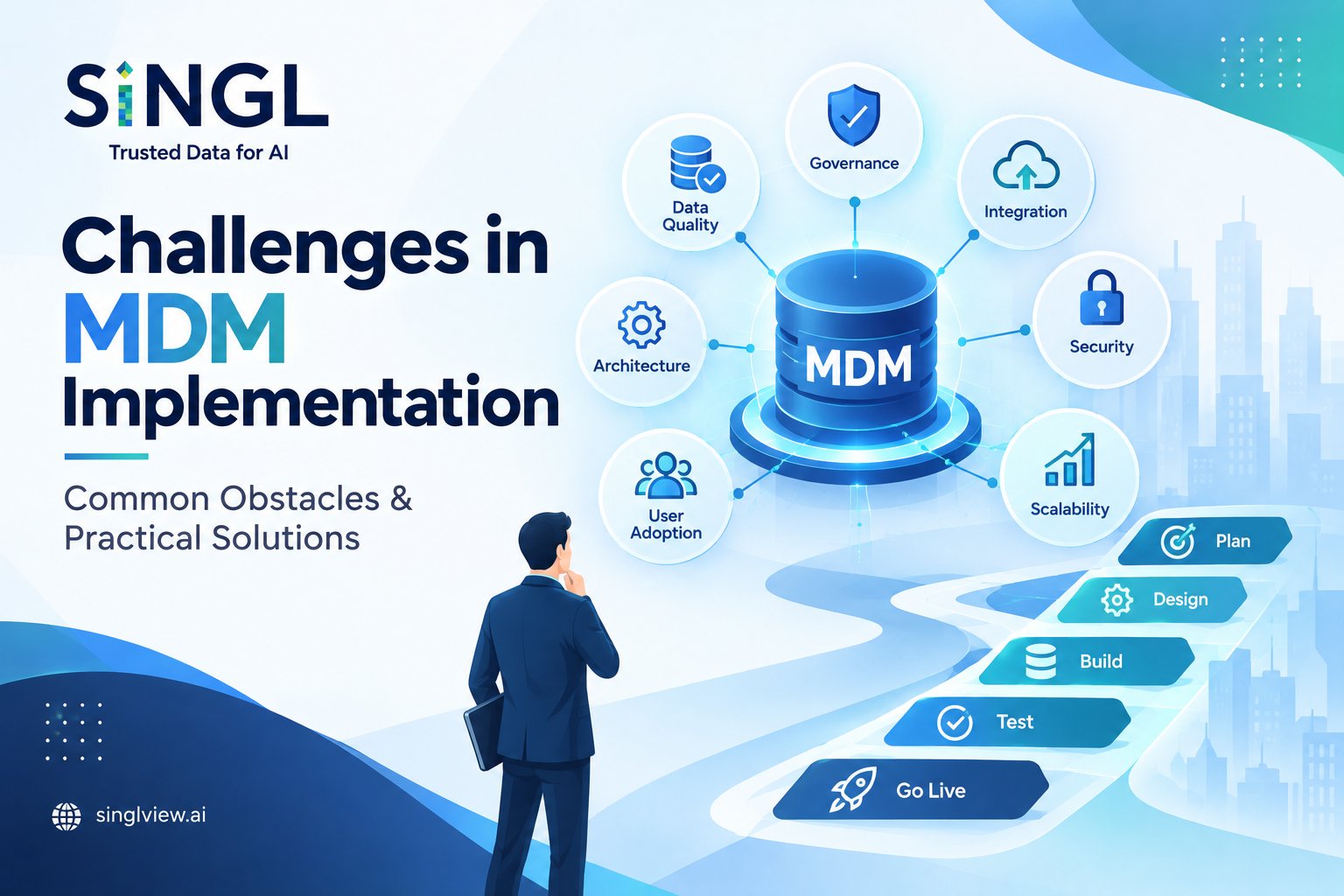
Master Data Management (MDM) helps organizations maintain accurate, consistent, and trusted information across business systems. However, implementing MDM can be complex because it involves more than technology. Organizations must address poor data quality, disconnected applications, unclear ownership, governance gaps, integration issues, and resistance to changing established processes.
This blog explores the major challenges in MDM implementation, why they occur, and practical strategies to overcome them. It also examines industry-specific considerations in financial services and healthcare, along with regional perspectives on data management initiatives in New York, Chicago, and Dallas.
1. Understanding the Main Challenges in MDM Implementation
MDM implementation brings together technology, business processes, and people. Challenges often arise when organizations underestimate the quality of their existing data, select an unsuitable architecture, or fail to establish clear responsibilities.
The following are the most common obstacles organizations should anticipate before starting an MDM initiative.
2. Poor Data Quality and Inconsistent Records
One of the biggest challenges in MDM implementation is dealing with unreliable source data. Organizations may store duplicate customer records, incomplete product details, outdated supplier information, or inconsistent naming conventions across multiple applications.
For example, a customer might appear under slightly different names in a CRM platform, billing system, and support application. These differences make it difficult to determine whether the records represent the same individual or separate entities.
If poor-quality data enters the MDM environment without adequate assessment and cleansing, the resulting master records may remain inaccurate.
How to overcome this challenge
Start with data profiling to identify duplicates, missing attributes, inconsistent formats, and invalid values. Establish common standards for important fields and define validation rules before migrating data.
Organizations should also assign responsibility for resolving data quality issues at their source. This prevents the same problems from repeatedly entering the MDM environment.
3. Data Silos and Integration Complexity
Many enterprises use separate systems for finance, sales, procurement, customer service, inventory, and operations. These systems may have different data formats, identifiers, update frequencies, and integration methods.
Connecting them to an MDM platform can be difficult, especially when legacy applications lack modern interfaces or contain undocumented business rules.
For example, a product may have one identifier in an ERP system and another in an e-commerce platform. The implementation team must determine how these identifiers relate and how changes should be shared between systems.
How to overcome this challenge
Create a detailed inventory of source and target systems. Document data ownership, source-to-target mappings, integration dependencies, and update requirements.
Choose appropriate integration methods, such as APIs, batch processing, or event-driven data exchange, based on business needs. Test error handling, synchronization, and data reconciliation before moving into production.
A phased integration strategy can reduce disruption and make it easier to identify issues early.
4. Unclear Data Ownership and Governance
MDM requires business teams to agree on who owns data, who can change it, and which rules determine whether a record is acceptable.
Without clear ownership, departments may follow different definitions and quality standards. A sales team might prioritize customer contact details, while finance focuses on billing information and compliance requirements.
When these teams do not coordinate, conflicting values and unresolved exceptions can continue even after an MDM platform is deployed.
How to overcome this challenge
Establish a governance framework before implementation begins. Define data owners, data stewards, approval responsibilities, data definitions, quality standards, and escalation procedures.
Document which systems are authoritative for particular attributes and how conflicts should be resolved. Governance policies should be incorporated into daily workflows rather than treated as separate documentation.
A clear accountability model helps ensure that data quality remains a shared business responsibility.
5. Choosing the Wrong MDM Architecture
MDM platforms support different implementation styles, including registry, consolidation, coexistence, and centralized approaches. Each style handles data storage, ownership, and synchronization differently.
Selecting an unsuitable architecture can create unnecessary integration work, increase costs, or make governance difficult to enforce.
For instance, a business that only needs consolidated records for analytics may not initially require a centralized model in which all master data changes are managed through one hub. Conversely, an organization requiring strict control over record creation and approval may need stronger centralized governance capabilities.
How to overcome this challenge
Evaluate the architecture against business objectives, data complexity, governance maturity, integration requirements, and operational constraints.
Consider how data will be created, updated, approved, and distributed. Validate important requirements through a proof of concept before committing to a full rollout.
Architecture decisions should support the current use case while allowing the organization to expand to additional domains over time.
6. High Implementation Costs and Budget Constraints
MDM implementation costs extend beyond software licensing. Projects may require data cleansing, platform configuration, integration development, infrastructure, consulting, training, migration, testing, and ongoing support.
Costs can rise when organizations underestimate the condition of their source data or attempt to implement too many domains simultaneously.
A lack of clearly defined business outcomes can also make it difficult to demonstrate the value of the investment.
How to overcome this challenge
Build a realistic business case that includes both initial and ongoing costs. Identify the highest-value use case and prioritize the capabilities needed to address it.
Begin with a focused pilot, measure the results, and use the findings to guide subsequent phases. Track improvements such as reduced duplicate records, lower manual reconciliation effort, better data completeness, and faster issue resolution.
This approach helps organizations demonstrate value before committing to broader expansion.
7. Resistance to Change and Low User Adoption
MDM often changes established ways of creating, updating, approving, and sharing data. Employees who are accustomed to spreadsheets or department-specific systems may view new processes as additional work.
If users do not understand the purpose of MDM or find its workflows difficult to follow, they may continue using unofficial records and workarounds.
As a result, the organization may have a functioning platform but fail to achieve consistent adoption.
How to overcome this challenge
Involve business users early in the implementation. Explain how MDM addresses existing problems and demonstrate the benefits for each team.
Provide role-specific training for data stewards, business users, administrators, and technical teams. Collect feedback during the pilot and make workflows practical for everyday operations.
Executive sponsorship and clear communication can help reinforce the importance of using approved master data processes.
8. Complex Matching, Merging, and Golden Record Creation
Creating a trusted master record is not simply a matter of combining duplicate entries. Organizations must determine which records refer to the same entity and which values should be retained when sources disagree.
For example, two customer records may share a telephone number but belong to different family members. Automatically merging them based on one matching attribute could create an incorrect record.
Similarly, one source may contain the most recent address while another contains a more complete legal name.
How to overcome this challenge
Develop matching rules that use appropriate identifiers and combinations of attributes. Establish survivorship rules that define how the preferred value is selected for each field.
Test these rules against representative data, including edge cases and known duplicates. Use confidence thresholds and human review for uncertain matches, especially in sensitive domains.
Maintain traceability so teams can understand where master record values originated and why particular decisions were made.
9. Legacy Systems and Technical Limitations
Older enterprise applications may use outdated data structures, limited integration capabilities, or undocumented dependencies. These limitations can make it difficult to connect the systems to a modern MDM platform.
Legacy applications may also contain business logic that is not documented elsewhere. Changing data flows without understanding those dependencies can disrupt existing operations.
How to overcome this challenge
Assess legacy systems before designing the integration architecture. Document their interfaces, data structures, dependencies, and operational constraints.
Where direct integration is impractical, consider controlled staging layers, middleware, or incremental modernization. Test changes in a non-production environment and establish rollback procedures for critical deployments.
The objective is to introduce trusted master data without unnecessarily disrupting systems that the business still depends on.
10. Security, Privacy, and Regulatory Requirements
Master data can contain sensitive customer, employee, financial, or healthcare information. Centralizing or sharing this data introduces important questions about access, retention, privacy, and auditability.
Organizations must ensure that information is available to authorized users without exposing sensitive fields to people or systems that do not need them.
Requirements can vary significantly by industry, jurisdiction, and data type.
How to overcome this challenge
Include security and privacy requirements in the initial architecture and governance design. Apply role-based access controls, appropriate encryption, audit logging, retention policies, and data minimization.
Review applicable regulations and internal policies with legal, compliance, privacy, and security teams. Test access controls and document how sensitive information moves between systems.
A well-governed MDM environment should improve data reliability without weakening privacy or security protections.
11. Performance, Scalability, and Real-Time Data Needs
As an organization adds data domains and source systems, the MDM environment may need to process larger volumes of records, more frequent updates, and increasingly complex matching rules.
A design that performs well in a small pilot may struggle under production workloads. Batch processing may also be unsuitable for use cases that require timely updates across operational systems.
How to overcome this challenge
Estimate current and future data volumes, transaction rates, concurrency, and response-time requirements. Conduct performance and load testing using realistic datasets.
Select an architecture and integration strategy that matches business latency needs. Monitor processing times, failed jobs, resource utilization, and data synchronization delays after deployment.
Scalability should be considered during design rather than addressed only after performance problems appear.
12. Measuring ROI and Demonstrating Business Value
MDM programs can be difficult to evaluate when success is defined only by technical milestones, such as platform deployment or data migration completion.
Business leaders need evidence that the program is improving data reliability, reducing manual work, supporting better decisions, or reducing operational risk.
How to overcome this challenge
Define key performance indicators before implementation. Useful measures include duplicate record rates, data completeness, matching accuracy, data issue resolution time, integration success rates, and manual reconciliation effort.
Establish a baseline before deployment and compare results at regular intervals. Combine technical metrics with business outcomes, such as improved onboarding processes or more consistent reporting.
Clear measurement makes it easier to identify gaps, demonstrate value, and prioritize future improvements.
13. Industry-Specific Challenges in MDM Implementation
Although the core principles of MDM remain similar, different industries face distinct data requirements and implementation risks.
Financial Services MDM
Financial institutions manage customer, account, counterparty, product, and reference data across numerous operational systems. Inconsistent information can complicate customer onboarding, risk analysis, reporting, and compliance processes.
Financial Services MDM initiatives may face challenges involving complex entity relationships, duplicate customer records, changing identifiers, audit requirements, and data ownership across departments.
To address these issues, institutions should define authoritative sources, establish clear governance rules, validate matching logic, and maintain appropriate audit trails. Security and regulatory requirements should be incorporated into the design from the beginning.
Healthcare MDM
Healthcare organizations manage patient, provider, facility, and healthcare product information across clinical and administrative systems. Data inconsistencies can complicate record matching, provider directories, reporting, and information exchange.
Healthcare MDM implementation can be particularly challenging when organizations operate multiple electronic health record systems or inherit different data structures following mergers and acquisitions.
Solutions should emphasize careful identity matching, privacy safeguards, standardized data definitions, and appropriate review of uncertain records. Healthcare organizations should also establish clear ownership and ensure that relevant regulatory requirements are addressed.
Retail and Manufacturing
Retailers and manufacturers frequently manage product, supplier, material, and location data across ERP, inventory, procurement, and commerce applications.
Common difficulties include inconsistent product attributes, duplicate supplier records, incompatible identifiers, and complex hierarchies.
Organizations can reduce these problems through standardized data models, agreed validation rules, coordinated stewardship, and carefully tested integrations.
14. Regional Considerations for MDM Initiatives
Organizations evaluating implementation strategies or external expertise should focus on business requirements, industry experience, technical capabilities, and long-term support. Location can influence industry priorities, but it does not guarantee that a provider is suitable.
Master Data Management in New York
Organizations researching Master Data Management in New York may include financial services firms, healthcare organizations, retailers, and technology companies.
Financial data governance, customer identity resolution, reference data consistency, and auditability may be important considerations for some businesses. Implementation teams should understand the relevant industry requirements and the organization's existing applications.
Master Data Management in Chicago
Businesses exploring Master Data Management in Chicago may operate in manufacturing, logistics, retail, financial services, and professional services.
Their MDM programs may need to address product data standardization, supplier information, material records, and integration with ERP and operational systems. Clear data ownership and a phased rollout can help reduce disruption.
Master Data Management in Dallas
Organizations researching Master Data Management in Dallas may include companies across technology, telecommunications, healthcare, and financial services.
Potential implementation priorities include cloud integration, customer data consolidation, data quality monitoring, and scalable governance workflows. Organizations should assess potential partners on demonstrated platform experience, delivery methodology, and ongoing support capabilities.
Across all three markets, the best implementation approach depends on the organization's specific requirements rather than the city alone.
15. Best Practices for Overcoming MDM Implementation Challenges
A structured implementation strategy can reduce avoidable risks and improve the likelihood of long-term success.
Start with a clear business case: Identify a high-value problem and define measurable objectives.
Assess data quality early: Profile existing records before finalizing migration and matching plans.
Establish governance from the beginning: Assign owners, stewards, and decision-making responsibilities.
Use a phased approach: Start with one manageable data domain and expand as the program matures.
Choose architecture carefully: Align the implementation style with business requirements and governance readiness.
Involve business stakeholders: Ensure data definitions and workflows reflect operational realities.
Plan for security and privacy: Address sensitive information, access control, and compliance requirements.
Test thoroughly: Validate matching accuracy, integration reliability, scalability, and exception handling.
Invest in training: Help users understand the new processes and their responsibilities.
Monitor continuously: Review quality metrics and business outcomes after go-live.
MDM should be treated as an ongoing organizational capability, not a one-time technology deployment. Continued stewardship and process improvement are essential for maintaining trusted data as systems and business requirements change.
16. How Master Data Management Solutions Can Help
Appropriate Master Data Management Solutions can provide capabilities for data standardization, matching and merging, golden record creation, governance workflows, and integration across enterprise applications.
However, software alone cannot resolve every implementation challenge. Organizations still need clear objectives, suitable architecture, reliable source data, accountable data owners, and business processes that support ongoing maintenance.
When evaluating solutions, assess their support for the required data domains, integration patterns, quality rules, access controls, scalability, and monitoring capabilities. A proof of concept can help confirm whether the selected platform meets the organization's most important needs.
A well-planned solution should fit into the wider enterprise data architecture and support the organization's long-term governance and analytics objectives.
Explore SiNGL Master Data Management Solutions to learn more about building a consistent and trusted foundation for enterprise data.
Conclusion
The challenges in MDM implementation extend across data quality, integration, governance, architecture, costs, security, user adoption, and long-term maintenance. These challenges are interconnected: poor governance can undermine data quality, weak integration can create synchronization problems, and low adoption can prevent the organization from realizing the value of its investment.
Organizations can address these risks by defining clear business objectives, prioritizing data domains, assessing existing systems, establishing governance, selecting an appropriate architecture, and implementing the solution in phases.
They should also measure success through meaningful business and technical indicators and continue monitoring data quality after deployment.
With the right combination of planning, technology, ownership, and continuous improvement, MDM can help organizations create more reliable information, improve operational consistency, and build a stronger foundation for analytics and AI initiatives.