
How to Implement MDM: A Step-by-Step Guide to Master Data Management
Learn how to implement Master Data Management (MDM) with a step-by-step guide covering data quality, governance, architecture, platform selection, integration, and implementation best practices.
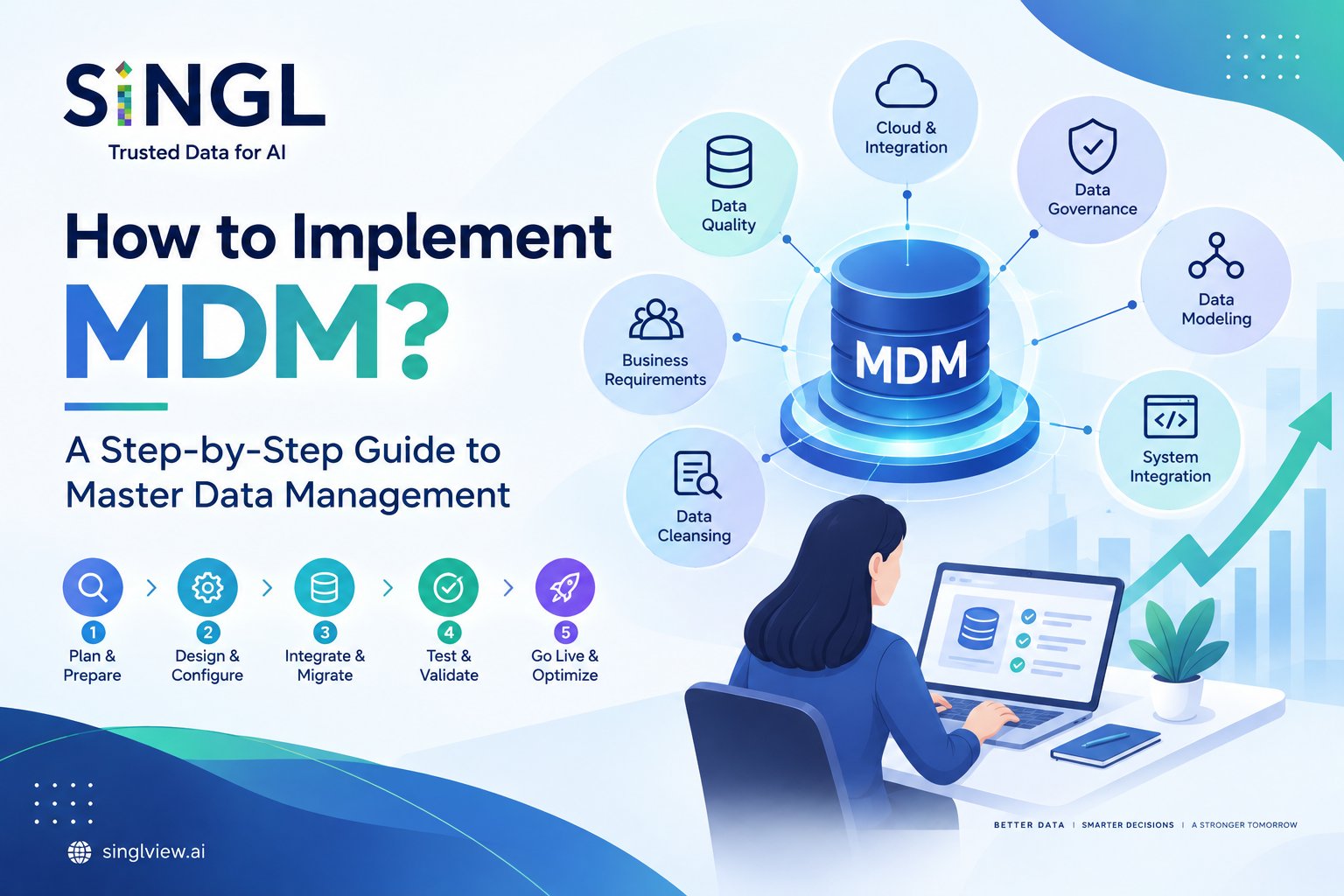
Every organization relies on data to manage customers, products, suppliers, employees, and business operations. However, when information is scattered across multiple applications, maintaining accuracy and consistency becomes challenging. Duplicate customer profiles, outdated supplier details, inconsistent product descriptions, and conflicting reports can affect operational efficiency and business decisions.
Master Data Management (MDM) helps address these challenges by establishing consistent, trusted records for critical business entities. However, successful MDM implementation requires more than installing a platform. It involves business planning, data assessment, governance, data integration, technology configuration, and continuous monitoring.
Organizations that approach implementation strategically can reduce data inconsistencies, improve reporting, support regulatory requirements, and create a reliable foundation for analytics and artificial intelligence.
This guide explains how to implement MDM step by step, the technologies and governance practices involved, common implementation challenges, and the best practices organizations can follow to achieve long-term value.
What Is MDM Implementation?
MDM implementation is the process of designing, deploying, and maintaining a framework that creates consistent and reliable master data across an organization.
Master data refers to the core information used by multiple business processes and systems. Common examples include customer records, product information, supplier details, employee profiles, and business locations.
Consider a retail company that stores customer information in its website, mobile application, customer relationship management system, and billing software. Each system may contain different versions of the same customer's details. An MDM implementation helps identify matching records, resolve inconsistencies, establish trusted values, and make reliable information available to authorized systems.
A typical implementation combines several capabilities:
Data profiling and cleansing to identify data quality problems.
Data modeling to establish consistent structures and definitions.
Matching and merging to identify duplicate records.
Golden record management to determine trusted values.
Data governance to define ownership, responsibilities, and policies.
Data integration to connect source and consuming systems.
Monitoring to maintain data quality over time.
The implementation approach depends on an organization's existing technology landscape, data maturity, business priorities, and governance requirements. Informatica's MDM implementation guide also emphasizes aligning the implementation approach with business objectives, architecture, and governance readiness.
Why Is MDM Implementation Important?
Before planning an implementation, organizations should understand the business problems they want to solve. A clear purpose helps teams choose the right data domains, platform capabilities, and performance measures.
1. Improve Data Accuracy and Consistency
Organizations frequently maintain similar information in different applications. Over time, those records can become inconsistent because of manual entry, incomplete updates, and different validation rules.
MDM introduces common standards and processes for maintaining critical data. For example, a company can establish consistent product identifiers and descriptions across procurement, inventory, sales, and reporting systems.
This reduces the need for repeated manual corrections and helps business teams work with more dependable information.
2. Create a Trusted View of Business Entities
A golden record is a consolidated master record created from relevant information across multiple sources. The process may involve matching duplicate records, comparing attribute values, and applying agreed rules to select trusted information.
For example, a customer record may contain an address from a CRM system and an updated contact number from a service application. MDM rules determine how these values should be evaluated and maintained.
A trusted record does not necessarily mean every application must store an identical copy. Instead, the architecture should define where authoritative information resides and how it is shared.
3. Strengthen Governance and Compliance
Master data often supports processes involving financial reporting, customer onboarding, procurement, and sensitive personal information. Inconsistent records and unclear ownership can make these processes difficult to manage.
MDM implementation establishes data owners, stewards, validation rules, approval workflows, and access controls. These measures help organizations maintain accountability and support applicable regulatory and internal policy requirements.
4. Support Analytics and AI Initiatives
Analytics and AI systems depend on reliable information. When customer, product, or supplier data contains duplicates and conflicting values, the resulting analysis may be misleading.
A well-designed MDM program improves the consistency and traceability of important data used by reporting systems, machine learning applications, and AI-enabled workflows.
However, MDM alone does not guarantee accurate AI outcomes. Organizations must also consider data relevance, privacy, access permissions, model quality, and the intended use of the information.
How to Implement MDM: A Step-by-Step Process
A successful implementation follows a structured roadmap. The steps below provide a practical approach that organizations can adapt to their size, industry, and technology environment.
Step 1: Define Business Objectives and Requirements
Begin by identifying why the organization needs MDM. Avoid starting with a software purchase before understanding the business problem.
Possible objectives include reducing duplicate customer records, improving supplier onboarding, standardizing product information, improving reporting consistency, or establishing stronger data governance.
Work with business leaders, IT teams, data owners, and operational stakeholders to document the current problems and desired outcomes.
For example, a manufacturer may want to standardize product information across procurement, production, and distribution. A financial institution may prioritize customer identity consistency and reference data governance.
Key activities:
Identify the business problems MDM should address.
Define measurable objectives and expected outcomes.
Identify stakeholders and decision-makers.
Establish project scope, budget, and initial timeline.
Prioritize the first data domain and business use case.
Expected outcome: A clear business case and an agreed implementation scope.
Step 2: Identify and Prioritize Master Data Domains
Master data can cover several business entities, but implementing every domain at once may increase complexity and delay measurable results.
Organizations should identify the domains most relevant to their objectives and begin with a manageable scope.
Select the first domain based on business value, data availability, complexity, and stakeholder readiness.
For instance, an organization experiencing frequent duplicate supplier records might begin with supplier master data. A retailer with inconsistent product listings might prioritize product data instead.
Expected outcome: A prioritized domain roadmap with clear boundaries and measurable goals.
Step 3: Assess Existing Data and Source Systems
Once the scope is defined, examine where the relevant data currently resides. Most organizations store information across ERP systems, CRM platforms, spreadsheets, operational databases, cloud applications, and data warehouses.
The assessment should document each source, the information it contains, its business owner, update frequency, data format, and relationship with other systems.
Data profiling helps identify missing fields, duplicate records, invalid values, inconsistent formats, and outdated information.
For example, customer addresses may use different abbreviations, telephone numbers may follow inconsistent formats, and product identifiers may not match across applications.
Do not assume that every source is equally reliable. Evaluate which systems are authoritative for particular attributes and identify where business rules are needed to resolve conflicts.
Key activities:
Inventory source systems and data owners.
Profile data for completeness, uniqueness, accuracy, and consistency.
Identify duplicate records and conflicting values.
Map important fields across systems.
Document security, privacy, and retention requirements.
Expected outcome: A source-system inventory, data quality baseline, and list of remediation priorities.
Step 4: Establish Data Governance and Ownership
Data governance should be designed early rather than added after the technology has been deployed. Without clear accountability, data quality may deteriorate even when the MDM platform is functioning correctly.
Define who can create, update, approve, and retire master records. Establish the responsibilities of data owners, data stewards, IT teams, and governance committees.
Data owners are accountable for decisions about their data domains. Data stewards help maintain standards, investigate exceptions, and coordinate corrections. Technical teams implement the required platform rules and integration processes.
Governance should also specify data definitions, quality thresholds, approval processes, access permissions, and escalation procedures.
For example, a supplier record may require mandatory tax or business identifiers before it can be approved for use. The responsible team should know how to handle missing information and who can authorize exceptions.
Expected outcome: A documented governance framework with clear ownership, standards, workflows, and accountability.
Step 5: Select the Right MDM Implementation Architecture
The architecture determines how the MDM environment interacts with source systems and how trusted data is created and distributed. The right approach depends on the organization's operational needs and existing systems.
Common implementation styles include:
Registry style: Maintains links or references to source records and provides a consolidated view without necessarily centralizing all master data.
Consolidation style: Collects master data from multiple systems, creates consolidated records, and supports analytics and reporting.
Coexistence style: Maintains master data across connected systems while synchronizing agreed updates between them.
Centralized or transactional style: Uses a central MDM environment to manage master data creation and changes, with approved information distributed to other systems.
These styles represent different architectural patterns. Actual platform capabilities and terminology vary by vendor, and organizations may combine or evolve approaches over time.
When evaluating architecture, consider data ownership, latency requirements, transaction volumes, integration complexity, governance maturity, scalability, and the need to write data back to source systems.
Expected outcome: An architecture that supports the intended business processes without adding unnecessary complexity.
Step 6: Choose an Appropriate MDM Platform
After defining requirements and architecture, evaluate platforms that can support the selected domains and implementation style.
Compare solutions based on their functional capabilities, integration options, security controls, governance workflows, scalability, usability, implementation effort, and total cost of ownership.
Depending on the organization, the evaluation may include Informatica MDM, SAP Master Data Governance, and other enterprise MDM platforms.
The decision should reflect both current needs and the organization's future roadmap. For example, a business planning to introduce additional domains should assess how easily the platform can accommodate customer, product, supplier, and location data.
A proof of concept can help validate critical requirements before committing to a larger implementation.
Expected outcome: A selected platform and implementation plan aligned with business and technical requirements.
Step 7: Design the Data Model and Quality Rules
The data model defines how master records are structured, which attributes are required, how entities relate to each other, and which identifiers are used to distinguish records.
For a customer domain, the model might include customer ID, legal name, contact details, addresses, customer type, and status. Different industries may require additional fields and relationships.
Next, define data quality and mastering rules.
Important rules include:
Validation: Check required fields, formats, and permitted values.
Standardization: Normalize names, addresses, dates, and identifiers.
Matching: Identify records that may represent the same entity.
Merging: Consolidate records that meet the agreed criteria.
Survivorship: Determine which source value should be retained for each attribute.
Hierarchy management: Define relationships between parent and child entities.
Matching and merging rules should be tested carefully. Overly strict rules may leave duplicates unresolved, while overly broad rules may incorrectly combine different entities.
Expected outcome: An approved data model and tested set of data quality and mastering rules.
Step 8: Cleanse, Migrate, and Integrate Master Data
After defining the data model and quality rules, prepare the existing records for the MDM environment.
Data cleansing may involve correcting formats, standardizing values, filling required fields where valid information is available, resolving duplicates, and addressing conflicting records.
The migration process should preserve necessary identifiers, relationships, and audit information. Before production migration, test the process using representative data and reconcile the results against the source systems.
Integration connects the MDM environment to the systems that create, consume, or update master data. Depending on the architecture, this may involve batch processing, APIs, messaging, or event-driven synchronization.
Establish error handling and monitoring so failed records, rejected updates, and synchronization issues can be investigated.
Expected outcome: Cleaned master data, validated migration results, and reliable integration flows.
Step 9: Test the Solution and Run a Pilot
Before a full rollout, test whether the solution meets its business and technical requirements.
Testing should cover data quality, matching accuracy, survivorship rules, access permissions, workflow approvals, integration reliability, performance, and exception handling.
A pilot involving one business unit, source system, or data domain helps identify practical issues before the implementation expands.
Involve business users and data stewards in validating the results. Technical testing alone may not reveal whether the golden records and approval processes reflect real business needs.
Document issues, assign responsibility, resolve critical defects, and obtain approval against predefined acceptance criteria.
Expected outcome: A validated implementation that is ready for controlled production deployment.
Step 10: Deploy, Train Users, and Monitor Performance
A production launch should include a rollout plan, user training, support arrangements, and clear escalation procedures.
Business users need to understand how to request record changes, review exceptions, and follow governance policies. Data stewards should know how to resolve quality issues and manage approval workflows.
After deployment, monitor data quality, matching performance, integration failures, user adoption, and business outcomes. Review the results regularly and update rules as requirements change.
MDM is an ongoing capability, not a one-time software installation. New systems, acquisitions, products, regulations, and business processes may require changes to the data model and governance framework.
Expected outcome: A maintained MDM environment with defined operational ownership and continuous improvement processes.
Key Components of a Successful MDM Implementation
An implementation is more likely to deliver sustainable value when its major components work together.
These capabilities should be planned as part of one coordinated implementation rather than treated as isolated activities.
How MDM Implementation Supports Different Industries
MDM implementation practices are broadly similar across industries, but data domains, quality rules, and governance requirements vary according to business needs.
Financial Services MDM
Financial institutions manage customer, account, product, counterparty, and reference data across numerous applications. Inconsistent information can complicate reporting, customer onboarding, risk processes, and regulatory operations.
A Financial Services MDM implementation may begin by consolidating customer or party records, standardizing identifiers, establishing data ownership, and defining rules for resolving conflicts between systems.
Implementation teams must consider applicable privacy and regulatory requirements, security controls, auditability, and integration with existing banking or financial applications. The exact scope depends on the institution and the business processes being supported.
Healthcare MDM
Healthcare organizations manage information about patients, providers, facilities, medical services, and products. Inconsistent records can create administrative difficulties and make it harder for systems to exchange reliable information.
Healthcare MDM may focus on provider directories, patient identity matching, facility data, and standardized healthcare reference information. Implementation requires careful attention to privacy, access control, identity matching accuracy, and applicable healthcare data regulations.
Because incorrect record matching can have serious consequences, healthcare organizations should validate matching rules and establish appropriate review procedures for uncertain cases.
Retail and Manufacturing
Retailers and manufacturers often need consistent product, supplier, material, and location information across ERP, procurement, inventory, sales, and commerce systems.
An MDM implementation can standardize product attributes, establish common identifiers, reduce duplicate supplier records, and support consistent product hierarchies. These improvements can help operational teams work with more reliable information across business functions.
Technology and Professional Services
Technology companies and consulting organizations may implement MDM to unify customer records, manage supplier information, support mergers and acquisitions, or improve the data foundation for analytics.
Their projects often involve multiple applications and teams, making integration planning, governance, and change management particularly important.
MDM Implementation Considerations Across Major US Cities
Organizations researching implementation services or data management expertise should evaluate providers based on industry knowledge, platform experience, governance capabilities, integration skills, and support requirements rather than location alone.
Master Data Management in New York
Organizations exploring Master Data Management in New York may include banks, insurance companies, healthcare providers, retailers, and technology businesses.
For financial services organizations, implementation priorities may include customer and counterparty data, reference data, data quality, and auditability. A suitable implementation partner should understand the relevant business processes and demonstrate experience with the organization's existing systems.
Master Data Management in Chicago
Businesses researching Master Data Management in Chicago may operate across manufacturing, logistics, retail, financial services, and professional services.
Their MDM initiatives may focus on product data, supplier records, material masters, and cross-system integration. A practical implementation plan should account for ERP dependencies, source data quality, business ownership, and the needs of operational users.
Master Data Management in Dallas
Organizations looking into Master Data Management in Dallas may include companies in technology, telecommunications, financial services, healthcare, and business services.
Common implementation considerations include cloud integration, customer data consolidation, governance workflows, and scalable data architecture. Organizations should assess prospective partners according to their technical capabilities, implementation methodology, industry experience, and ongoing support model.
In all three markets, evaluate the actual capabilities and references of any provider under consideration. City-level presence alone does not establish implementation quality or suitability.
Common MDM Implementation Challenges and How to Overcome Them
Even a carefully planned project can encounter obstacles. Identifying risks early helps organizations control costs and avoid delays.
Poor Source Data Quality
Existing data may contain duplicates, missing attributes, inconsistent formats, and outdated information. These issues can affect matching accuracy and reduce trust in the resulting master records.
How to address it: Profile data before migration, prioritize high-impact defects, establish validation rules, and assign responsibility for resolving recurring issues.
Unclear Data Ownership
If no one is responsible for data quality or approving changes, exceptions can remain unresolved and inconsistent information can reappear.
How to address it: Assign data owners and stewards, document responsibilities, and create workflows for reviewing and resolving issues.
Excessive Implementation Scope
Trying to manage every data domain and source system in the first release can increase project complexity and delay benefits.
How to address it: Start with a high-value domain, validate the approach through a pilot, and expand using lessons learned.
Integration Complexity
Legacy applications, different data formats, and inconsistent identifiers can make integration difficult.
How to address it: Document source-to-target mappings, test interfaces early, define error-handling procedures, and monitor synchronization after deployment.
Low User Adoption
Users may continue relying on spreadsheets or existing applications if new workflows are difficult to understand or do not fit business processes.
How to address it: Involve users early, provide practical training, communicate the benefits, and incorporate feedback into the implementation.
Weak Long-Term Maintenance
Data quality may decline after launch if rules are not monitored and business ownership is unclear.
How to address it: Establish ongoing monitoring, periodic reviews, stewardship processes, and a clear approach to updating rules as requirements evolve.
Best Practices for Successful MDM Implementation
Organizations can improve implementation outcomes by following a few core principles.
Start with business value. Select a problem that matters to the organization and define how success will be measured.
Implement in phases. Use a focused first release to test the approach before expanding to additional domains.
Build governance early. Establish ownership, policies, and workflows before the production launch.
Measure data quality. Set a baseline and track improvements in completeness, accuracy, consistency, and duplication.
Involve business and technical teams. Ensure that the data model and rules reflect operational requirements.
Design for integration. Plan how master data will be created, updated, and distributed across connected systems.
Protect sensitive data. Apply suitable access controls, security safeguards, and privacy requirements.
Plan for continuous improvement. Review performance and adjust data rules as business needs change.
These practices help position MDM as a long-term business capability rather than a standalone IT project.
How to Measure MDM Implementation Success
An MDM program should be evaluated through measurable business and technical indicators. Establish baseline values before deployment so that improvements can be assessed fairly.
Targets should reflect the business context, data domain, and risk level. For example, a healthcare identity-matching process may require different validation and review thresholds from a product catalog.
Organizations should also track business outcomes such as reduced manual reconciliation, improved reporting consistency, and fewer data-related operational errors. These measures help demonstrate whether the implementation is delivering practical value.
The Role of Master Data Management Solutions in Modern Enterprises
Choosing suitable Master Data Management Solutions is an important part of implementation, but technology should support a clearly defined strategy.
A suitable solution can help organizations manage data models, standardize records, identify duplicates, apply matching and survivorship rules, govern changes, and distribute trusted information across connected applications.
When evaluating solutions, consider support for the required data domains, integration patterns, governance workflows, security, scalability, monitoring, and future expansion. A proof of concept can help validate the most important requirements before a full rollout.
Organizations should also assess how the MDM platform fits into their wider data architecture, including data quality tools, data catalogs, analytics platforms, and cloud services.
Explore SiNGL Master Data Management Solutions to learn more about building a consistent and trusted foundation for enterprise master data.
Conclusion
Implementing MDM is a structured process that combines business objectives, data quality, governance, architecture, technology, integration, and continuous improvement.
Organizations should begin by defining their business goals, prioritizing the right data domains, assessing existing systems, and assigning clear ownership. They can then select an appropriate architecture and platform, establish data models and quality rules, integrate and test their data, and roll out the solution in manageable phases.
The work does not end at go-live. Ongoing monitoring, user adoption, governance, and quality improvement are essential for maintaining trusted master data as business requirements evolve.
With a practical implementation roadmap and measurable goals, organizations can make their data more consistent, support better decisions, and build a stronger foundation for analytics and AI initiatives.