Skills Required for MDM: A Complete Guide to Master Data Management Skills
Discover the essential skills required for MDM, including data quality, SQL, data modeling, integration, governance, MDM platforms, and business domain knowledge.
Master Data Management (MDM) has become an important capability for organizations dealing with large volumes of customer, product, supplier, financial, and location data. As businesses connect more applications, cloud platforms, analytics environments, and AI systems, they need professionals who can make critical data accurate, consistent, governed, and usable across the enterprise.
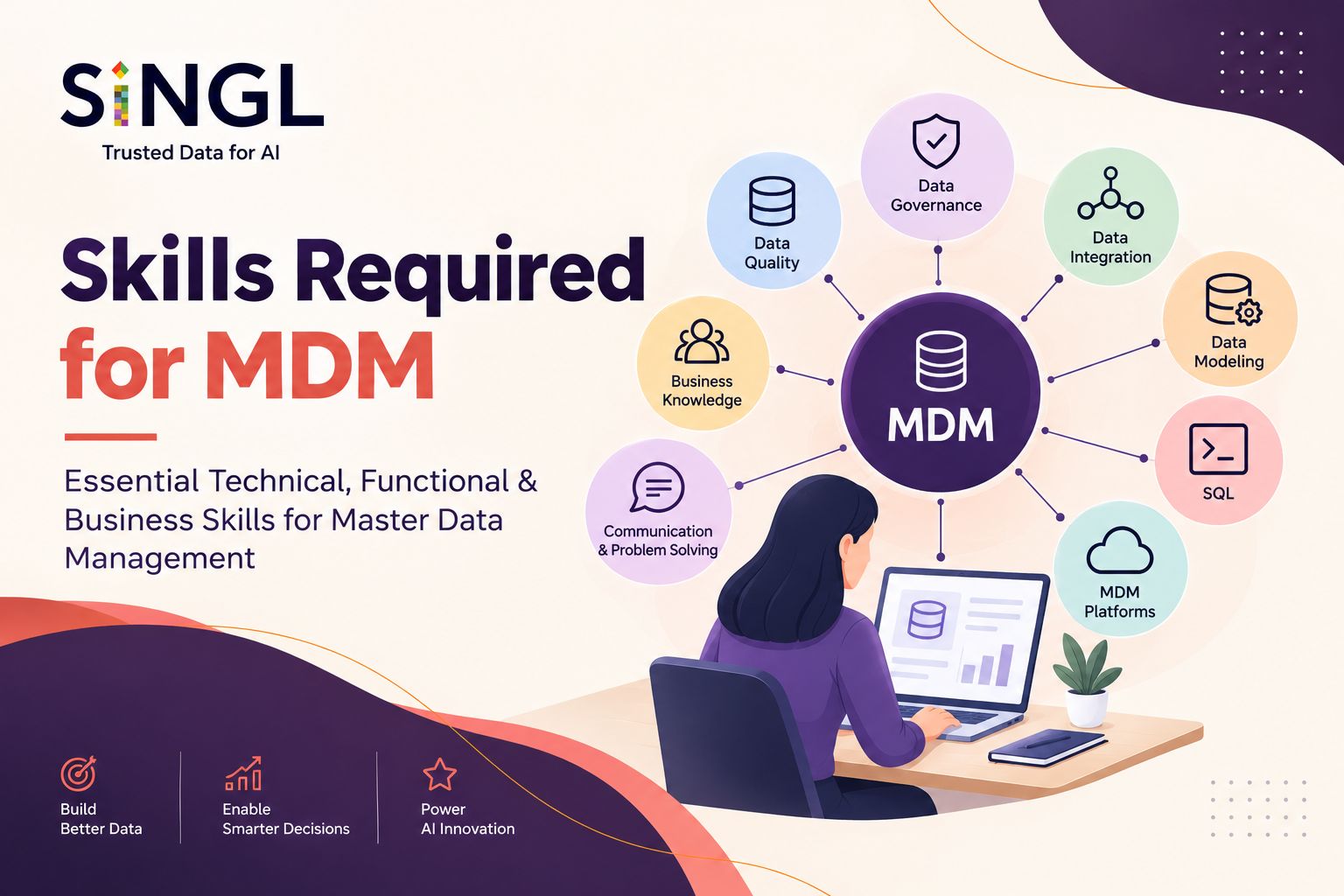
An MDM professional therefore needs more than knowledge of a specific MDM platform. The role combines data management, data quality, governance, integration, business analysis, technology, and problem-solving skills.
Modern MDM platforms bring together activities such as data integration, reconciliation, enrichment, matching, deduplication, governance, and creation of trusted master records.
This guide explains the key skills required for Master Data Management, the technical and functional knowledge professionals should develop, and how these skills apply across industries.
What Is Master Data Management?
Master Data Management is a discipline used to create and maintain reliable, consistent, and governed records for critical business entities such as customers, products, suppliers, locations, and financial information.
For example, a company may have the same customer recorded differently in its CRM, ERP, billing platform, e-commerce system, and marketing database. MDM helps identify those records, apply data quality and matching rules, and create a trusted master representation.
This trusted record is often called a golden record or a single version of trusted information.
Because MDM operates across business systems, professionals working in this field need a combination of technical and business-oriented capabilities.
10 Essential Skills Required for MDM
1. Understanding of Master Data Concepts
The first skill required for MDM is a strong understanding of master data itself.
Professionals should know the difference between master data, transactional data, and reference data. They should also understand common master data domains such as:
Customer
Product
Supplier
Employee
Location
Financial data
Asset data
Reference data
Understanding these domains helps an MDM professional identify what information needs to be mastered and how that information should be structured.
For example, customer master data may include names, addresses, contact information, identifiers, relationships, and customer classifications. Product master data may contain product descriptions, categories, specifications, units, and organizational relationships.
A strong foundation in these concepts makes it easier to design appropriate data models and governance processes.
2. Data Quality Management
Data quality is one of the most important skills in MDM.
Master data cannot become trustworthy if the underlying records are incomplete, duplicated, outdated, inconsistent, or incorrectly formatted. MDM professionals therefore need to understand common data quality dimensions such as:
Accuracy
Completeness
Consistency
Uniqueness
Validity
Timeliness
They should also know how to identify and resolve common problems such as duplicate customer records, invalid addresses, missing product attributes, inconsistent naming conventions, and incorrect codes.
Modern MDM practices combine profiling, cleansing, validation, standardization, matching, and monitoring to improve master data quality.
Why this skill matters
Poor-quality master data can affect reporting, customer experiences, operations, compliance, analytics, and AI initiatives. This makes data quality knowledge essential for anyone building or managing an MDM program.
3. Data Governance and Stewardship
MDM is not simply a technical exercise. It also requires clear ownership and governance.
An MDM professional should understand:
Data ownership
Data stewardship
Data policies
Data standards
Approval workflows
Data access
Data accountability
Auditability
Data lineage
Data governance establishes how master data should be created, changed, approved, maintained, and used across an organization.
For example, if a new supplier is added to an enterprise system, the organization may need validation, approval, duplicate checking, and authorization before the record becomes an approved master record.
Strong governance helps organizations maintain consistent rules across different systems and business units.
4. Data Integration Skills
MDM professionals frequently work with data coming from multiple enterprise applications.
That makes data integration an important skill.
Professionals should understand concepts such as:
ETL and ELT
APIs
Batch processing
Real-time integration
Change data capture
Data pipelines
Application integration
Data synchronization
Event-driven architecture
An MDM solution may need to receive information from CRM, ERP, e-commerce, supply-chain, finance, or other business applications and then distribute trusted master data to downstream systems.
Modern MDM integration architectures increasingly use API-first, event-driven, cloud-native, and hybrid approaches alongside traditional batch integration.
Understanding how data moves between systems helps MDM professionals design more reliable and scalable solutions.
5. SQL and Database Knowledge
SQL remains a valuable technical skill for MDM professionals.
A working knowledge of SQL helps with:
Querying records
Identifying duplicates
Comparing datasets
Validating transformations
Investigating data issues
Analyzing source-system data
Performing data quality checks
For example, an MDM developer may need to identify customers with the same email address, compare records across systems, or locate products with missing attributes.
Professionals do not necessarily need to become database administrators, but they should be comfortable working with relational databases, tables, joins, filters, aggregations, and basic data analysis.
6. Data Modeling Skills
Data modeling is another core MDM capability.
MDM professionals need to understand how business entities and their relationships should be represented.
For example:
Customer → Account → Address → Product → Transaction
An MDM data model defines the important attributes, relationships, hierarchies, identifiers, and business rules associated with these entities.
Good data modeling helps organizations establish a consistent structure for their master data.
Professionals working with multidomain MDM may also need to understand relationships between customers, suppliers, products, locations, and other domains. Current MDM training programs specifically cover areas such as data models, business rules, hierarchies, matching, merging, and data onboarding.
7. Matching, Merging, and Deduplication
One of the defining technical capabilities of MDM is identifying when multiple records represent the same real-world entity.
Consider:
ABC Technologies Pvt. Ltd.
ABC Technologies Private Limited
A.B.C. Technologies Pvt Ltd
These may represent the same organization.
An MDM system can use matching rules and other techniques to determine whether records should be considered duplicates. Once identified, records may be merged according to predefined survivorship rules.
Professionals should understand:
Exact matching
Fuzzy matching
Match thresholds
Duplicate detection
Survivorship rules
Merge strategies
Golden-record creation
This is especially important in large organizations where duplicate records can accumulate across multiple applications.
8. Knowledge of MDM Platforms
Practical platform knowledge is valuable for professionals entering the MDM field.
Depending on the organization, this may include technologies such as:
Informatica MDM
SAP Master Data Governance
Microsoft-based data management environments
IBM data management technologies
Cloud MDM platforms
Industry-specific MDM solutions
The exact platform is less important than understanding the underlying concepts.
For example, an MDM professional working with Informatica Multidomain MDM may need to understand data models, business rules, data onboarding, cleansing, matching, merging, hierarchies, workflows, and role-based access.
Learning one major platform can provide practical experience, while understanding MDM principles makes those skills transferable.
9. Business and Domain Knowledge
Technical skills alone are not enough.
MDM professionals need to understand how master data is used by the business.
For example, a financial services organization may have different requirements for customer and account information than a healthcare organization managing patients, providers, facilities, and clinical reference information.
Similarly, a retailer may prioritize product, supplier, store, and customer data.
This is why professionals working on Financial Services MDM should understand financial processes, customer relationships, regulatory requirements, and account structures.
In healthcare, Healthcare MDM can involve complex relationships between patients, providers, organizations, locations, and healthcare reference information.
Domain knowledge helps professionals translate business requirements into effective MDM models and governance rules.
10. Communication and Problem-Solving Skills
MDM professionals often work between technical teams and business stakeholders.
They may need to communicate with:
Data architects
Developers
Data stewards
Business analysts
Compliance teams
IT teams
Marketing teams
Finance teams
Operations teams
Senior management
For this reason, communication and problem-solving skills are extremely important.
An MDM professional may need to explain why two customer records should be merged, why a particular data rule is necessary, or why a business unit needs to change how it captures information.
The ability to convert technical data problems into understandable business issues is a valuable skill.
Technical Skills vs Functional Skills in MDM
MDM roles can require different combinations of technical and functional capabilities.
The exact combination depends on the role.
An MDM developer may focus more heavily on integration, SQL, configuration, data models, matching, and technical implementation.
An MDM business analyst may spend more time gathering requirements, defining business rules, documenting processes, and working with data owners.
A data steward may focus more heavily on data quality, governance, issue resolution, and maintaining business definitions.
Skills Required for MDM in Different Industries
The core MDM skills remain similar across industries, but the business context changes.
Financial Services
Financial institutions manage large volumes of customer, account, product, branch, organization, and reference data.
Professionals working in Financial Services MDM may need additional knowledge of:
Customer identity
Account relationships
Regulatory data
Financial products
Organizational hierarchies
Risk and compliance processes
The ability to combine data quality, governance, integration, and domain knowledge is particularly important in this environment.
Healthcare
Healthcare organizations can have complex relationships among patients, providers, facilities, payers, and healthcare organizations.
Professionals working with Healthcare MDM may therefore need knowledge of:
Patient data
Provider data
Healthcare organizations
Locations
Healthcare reference data
Privacy and access requirements
Data interoperability
Reference data can also be important in healthcare because standardized codes may be used to describe clinical or administrative information.
How MDM Skills Can Support Regional Data Management Needs
The demand for MDM skills can also be viewed through the needs of businesses operating in different markets.
Organizations looking for Master Data Management in New York may deal with complex financial, professional services, retail, healthcare, and technology environments. MDM professionals in these organizations need to understand both enterprise data practices and the specific requirements of their business domains.
Similarly, organizations implementing Master Data Management in Chicago may need professionals capable of connecting data across manufacturing, logistics, healthcare, financial, and commercial systems.
For organizations exploring Master Data Management in Dallas, MDM expertise can be relevant to enterprises managing customer, supplier, product, location, and operational data across distributed systems.
The important point is that location does not fundamentally change the principles of MDM. The required skills remain centered on data quality, governance, integration, modeling, business understanding, and technology, while the industry and organizational context determines how those skills are applied.
How AI Is Changing MDM Skills
AI is also changing the expectations around modern MDM.
Organizations increasingly need trusted master data to support analytics, automation, and AI applications. Inconsistent or duplicated master data can affect the quality of downstream insights and AI outputs.
As a result, MDM professionals can benefit from developing knowledge of:
AI-ready data
Machine learning concepts
Automated data quality
Intelligent matching
Metadata
Data lineage
Data observability
AI governance
Responsible data usage
This does not mean every MDM professional needs to become an AI engineer. Instead, they should understand how high-quality master data supports AI and how AI-based capabilities can assist data management processes.
What Skills Should Beginners Learn First?
Someone starting an MDM career does not need to master everything simultaneously.
A practical learning path can look like this:
Step 1: Learn Data Fundamentals
Start with databases, data types, data quality, master data, reference data, and transactional data.
Step 2: Learn SQL
Develop enough SQL knowledge to query, compare, validate, and investigate business data.
Step 3: Understand Data Integration
Learn ETL, APIs, data pipelines, batch processing, and real-time integration concepts.
Step 4: Learn Data Governance
Understand ownership, stewardship, business rules, policies, data quality standards, and approval processes.
Step 5: Learn Data Modeling
Practice designing entities, attributes, relationships, hierarchies, and identifiers.
Step 6: Learn Matching and Survivorship
Understand duplicate detection, matching logic, merging, golden records, and survivorship rules.
Step 7: Learn an MDM Platform
Choose a major MDM platform and gain hands-on experience with configuration, data onboarding, quality rules, matching, workflows, and integration.
Step 8: Develop Business Knowledge
Finally, learn how MDM is applied in industries such as financial services, healthcare, manufacturing, retail, and technology.
Why These Skills Matter for Modern MDM Solutions
Businesses rarely need MDM simply because they want another data platform. They need it because critical information is often fragmented across applications and business units.
Effective Master Data Management Solutions bring together capabilities such as data quality, integration, matching, governance, enrichment, and distribution to create trusted master data.
An MDM professional must therefore think beyond individual records and understand the entire data lifecycle—from where information originates to how it is validated, governed, mastered, and consumed.
Modern implementation guidance similarly emphasizes that MDM involves technology selection, data modeling, governance, integration architecture, and ongoing data stewardship rather than simply installing an MDM application.
Career Opportunities in MDM
The combination of technical and business skills creates several career paths within the MDM ecosystem.
Common roles include:
MDM Developer
MDM Consultant
MDM Architect
Data Architect
Data Governance Analyst
Data Steward
Data Quality Analyst
Business Data Analyst
MDM Administrator
Data Integration Developer
Enterprise Data Management Consultant
As professionals gain experience, they can move from platform-specific development toward architecture, governance, consulting, or enterprise data strategy.