SAP MDG vs Informatica MDM: Which Is Better for AI Use Cases?
Compare SAP MDG and Informatica MDM to understand which platform is better suited for AI use cases. Explore their key capabilities, data governance approaches, AI-powered matching, integration, scalability, and industry applications.
Introduction
Artificial Intelligence is changing how organizations manage enterprise information, automate business processes, and make data-driven decisions. From predictive analytics and machine learning to generative AI and intelligent agents, businesses are increasingly looking for ways to use their data more effectively.
However, AI applications are only as reliable as the information they use. When enterprise data is fragmented across multiple systems, contains duplicate records, or follows inconsistent standards, AI models and automated workflows may produce inaccurate results.
This makes Master Data Management (MDM) an important part of an organization's AI strategy. MDM helps establish consistent, trusted records for critical business entities such as customers, products, suppliers, employees, and financial information.
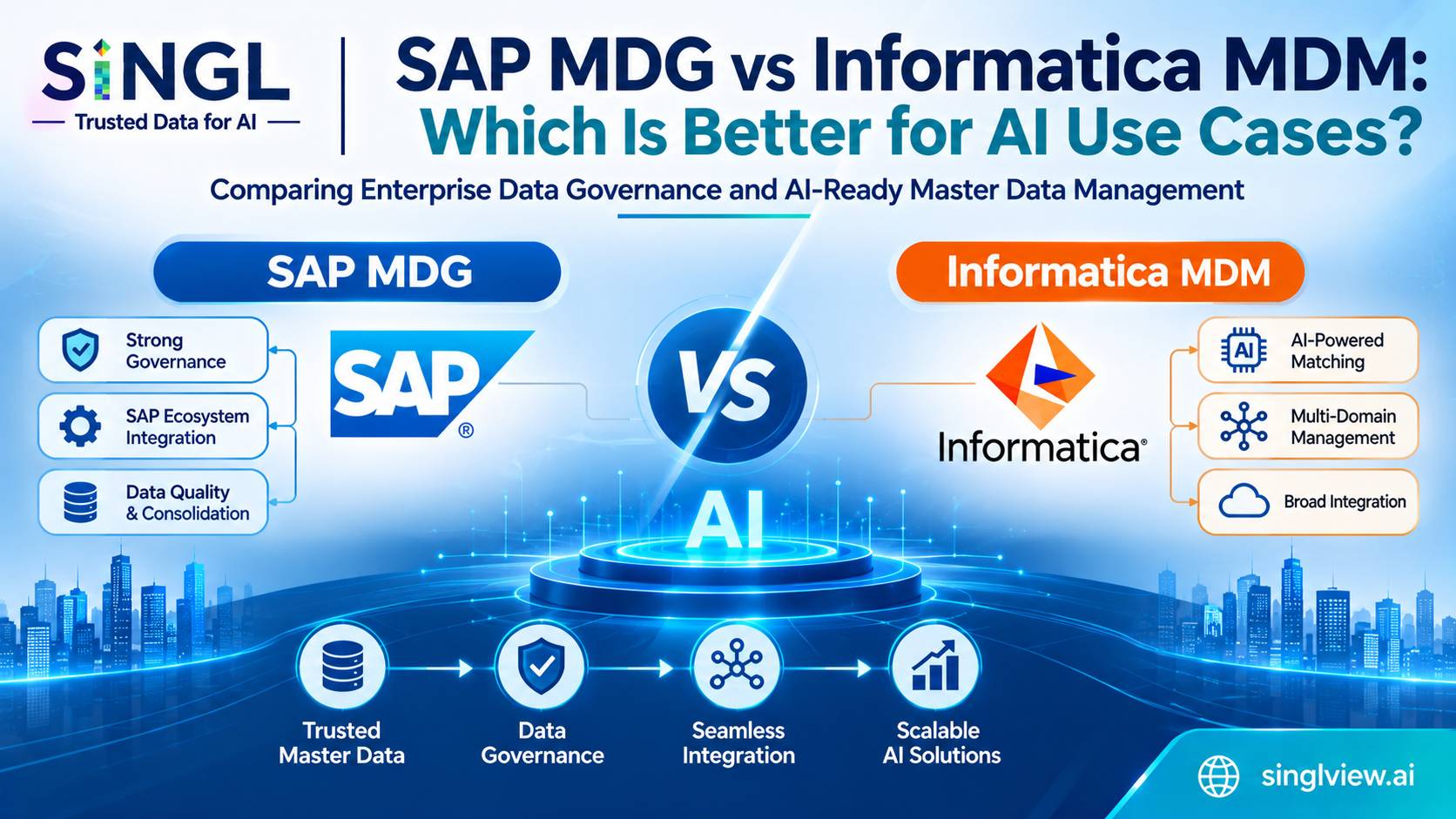
Two established platforms organizations may evaluate for these requirements are SAP Master Data Governance (SAP MDG) and Informatica Master Data Management (Informatica MDM). Both support master data quality, governance, consolidation, and trusted business information, but they approach enterprise data management differently.
SAP MDG is particularly relevant for organizations that rely heavily on SAP applications and need controlled master data creation, approval, and governance. Informatica MDM is particularly relevant for enterprises managing multiple data domains across diverse systems and looking for AI-assisted matching, enrichment, and stewardship capabilities.
So, SAP MDG vs Informatica MDM: which is better for AI use cases?
The answer depends on your organization's existing technology environment, data complexity, AI goals, integration requirements, and governance priorities. This guide compares both platforms and explains how to evaluate them for modern AI-driven enterprises.
What Is SAP Master Data Governance (SAP MDG)?
SAP Master Data Governance is SAP's platform for managing and governing important enterprise master data. It helps organizations maintain consistent information through centralized governance, consolidation, data quality management, workflows, and business rules.
SAP MDG is especially relevant in organizations that use SAP ERP or SAP S/4HANA as a core part of their business operations.
Its capabilities help businesses control how master data is created, changed, validated, approved, and distributed across connected systems.
Key Capabilities of SAP MDG
1. Centralized Master Data Governance
SAP MDG supports controlled creation and modification of master records through change requests, validation rules, workflows, and approval processes. This helps organizations maintain consistent information according to defined business policies.
2. Master Data Consolidation
Organizations can collect master data from different sources, standardize records, identify potential duplicates, and calculate trusted records using configured survivorship rules.
3. Data Quality Management
SAP MDG supports data validation, derivation rules, data quality monitoring, and quality-related analytics. Certain capabilities can also use machine learning to identify potential rule improvements.
4. SAP Ecosystem Integration
SAP MDG works closely with SAP business applications and can be deployed as a separate hub or co-deployed with SAP ERP, depending on the architecture and product version.
5. Workflow and Auditability
The platform supports structured change requests, staging, approvals, activation, and distribution. These controls help organizations track master data changes and maintain accountability.
How SAP MDG Supports AI Use Cases
AI initiatives depend on reliable business information. SAP MDG can support this foundation by improving the consistency and governance of master data used by SAP applications and connected AI solutions.
For example, an organization using SAP S/4HANA may use SAP MDG to govern supplier and product records. Consistent master data can then support procurement analytics, inventory forecasting, financial reporting, and AI-assisted business workflows.
SAP's current product direction also positions master data governance as part of a broader business data environment, with trusted records and business context supporting applications and AI agents.
What Is Informatica Master Data Management?
Informatica Master Data Management is part of Informatica's Intelligent Data Management Cloud (IDMC). It helps organizations consolidate, manage, govern, and distribute trusted master data across multiple business domains and applications.
Informatica is particularly relevant to organizations that manage information across heterogeneous environments, including cloud platforms, enterprise applications, databases, and third-party systems.
Its MDM capabilities support the creation of trusted records for entities such as customers, products, suppliers, and financial information.
Key Capabilities of Informatica MDM
1. Multi-Domain Master Data Management
Informatica supports multiple master data domains through capabilities and applications such as Customer 360, Product 360, Supplier 360, Finance 360, and Reference 360.
This allows organizations to manage different types of enterprise information within a connected data management environment.
2. AI-Powered Matching and Merging
Informatica uses its CLAIRE AI capabilities to support record matching, merging, and recommendations. Its current MDM offering describes self-tuning AI-assisted matching with explainability features to help resolve fragmented records.
3. Intelligent Data Stewardship
AI-assisted workflows can help identify potential data issues, flag records, and support enrichment activities. This can reduce repetitive manual work and allow data stewards to focus on decisions that require business judgment.
4. Headless MDM and API-Based Access
Informatica's headless MDM approach makes golden records and stewardship capabilities accessible through APIs and connected applications, workflows, and agents.
This can be useful when organizations want to make trusted master data available beyond a single business application.
5. Data Integration and Governance Capabilities
Informatica's IDMC platform brings together master data management, data integration, data quality, observability, cataloguing, and lineage capabilities within a broader cloud data management environment.
How Informatica MDM Supports AI Use Cases
Informatica MDM can support AI initiatives by helping organizations create trusted, connected records across multiple systems.
For example, a retail organization may collect product information from suppliers, ERP systems, e-commerce platforms, and product catalogues. Informatica can help match and consolidate product records, support enrichment, and make standardized information available to recommendation engines and other AI applications.
Its AI-assisted matching and stewardship capabilities are also relevant to organizations that need to manage large volumes of fragmented customer, supplier, and product information.
SAP MDG vs Informatica MDM: Key Differences
Although both platforms support enterprise master data management, their strengths and typical implementation priorities differ.
The comparison reflects published product capabilities. Actual functionality depends on the selected product edition, deployment model, release, licensing, and configuration.
SAP MDG vs Informatica MDM for AI Use Cases
The most useful way to compare these platforms is to evaluate how they support specific AI requirements.
1. AI-Powered Data Matching and Deduplication
AI applications often rely on accurate customer, supplier, and product identities. Duplicate records can create fragmented profiles and inconsistent business insights.
SAP MDG: SAP MDG supports consolidation, matching, duplicate identification, and best-record calculation through configured rules and survivorship logic. Its data quality capabilities can also use machine learning to suggest validation rules.
Informatica MDM: Informatica emphasizes CLAIRE AI-assisted matching and merging, including recommendations and explainability features. This can be useful when organizations need to identify complex record similarities across multiple data sources.
Which is better?
Informatica may be a stronger fit when AI-assisted matching across large, diverse datasets is a primary requirement. SAP MDG can be a strong fit when matching and consolidation need to operate within established SAP governance processes.
The final decision should be based on matching accuracy against the organization's own data, including false positives, false negatives, review effort, and processing performance.
2. AI-Ready Data Governance
AI systems require more than clean records. They need consistent business definitions, clear ownership, access controls, and traceable data changes.
SAP MDG: Its central governance model supports controlled data creation and modification through business rules, workflows, staging, and approvals. This is particularly useful when master data is closely connected to SAP operational processes.
Informatica MDM: Its MDM and IDMC capabilities support governance and stewardship across multiple domains and connected systems. AI-assisted stewardship can help identify records that need attention and support enrichment workflows.
Which is better?
SAP MDG may be the better fit when an organization wants to enforce data policies directly within SAP business processes. Informatica may be more suitable when governance must span several platforms and master data domains.
3. Generative AI and AI Agents
Generative AI and agentic applications need reliable business context to provide useful responses and take appropriate actions.
For example, an AI agent supporting procurement may need accurate supplier details, contract information, product records, and organizational relationships.
SAP MDG: SAP's current business data strategy positions governed master data as an important foundation for applications and AI agents. SAP MDG can help maintain business data through structured governance and quality controls.
Informatica MDM: Informatica's headless MDM approach is designed to make golden records and stewardship capabilities available through APIs and connected applications, workflows, and agents.
Which is better?
Informatica may be attractive when an organization wants to expose trusted master data to a broad mix of applications and AI agents. SAP MDG may be preferable when AI use cases are closely connected to SAP business processes and governed SAP data.
In either case, the MDM platform is not a complete generative AI solution. It provides trusted data and governance capabilities that must be integrated with suitable AI models, retrieval systems, applications, and security controls.
4. Multi-Domain Data Management
Many AI use cases require information from more than one business domain.
A customer recommendation system, for example, may need customer, product, transaction, and location information. A supplier risk application may require supplier, organization, finance, and procurement data.
SAP MDG: Supports multiple master data domains, although available capabilities and configuration differ across classic, cloud-ready, and other product modes.
Informatica MDM: Offers multi-domain capabilities and domain-specific applications such as Customer 360, Product 360, Supplier 360, and Finance 360.
Which is better?
Informatica may be a strong choice for organizations prioritizing broad multi-domain management across heterogeneous systems. SAP MDG can be effective for organizations that need to govern multiple domains within an SAP-oriented enterprise architecture.
5. Data Integration Across Enterprise Systems
AI initiatives frequently depend on data from CRM, ERP, cloud applications, data warehouses, and third-party systems.
SAP MDG: Its integration strengths are especially relevant to SAP environments. It can also support non-SAP sources, depending on the architecture and integration design.
Informatica MDM: Its wider IDMC environment combines MDM with data integration, data quality, observability, and governance capabilities. This can support organizations with more diverse data landscapes.
Which is better?
Informatica may be more suitable when broad cross-platform integration is a central requirement. SAP MDG may be more suitable when the primary objective is to govern master data within SAP processes and distribute it to connected applications.
Which Platform Is Better for Different AI Use Cases?
The following table summarizes which platform may be a better starting point for common enterprise scenarios.
This is a directional comparison, not a universal performance ranking. Organizations should validate the exact capabilities available in their intended product versions and deployment configurations.
When Should You Choose SAP MDG?
SAP MDG is worth considering when your organization has an established SAP environment and needs strong control over the creation, modification, and distribution of business-critical master data.
It may be a suitable choice when:
SAP S/4HANA is a central business platform.
Master data governance must follow SAP business rules.
Data creation and changes require structured approvals.
Organizations need controlled supplier, customer, product, or financial master data.
Auditability and standardized business processes are important.
AI applications primarily consume trusted data from SAP business processes.
For example, a manufacturing organization using SAP S/4HANA may use SAP MDG to govern material and supplier records. Consistent information can then support inventory planning, procurement analytics, and AI-enabled operational decisions.
SAP MDG is also available in different modes. For example, SAP documentation describes classic and cloud-ready modes, with different domain and configuration coverage. The cloud-ready mode documented for SAP S/4HANA has specific domain limitations, so organizations should verify the required functionality before choosing a deployment path.
When Should You Choose Informatica MDM?
Informatica MDM may be a stronger candidate when an organization needs to unify data from multiple enterprise platforms and manage several master data domains.
It may be suitable when:
Business information is distributed across SAP and non-SAP systems.
Customer, product, supplier, and finance data need to be managed together.
AI-assisted matching and merging are high priorities.
Data stewardship processes need automation support.
Applications require API-based access to trusted master records.
The organization wants MDM within a broader cloud data management environment.
For example, a global retail business may maintain product data across supplier portals, ERP systems, e-commerce platforms, and regional product catalogues. Informatica MDM can help consolidate product information and support standardized records for commerce, analytics, and AI applications.
Its multi-domain applications and CLAIRE AI capabilities make it worth evaluating for enterprises that want to expand AI-assisted data management across a varied application landscape.
Can SAP MDG and Informatica MDM Work Together?
Some organizations may not need to select one platform as a complete replacement for the other. Depending on their architecture and requirements, they may use complementary data management capabilities.
For example, an enterprise could use SAP MDG to govern the creation and modification of operational master data within SAP processes while using Informatica capabilities to support broader data integration, quality, or cross-system data management.
However, running two MDM platforms requires clear architectural decisions.
Organizations should define:
Which platform owns each master data domain.
Which system creates and approves master records.
How golden records are synchronized.
How duplicate matching is coordinated.
Which platform manages survivorship rules.
How changes are distributed to downstream applications.
How data lineage and audit records are maintained.
Without clear ownership, two platforms may create competing versions of the same master record.
The objective should be a well-defined architecture with clear responsibilities rather than duplicating MDM functionality unnecessarily.
Industry Applications of SAP MDG and Informatica MDM for AI
The best MDM platform can also depend on industry-specific data requirements, regulatory considerations, and existing enterprise systems.
Financial Services MDM
Financial institutions manage customer, account, product, organization, and transaction-related information across multiple applications.
Financial Services MDM helps banks, insurance providers, and financial organizations maintain consistent records and support reliable analytics.
SAP MDG may be suitable for financial institutions with SAP-centric financial and operational processes that require structured governance. Informatica MDM may be worth evaluating when customer, account, and related records need to be unified across a diverse application landscape.
AI applications in this sector may include:
Customer identity resolution.
Fraud analytics.
Customer segmentation.
Risk-related data analysis.
Financial reporting.
Intelligent customer service.
The platform selection should account for data security, regulatory requirements, auditability, and the accuracy of entity matching.
Healthcare MDM
Healthcare organizations manage patient, provider, facility, supplier, and service information across clinical and administrative systems.
Healthcare MDM supports the creation of consistent records across healthcare applications and helps reduce data fragmentation.
SAP MDG may be appropriate for healthcare organizations with significant SAP operational and financial processes. Informatica MDM may be useful when patient, provider, and facility-related information must be consolidated across multiple systems.
AI applications may include:
Patient identity matching.
Healthcare provider data management.
Healthcare analytics.
Operational forecasting.
Resource planning.
Administrative workflow automation.
Healthcare organizations must also evaluate privacy, access control, data retention, and applicable regulatory requirements before using sensitive information in AI applications.
Master Data Management in New York
Organizations exploring Master Data Management in New York may operate across financial services, healthcare, technology, retail, and professional services.
Businesses in these sectors often manage information across multiple applications and departments.
SAP MDG may suit enterprises that prioritize SAP-based governance and operational consistency. Informatica MDM may be a stronger candidate for organizations managing customer, supplier, and product information across heterogeneous systems.
The right approach depends on the organization's data architecture, AI use cases, and governance requirements.
Master Data Management in Chicago
Businesses considering Master Data Management in Chicago may have data management requirements across manufacturing, logistics, healthcare, financial services, and distribution.
These organizations often need consistent supplier, product, customer, and location information across operational systems.
SAP MDG can support governance within SAP-oriented manufacturing and procurement processes. Informatica MDM can be evaluated for cross-platform consolidation and multi-domain data management.
Both approaches can support AI initiatives when master data is accurately maintained and made available to downstream applications.
Master Data Management in Dallas
Organizations evaluating Master Data Management in Dallas may operate across technology, energy, healthcare, retail, and financial services.
As these businesses expand, they may need to connect information from newly introduced applications, acquired operations, and geographically distributed teams.
SAP MDG can help maintain controlled master data within SAP business environments, while Informatica MDM can support broader data unification across different platforms.
A suitable MDM strategy can help prepare trusted information for predictive analytics, intelligent automation, and enterprise AI applications.
Factors to Consider Before Selecting an MDM Platform for AI
Choosing an MDM platform should involve more than comparing feature lists. Organizations should evaluate how each product fits their actual data environment.
1. Existing Technology Ecosystem
Review whether your organization primarily uses SAP applications or operates across multiple enterprise platforms.
An SAP-centric environment may benefit from SAP MDG's alignment with SAP business processes. A heterogeneous environment may require broader cross-platform integration and multi-domain management.
2. AI Use Case Requirements
Identify whether your primary objective is AI-assisted data matching, generative AI, customer intelligence, product recommendations, supplier analysis, or intelligent automation.
Different use cases may require different combinations of MDM, integration, governance, and AI capabilities.
3. Data Domain Complexity
Consider how many master data domains need to be managed and how they relate to each other.
A business managing customer, product, supplier, finance, and reference data across multiple systems may need a broader multi-domain architecture.
4. Integration and Scalability
Evaluate how the platform connects with existing databases, ERP systems, CRM applications, cloud platforms, data warehouses, and AI environments.
Also assess performance, data volumes, update frequency, and the ability to support future business growth.
5. Governance and Compliance
Review approval workflows, access controls, audit trails, data ownership, and regulatory requirements.
For regulated industries, governance should be treated as a core platform-selection requirement rather than an additional feature.
6. Total Cost of Ownership
Compare licensing, implementation, integration, infrastructure, customization, maintenance, and training costs.
The overall cost should be evaluated against the business value expected from improved data quality, reduced manual effort, and more reliable AI applications.
7. Implementation and Team Readiness
Consider the availability of SAP, Informatica, data engineering, architecture, and governance expertise.
A technically capable platform may still be difficult to implement if the organization lacks the skills, ownership model, or change management support required to operate it effectively.
How SiNGL Supports Master Data Management Solutions
Selecting between SAP MDG and Informatica MDM is one part of a larger enterprise data strategy. Organizations also need to establish trusted master records, maintain data quality, connect information across systems, and prepare data for AI applications.
SiNGL's Master Data Management Solutions help organizations work towards a consistent and governed view of critical business information.
A structured MDM approach can support:
Consolidation of customer, product, supplier, and other business records.
Identification and management of duplicate information.
Standardization of enterprise data attributes.
Improved data quality and governance.
Consistent master data across connected applications.
A trusted foundation for analytics and AI initiatives.
Organizations can explore Master Data Management Solutions to understand how a structured MDM strategy can support their enterprise data requirements.
For industry-specific requirements, businesses can also explore Financial Services MDM and Healthcare MDM.
Conclusion: SAP MDG vs Informatica MDM — Which Is Better for AI?
There is no universal winner in the SAP MDG vs Informatica MDM comparison. Both platforms can support AI initiatives by improving the quality, consistency, and governance of enterprise master data.
SAP MDG is a compelling option for organizations that operate primarily within the SAP ecosystem and need structured governance, controlled data changes, and close alignment with SAP business processes.
Informatica MDM is a compelling option for organizations that manage multiple data domains across diverse systems and want AI-assisted matching, merging, stewardship, and broad data management capabilities.
The right platform depends on the organization's existing architecture, data complexity, AI roadmap, integration needs, governance priorities, and implementation resources.
Ultimately, successful AI adoption requires more than selecting an MDM tool. It requires a long-term strategy for creating trusted data, maintaining consistent records, and making governed information available wherever business applications and AI systems need it.
Build a stronger foundation for your AI initiatives with trusted enterprise data. Explore SiNGL's Master Data Management Solutions to understand how better data management can support your organization's AI and digital transformation goals.
Frequently Asked Questions
1. What is the main difference between SAP MDG and Informatica MDM?
SAP MDG focuses strongly on master data governance and controlled data management within SAP-oriented business environments. Informatica MDM emphasizes multi-domain master data management, cross-system data unification, and AI-assisted matching and stewardship.
2. Which is better for AI use cases: SAP MDG or Informatica MDM?
Neither is universally better. SAP MDG may be preferable for AI initiatives closely connected to SAP business processes. Informatica MDM may be preferable for cross-platform data unification and AI-assisted matching across multiple domains. The best choice depends on the organization's architecture and AI requirements.
3. Does SAP MDG support artificial intelligence?
SAP MDG supports data quality and governance capabilities, including machine-learning-supported rule mining in documented functionality. SAP's broader business data strategy also positions governed master data as a foundation for AI applications and agents.
4. What is CLAIRE AI in Informatica MDM?
CLAIRE is Informatica's AI technology used across its data management platform. In MDM, it supports capabilities such as AI-assisted matching and merging, recommendations, and agentic data stewardship.
5. Can SAP MDG manage non-SAP data?
Yes. SAP MDG can support master data consolidation and governance involving SAP and non-SAP sources, depending on the implementation architecture, integrations, and product capabilities.
6. Is Informatica MDM suitable for multi-domain data management?
Yes. Informatica offers multi-domain capabilities and applications for customer, product, supplier, finance, and reference data management.
7. Can SAP MDG and Informatica MDM be used together?
They can be used in complementary architectures when business requirements justify it. Organizations must define clear ownership, matching rules, synchronization processes, and responsibilities to avoid duplicate governance and conflicting master records.
8. Which MDM platform is better for financial services?
Both platforms may support financial services requirements. SAP MDG can be suitable for financial institutions with SAP-centric processes, while Informatica MDM may be suitable for organizations requiring cross-system customer and financial data unification. The decision should consider regulatory requirements, integration needs, and data domain complexity.
9. How do SAP MDG and Informatica MDM support healthcare AI?
Both can contribute to trusted healthcare data by supporting standardization, consolidation, governance, and consistent records. Healthcare organizations must ensure that patient and provider information is handled with appropriate privacy, security, and access controls.