ETL vs ELT vs MDM: What Do Modern AI Systems Use?
Explore the differences between ETL, ELT, and Master Data Management (MDM), and understand how modern AI systems use these approaches together to integrate, transform, govern, and maintain trusted enterprise data.
Introduction
Artificial intelligence is changing how businesses collect, process, analyze, and use enterprise data. From predictive analytics and machine learning to generative AI and autonomous agents, modern AI systems depend on large volumes of information from multiple sources. However, simply collecting and storing data does not make it ready for AI.
Enterprise data is often scattered across CRM platforms, ERP systems, financial applications, healthcare systems, customer databases, cloud platforms, and third-party services. The same customer, supplier, product, or organization may appear differently across these systems. Records may contain duplicate entries, inconsistent formats, outdated details, or incomplete information.
This creates an important question for enterprise data architects: Should modern AI systems use ETL, ELT, or Master Data Management (MDM)?
These three approaches serve different purposes. ETL and ELT move and prepare data for analytics and other workloads, while MDM helps organizations establish consistent, trusted records for important business entities. They are not competing technologies. In many modern data architectures, they work together to create a reliable foundation for AI.
This guide explains the differences between ETL, ELT, and MDM, how each supports AI systems, and why organizations need to consider all three when building an enterprise-ready data strategy.
Understanding ETL, ELT, and MDM
Before comparing their role in AI, it is important to understand what each approach does.
1. What Is ETL (Extract, Transform, Load)?
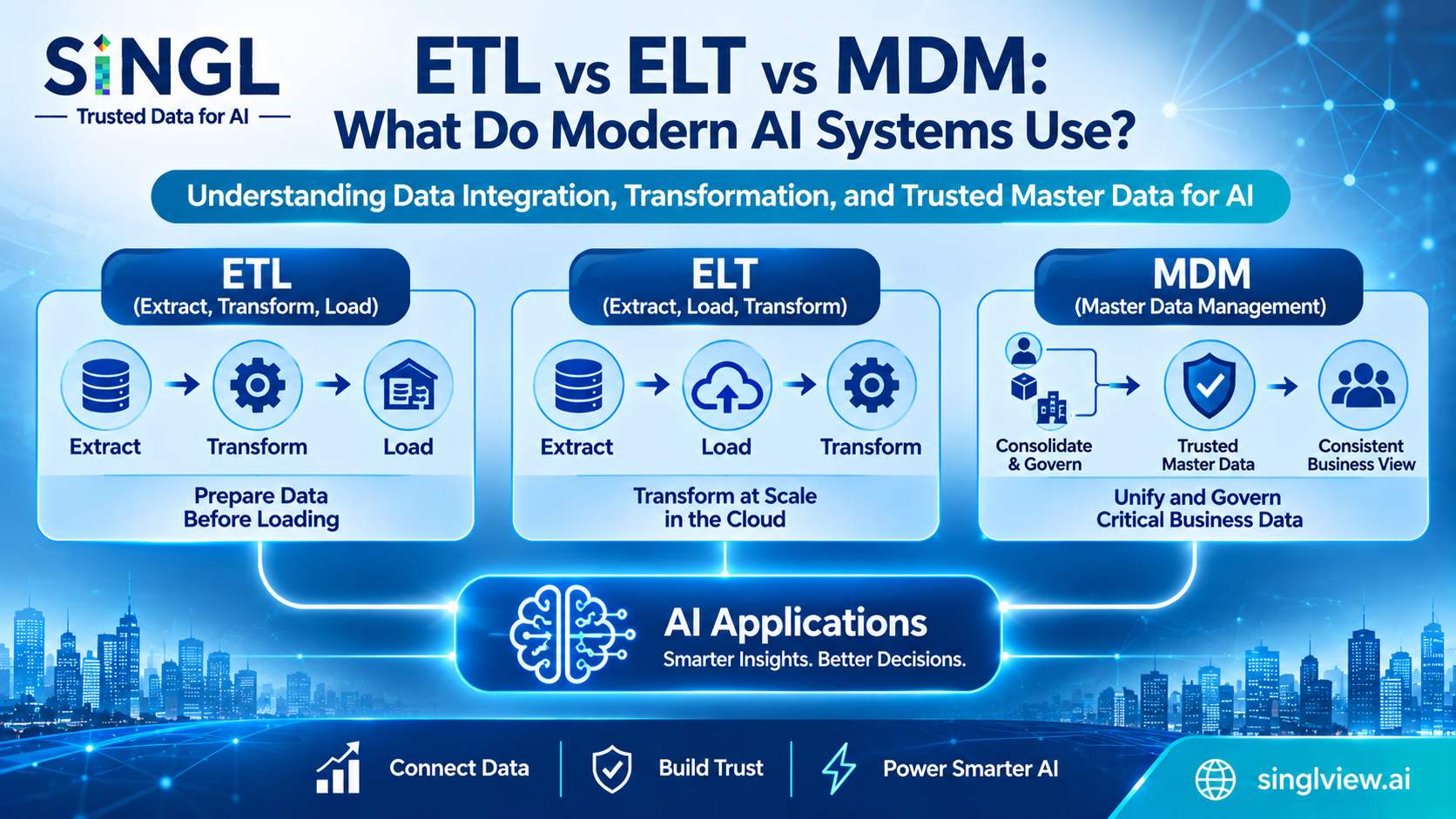
ETL stands for Extract, Transform, Load. It is a data integration process that collects information from different source systems, transforms it into a required format, and then loads the processed data into a target system such as a data warehouse.
The transformation process happens before the data reaches its destination.
How ETL works:
Extract: Collect data from databases, business applications, APIs, files, and other sources.
Transform: Clean, standardize, validate, filter, and restructure the information.
Load: Transfer the transformed data into a data warehouse or another destination.
For example, a financial organization may collect transaction records from multiple banking systems. Its ETL pipeline can standardize date formats, validate transaction fields, remove invalid records, and load the prepared information into an analytics platform.
Why ETL matters for AI
ETL is useful when AI applications require structured, validated, and consistently formatted datasets before they are loaded into their destination.
It can support:
Preparing historical datasets for machine learning.
Standardizing information from legacy systems.
Filtering sensitive data before it reaches analytical environments.
Applying predefined business rules.
Preparing structured datasets for reporting and predictive analytics.
ETL remains relevant in modern data architectures, particularly when data must be processed or governed before loading.
2. What Is ELT (Extract, Load, Transform)?
ELT stands for Extract, Load, Transform. It follows a similar process to ETL, but the order of operations is different.
In ELT, data is extracted from source systems and loaded into a target platform before transformation takes place. The destination platform, such as a cloud data warehouse or lakehouse, performs the transformation using its own processing capabilities.
How ELT works:
Extract: Collect data from databases, applications, APIs, files, and other sources.
Load: Transfer raw or minimally processed data into a cloud data warehouse, data lake, or lakehouse.
Transform: Clean, structure, enrich, and prepare the data within the destination environment.
For example, an e-commerce company may load customer interactions, website activity, order histories, and product information into a cloud data platform. Data engineers can then create different transformed datasets for customer analytics, recommendation models, and demand forecasting.
Why ELT matters for AI
ELT is especially useful when organizations work with large and diverse datasets and need flexibility to prepare information for different analytical or AI workloads.
It can support:
Loading large volumes of structured and semi-structured data.
Retaining raw data for future analysis.
Creating different datasets for machine learning experiments.
Preparing data for model training and evaluation.
Supporting scalable cloud-based analytics.
ELT is widely used in cloud-native data architectures because it allows organizations to use the processing power of their target platforms.
3. What Is Master Data Management (MDM)?
Master Data Management is a discipline and technology approach used to create, maintain, and distribute consistent, trusted records of an organization's most important business entities.
These entities may include:
Customers
Patients
Suppliers
Products
Employees
Locations
Business partners
Financial accounts
In large enterprises, the same entity often exists in several systems. A customer may have one name in a CRM, a different address in a billing application, and another customer ID in an ERP system.
MDM helps identify records that refer to the same real-world entity, resolve duplicates, standardize information, establish relationships, and maintain a reliable view of that entity.
How MDM works:
Data collection: Gather master data from connected business systems.
Data standardization: Apply consistent formats, validation rules, and business definitions.
Matching and deduplication: Identify records that represent the same customer, product, supplier, or other entity.
Record consolidation: Create a trusted, unified record using defined business rules.
Data governance: Establish ownership, approval workflows, access policies, and accountability.
Data distribution: Share trusted master data with operational applications, analytics platforms, and AI systems.
Why MDM matters for AI
AI systems need more than large datasets. They need reliable information about the entities represented in those datasets.
For example, an AI-powered customer analytics system may receive information about the same customer from a CRM, billing platform, website, and support application. Without entity resolution, the system may treat these records as separate individuals.
MDM helps connect these records and establish a more consistent customer view.
It can support:
More reliable customer and product information.
Duplicate detection and entity resolution.
Consistent business definitions across systems.
Better data governance and accountability.
Trusted datasets for AI and machine learning.
More accurate customer analytics and personalization.
For organizations building enterprise-wide Master Data Management Solutions, MDM provides a foundation for keeping critical business information consistent across applications and departments.
ETL vs ELT vs MDM: Key Differences
Although all three approaches contribute to enterprise data management, their responsibilities are different.
The key distinction is simple:
ETL prepares data before loading it.
ELT loads data first and transforms it within the target platform.
MDM establishes trusted and consistent business records across systems.
ETL and ELT answer the question, "How do we move and prepare data?"
MDM answers a different question: "How do we know that the data represents the correct customer, product, supplier, or other business entity?"
What Do Modern AI Systems Actually Use?
Modern AI systems do not rely on only one of these approaches. They often use a combination of ETL, ELT, and MDM, depending on the data sources, workload, governance requirements, and business objectives.
Each approach contributes to a different part of the AI data lifecycle.
1. ETL for Structured and Validated AI Data
Some AI applications depend on structured information with predefined formats and validation rules.
For example, a credit risk model may require transaction histories, account information, repayment records, and customer attributes in a consistent format.
ETL can prepare these datasets before loading them into the target environment. It can also apply data validation, remove invalid records, and standardize fields.
This makes ETL useful when organizations need controlled data preparation before information enters an analytical or AI environment.
2. ELT for Large-Scale AI Data Processing
Modern AI applications often use information from multiple sources, including application logs, customer interactions, documents, transactions, and digital activity.
ELT allows organizations to load large volumes of data into scalable cloud platforms and transform it according to different requirements.
For example, a retail organization may use the same raw data environment to prepare:
Customer purchase history for recommendation systems.
Website activity for customer behavior analysis.
Product information for demand forecasting.
Customer support interactions for language models.
Different teams can create purpose-specific datasets without repeatedly rebuilding the entire ingestion process.
3. MDM for Trusted Entity-Level AI Context
Even when ETL and ELT prepare data successfully, they do not automatically establish a unified identity for every business entity.
Consider a healthcare organization with multiple hospitals and diagnostic centers. A patient may have different identifiers in appointment systems, laboratory applications, pharmacy records, and billing platforms.
An AI system analyzing these records may fail to connect information that belongs to the same patient if the underlying identity data is inconsistent.
Healthcare MDM helps establish consistent patient-related master data and relationships across systems, subject to applicable privacy, consent, access, and regulatory requirements.
Similarly, customer-focused AI applications in banking, insurance, and retail can benefit from MDM because it helps connect records across different operational platforms.
This is where MDM adds a capability that data movement and transformation alone do not provide.
Why Modern AI Needs More Than ETL or ELT
ETL and ELT are essential for preparing and integrating data, but AI readiness involves additional requirements.
A dataset can be technically clean and still contain inaccurate business identities, duplicated entities, conflicting relationships, or outdated information.
For example, consider a business with three records:
Customer A: Rahul Sharma, Customer ID 1024.
Customer B: R. Sharma, Customer ID 4589.
Customer C: Rahul S., Customer ID 7832.
A data transformation pipeline may standardize the names and formats, but it may not reliably establish whether all three records represent the same person.
MDM applies entity matching, business rules, and stewardship processes to help resolve these identities.
This distinction matters because unreliable entity information can affect several AI applications.
Common AI challenges caused by inconsistent master data
1. Duplicate entities
An AI model may treat one customer as multiple individuals, affecting segmentation, personalization, and customer analytics.
2. Inconsistent product information
Different product descriptions or identifiers can create unreliable product recommendations and inventory insights.
3. Fragmented relationships
AI applications may struggle to understand connections between customers, accounts, suppliers, locations, and transactions.
4. Outdated records
Models and AI agents may retrieve information that no longer reflects the current state of a business entity.
5. Weak governance
Without clear ownership, access controls, and data lineage, organizations may find it difficult to understand where information originated and whether it can be used for a particular AI purpose.
ETL and ELT help prepare and move information. MDM helps improve the reliability of the core business entities within that information.
How ETL, ELT, and MDM Work Together in an AI Architecture
Instead of choosing one approach, enterprises should design an architecture in which each technology performs its intended role.
A typical modern AI data architecture may follow this sequence:
Step 1: Collect Data from Enterprise Sources
Data is collected from CRM, ERP, finance, healthcare, supply chain, customer service, SaaS applications, APIs, and external data providers.
The data may include structured records, semi-structured files, documents, and event streams.
Step 2: Use ETL or ELT for Data Integration
Organizations select the appropriate integration approach based on data volume, transformation requirements, target platforms, security, and latency.
ETL may be used to validate and transform information before loading. ELT may be used to load raw data into a scalable cloud environment before transforming it.
Some organizations use both approaches across different workloads.
Step 3: Apply MDM for Master Data Consistency
MDM identifies and manages important business entities across connected systems.
It can help:
Match duplicate customer and supplier records.
Standardize product and location information.
Maintain trusted entity relationships.
Apply data ownership and stewardship rules.
Create consistent master data for downstream applications.
Step 4: Make Trusted Data Available to AI Systems
Once data is integrated and master data is managed, relevant information can be made available to analytical platforms, machine learning pipelines, feature stores, search systems, and AI applications.
For generative AI and retrieval-augmented generation (RAG), trusted master data can help connect retrieved information to the correct customers, products, organizations, and other business entities.
For AI agents, governed access to current and consistent entity information can help reduce confusion when retrieving or acting on enterprise data.
Step 5: Monitor and Maintain Data Quality
Data management does not end when information reaches an AI model.
Organizations need ongoing monitoring for:
Data quality and completeness.
Duplicate and conflicting records.
Changes to master data.
Data lineage and traceability.
Access permissions and policy compliance.
Synchronization across connected systems.
This continuous approach helps maintain the reliability of enterprise data as applications and business requirements evolve.
ETL vs ELT vs MDM: Which Is Better for Different AI Use Cases?
The right approach depends on what the AI application needs to accomplish.
The table highlights an important point: ETL, ELT, and MDM are complementary. The most suitable architecture combines them according to the needs of each AI workload.
Industry Applications: Why MDM Matters Alongside ETL and ELT
Different industries have different data requirements, but they share a common challenge: important business entities are often represented across multiple systems.
1. Financial Services MDM
Banks, insurance companies, investment firms, and other financial institutions manage large volumes of customer, account, transaction, product, and compliance data.
ETL and ELT help integrate financial information from different platforms and prepare it for analytics, risk modelling, and reporting.
However, inconsistent customer identities and account relationships can affect the reliability of AI-driven financial applications.
Financial Services MDM helps organizations create consistent customer, account, product, and organization records across systems.
It can support:
Customer identity resolution.
Consolidated customer views.
Consistent account and relationship information.
Fraud and risk analytics.
Regulatory reporting and data governance.
AI-driven customer insights.
For example, an AI-powered fraud detection system may analyze transactions across multiple accounts. Reliable identity and relationship data can help the system connect relevant records more accurately.
2. Healthcare MDM
Healthcare organizations manage patient, provider, facility, treatment, insurance, and diagnostic information across multiple applications.
ETL and ELT can integrate data from electronic health records, laboratory systems, hospital management platforms, and other healthcare applications.
However, data integration alone does not guarantee that patient and provider records are consistent across these systems.
Healthcare MDM helps establish trusted patient, provider, facility, and other healthcare-related master data.
It can support:
Patient identity matching.
Provider data standardization.
Consistent facility information.
Healthcare analytics.
Operational reporting.
Better data foundations for AI-assisted healthcare applications.
For instance, a healthcare analytics platform may need to connect patient-related information from multiple facilities. Reliable master data can help reduce identity fragmentation and support more consistent analysis.
All such use must follow applicable privacy, consent, security, and healthcare data regulations.
3. Master Data Management in New York
Organizations operating in New York may work across financial services, healthcare, insurance, retail, and professional services. These businesses often rely on multiple enterprise applications and large volumes of customer and operational data.
A combination of ETL, ELT, and MDM can help them build a more reliable data environment.
For example, financial institutions can use ETL and ELT to integrate transaction data while MDM maintains consistent customer and account records.
Businesses exploring Master Data Management in New York can benefit from evaluating how master data governance, integration, entity resolution, and AI readiness fit into their existing architecture.
4. Master Data Management in Chicago
Chicago has a broad business ecosystem spanning manufacturing, logistics, healthcare, finance, retail, and distribution.
These industries depend on accurate information about customers, suppliers, products, facilities, inventory, and business partners.
ETL and ELT can integrate data from operational applications, supply chain platforms, and analytical systems. MDM can help establish consistent product, supplier, customer, and location records.
For enterprises considering Master Data Management in Chicago, a unified master data strategy can support supply chain visibility, operational analytics, customer insights, and AI-driven planning.
5. Master Data Management in Dallas
Businesses in Dallas operate across sectors such as technology, financial services, healthcare, telecommunications, energy, and logistics.
As organizations expand their cloud environments and AI initiatives, they need data that is accessible, consistent, and governed.
ETL and ELT can support data movement and transformation across enterprise platforms, while MDM helps maintain trusted business entities.
Organizations evaluating Master Data Management in Dallas should consider how a unified master data foundation can support enterprise integration, customer intelligence, operational efficiency, and AI adoption.
How to Choose Between ETL, ELT, and MDM
The decision should begin with the business problem rather than the technology name.
Choose ETL when:
Data must be transformed before entering the target system.
Strict validation rules need to be applied during ingestion.
Legacy systems require structured integration processes.
Sensitive fields must be filtered or protected before loading.
The destination requires predefined data formats.
Data must be transformed before entering the target system.
Strict validation rules need to be applied during ingestion.
Legacy systems require structured integration processes.
Sensitive fields must be filtered or protected before loading.
The destination requires predefined data formats.
Choose ELT when:
You are working with large volumes of data.
Your cloud warehouse or lakehouse provides scalable processing.
Teams need access to raw data for different analytical requirements.
Data transformation requirements change frequently.
You are building flexible data environments for AI and machine learning.
Choose MDM when:
The same business entities appear across multiple systems.
Duplicate or inconsistent master records affect operations.
AI applications require reliable customer, product, supplier, or patient identities.
Data ownership and governance need to be standardized.
Your organization needs a consistent view of critical business information.
Choose a combined approach when:
You are building an enterprise-wide AI data architecture.
Data comes from multiple operational and external sources.
Different workloads require different ingestion and transformation patterns.
Business entities must remain consistent across applications.
AI systems need scalable data access as well as trusted entity-level context.
For most large enterprises, a combined approach is more practical than treating ETL, ELT, and MDM as alternatives.
Why Choose SiNGL for Master Data Management Solutions?
Building an AI-ready data environment requires more than connecting applications or creating data pipelines. Organizations also need a consistent approach to managing critical business information.
SiNGL focuses on Master Data Management Solutions that help enterprises improve the consistency, reliability, and governance of master data across business systems.
A strong MDM strategy can help organizations:
Establish trusted views of critical business entities.
Improve data consistency across connected applications.
Reduce duplicate and conflicting master records.
Strengthen data governance and stewardship.
Support reliable analytics and AI initiatives.
Create a more consistent foundation for enterprise-wide data use.
Whether an organization is modernizing its data architecture, improving customer information management, or preparing for AI adoption, MDM can play an important role in making enterprise data more trustworthy and useful.
Explore SiNGL's Master Data Management Solutions to understand how a structured master data approach can support your enterprise data strategy.
You can also explore industry-specific approaches to Financial Services MDM and Healthcare MDM.
Conclusion: Modern AI Systems Need Integration, Transformation, and Trusted Master Data
ETL, ELT, and MDM solve different but connected data management challenges.
ETL prepares information before it enters a target system. ELT supports flexible, scalable data ingestion and transformation within modern data platforms. MDM establishes consistent and trusted records for important business entities across enterprise systems.
For modern AI systems, these capabilities are most effective when they work together.
An organization may have a powerful cloud data warehouse, advanced transformation pipelines, and sophisticated AI models. But if customer, product, supplier, or other master records are fragmented, the resulting AI applications may still produce unreliable insights.
A well-designed architecture combines the strengths of ETL, ELT, and MDM to create data that is accessible, usable, consistent, and governed.
The future of enterprise AI is not simply about processing more data. It is about making sure AI systems can use the right data, connected to the right business entities, with the right context.
Frequently Asked Questions (FAQs)
1. What is the main difference between ETL, ELT, and MDM?
ETL transforms data before loading it into a target system. ELT loads data first and transforms it within the destination platform. MDM manages the consistency, identity, and governance of important business entities across systems.
2. Do AI systems use ETL or ELT?
AI systems can use both ETL and ELT. ETL is useful for structured, prevalidated datasets, while ELT supports scalable ingestion and flexible transformation of large datasets. The choice depends on the AI workload and enterprise architecture.
3. Is MDM necessary for AI?
MDM is not mandatory for every AI application, but it can be important for enterprise AI systems that depend on accurate customer, product, supplier, patient, or other entity information. It helps reduce identity fragmentation and improve data consistency.
4. Can MDM replace ETL or ELT?
No. MDM does not replace ETL or ELT because they perform different functions. ETL and ELT integrate and prepare data, while MDM manages trusted master records. They often work together in enterprise architectures.
5. Which is better for AI: ETL or ELT?
Neither is universally better. ETL is suitable when data needs to be transformed and validated before loading. ELT is useful for large-scale cloud data environments where transformations can happen within the target platform.
6. How does MDM improve generative AI?
MDM can provide consistent entity identities, relationships, and business context to applications that retrieve or use enterprise information. This can help generative AI and RAG systems connect information to the correct business entities.
7. How does MDM support AI agents?
AI agents may retrieve information from multiple enterprise applications. MDM helps maintain consistent records and relationships for important business entities, giving agents a more reliable foundation when accessing governed enterprise data.
8. What is the role of MDM in Financial Services MDM?
In financial services, MDM helps manage consistent customer, account, product, and organization information across banking, insurance, and financial applications. It can support customer analytics, risk management, fraud detection, and data governance.
9. What is the role of Healthcare MDM in AI?
Healthcare MDM helps standardize and connect patient, provider, facility, and other healthcare-related master data. This can support more consistent healthcare analytics and AI applications while maintaining appropriate privacy and access controls.