How to Build a Scalable Data Pipeline for AI Using MDM
Learn how to build a scalable data pipeline for AI using Master Data Management (MDM). Explore data ingestion, cleansing, entity resolution, integration, storage, governance, and monitoring to create trusted, AI-ready enterprise data.
Introduction
Artificial Intelligence is transforming how businesses process information, generate insights, and make decisions. Organizations are investing in machine learning, predictive analytics, generative AI, and intelligent automation to improve efficiency and create new business opportunities. However, these technologies can only deliver reliable results when they are supported by accurate, consistent, and accessible data.
For many enterprises, building an AI-ready data pipeline is challenging because information is distributed across multiple systems. Customer records may exist in CRM platforms, product information in ERP applications, supplier details in procurement systems, and operational data in separate databases. These systems often use different formats, naming conventions, and data definitions. As a result, organizations may struggle with duplicate records, inconsistent attributes, incomplete information, and disconnected data flows.
A scalable AI data pipeline must do more than move information from one system to another. It must ensure that data is validated, standardized, connected, governed, and ready for AI applications.
This is where Master Data Management (MDM) becomes important. Master Data Management Solutions help organizations create consistent and trusted records for critical business entities, including customers, products, suppliers, employees, and locations. By integrating MDM into the data pipeline, businesses can establish a reliable foundation for analytics, machine learning, and generative AI.
In this guide, we explore how organizations can build a scalable data pipeline for AI using MDM, the essential architectural components, implementation steps, industry applications, and best practices for long-term success.
What Is an AI Data Pipeline?
An AI data pipeline is a structured process that collects, processes, validates, transforms, and delivers information to artificial intelligence and machine learning applications.
It connects different data sources and prepares information for activities such as model training, inference, predictive analytics, recommendation systems, and generative AI.
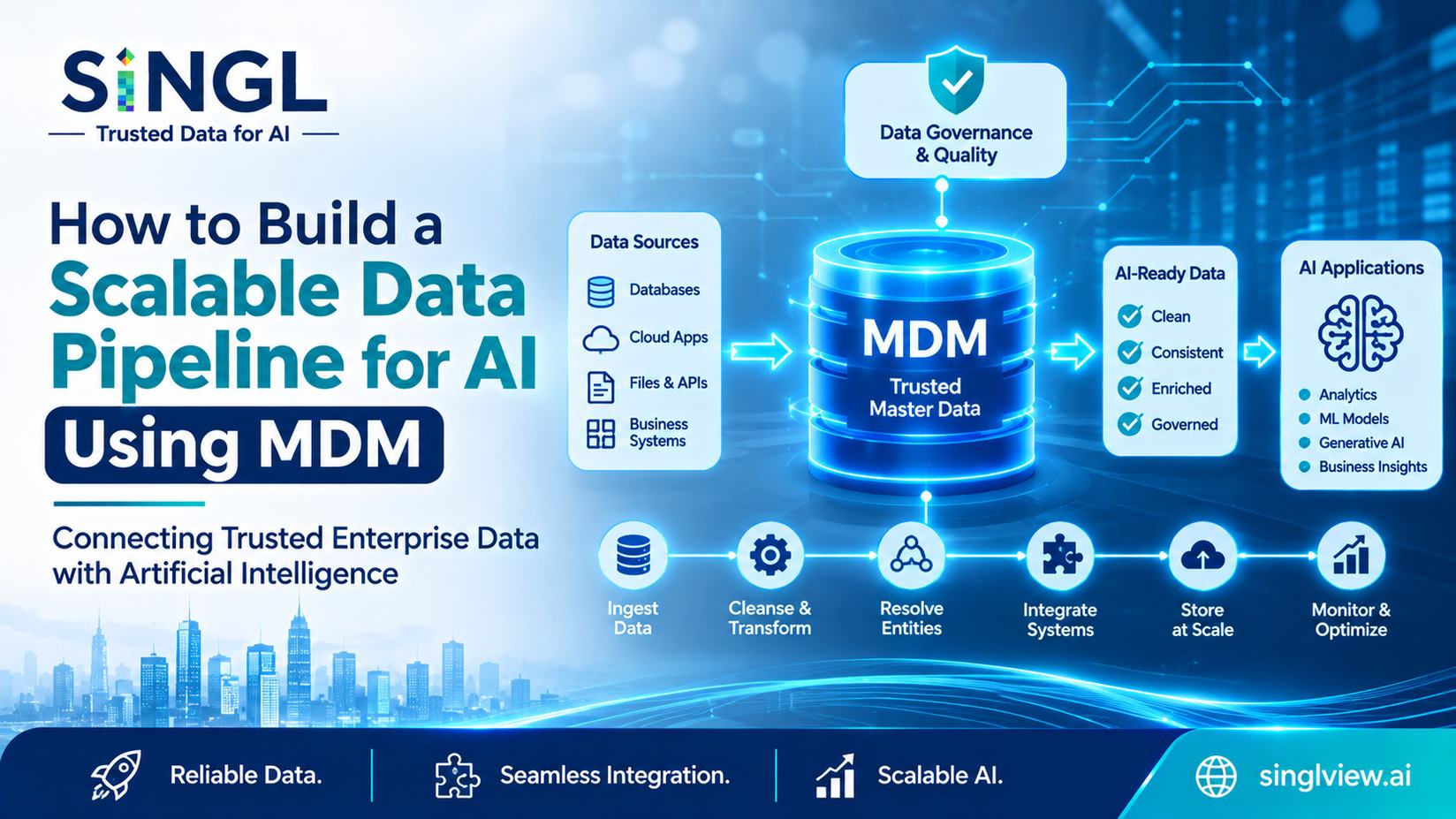
A typical AI data pipeline includes the following stages:
Data ingestion: Collecting information from databases, applications, APIs, files, sensors, and external sources.
Data processing: Cleaning, transforming, standardizing, and validating incoming information.
Data integration: Combining information from different systems into a connected data environment.
Data quality management: Identifying missing, inaccurate, inconsistent, and duplicate records.
Data storage: Maintaining processed information in suitable databases, data warehouses, or data lakes.
Data delivery: Making trusted information available to AI models, analytics platforms, and business applications.
Monitoring: Tracking pipeline performance, data quality, failures, and changes over time.
An AI pipeline must also support continuous updates, reliable data access, security, and governance. Without these capabilities, even advanced AI models can produce inaccurate or inconsistent outcomes.
Why Is MDM Important for Building Scalable AI Data Pipelines?
Traditional data pipelines primarily focus on moving and transforming information. However, moving data does not automatically make it accurate or consistent.
For example, an organization may have three customer records across its CRM, billing, and support platforms. Each record may contain slightly different names, addresses, or contact details. If these records are sent directly into an AI model without proper reconciliation, the model may interpret them as separate customers.
MDM addresses this problem by establishing consistent master records and relationships across systems.
Integrating MDM into an AI data pipeline helps organizations:
Create a consistent view of customers, products, suppliers, and other business entities.
Identify and manage duplicate records.
Standardize information across different source systems.
Improve data accuracy and completeness.
Maintain relationships between related business entities.
Establish data ownership and governance policies.
Provide reliable information for AI models and analytics applications.
Track changes and maintain data lineage.
MDM therefore acts as a trusted data foundation within the wider pipeline. It does not replace ingestion, processing, storage, or AI infrastructure. Instead, it strengthens these components by ensuring that important business information is consistently identified and governed.
Why Choose SiNGL for Master Data Management Solutions?
Building an AI-ready data pipeline requires more than connecting databases and deploying machine learning models. Organizations need a structured approach to data quality, integration, standardization, and governance.
SiNGL's Master Data Management Solutions support organizations in creating consistent master records and improving the reliability of enterprise information. By bringing critical business data into a governed environment, businesses can work towards a stronger foundation for analytics and AI initiatives.
An effective MDM strategy should help organizations:
Consolidate master data from multiple enterprise applications.
Standardize important business attributes.
Identify duplicate and inconsistent records.
Maintain trusted customer, product, and supplier information.
Improve data quality and governance processes.
Support consistent data distribution across connected systems.
Prepare enterprise information for advanced analytics and AI applications.
A well-designed MDM framework helps organizations manage data as a strategic business asset rather than treating it as disconnected information stored across applications.
Key Components of a Scalable AI Data Pipeline Using MDM
A scalable AI data pipeline should be designed around clear responsibilities. Each component must work with the others to ensure that information moves efficiently while maintaining its quality and meaning.
1. Data Ingestion from Multiple Sources
The first stage is collecting information from the systems where business data is generated and maintained.
Common data sources include:
CRM and customer management applications.
ERP and financial systems.
Product information management platforms.
Supplier and procurement applications.
Healthcare information systems.
Data warehouses and data lakes.
APIs and third-party data providers.
IoT devices and operational platforms.
Organizations should support both batch and real-time ingestion, depending on business requirements.
Batch ingestion collects information at scheduled intervals. It is suitable for periodic synchronization, historical analysis, and systems that do not require immediate updates.
Real-time or streaming ingestion processes events as they occur. It is useful for applications that need timely information, such as fraud monitoring, inventory updates, customer activity analysis, and operational alerts.
MDM helps establish consistent identifiers and data definitions across the information collected from these sources.
2. Data Profiling, Cleansing, and Standardization
Incoming data often contains formatting differences, missing attributes, invalid values, and inconsistent naming conventions.
Before information is used for AI applications, it should be examined and standardized.
Data profiling helps organizations understand the condition of their information by identifying:
Missing or incomplete fields.
Invalid formats.
Duplicate values.
Inconsistent naming conventions.
Outdated records.
Unexpected patterns and anomalies.
Cleansing and standardization rules can then correct common issues.
For example, different systems may represent a location as "New York," "New York City," or "NYC." A standardization process can map these variations to an approved value while preserving the original source information when required.
AI can assist with identifying patterns and recommending corrections, while MDM governance rules help determine which values are accepted as trusted master data.
3. Entity Resolution and Master Record Creation
Entity resolution is a central part of an MDM-enabled AI pipeline. It identifies records that refer to the same real-world entity, even when their attributes are not identical.
Consider a supplier whose information appears in multiple systems:
ABC Technologies Pvt. Ltd.
ABC Technology Private Limited
ABC Technologies
These records may refer to the same organization. Entity resolution evaluates available attributes, such as names, addresses, registration identifiers, and other relevant information, to identify potential matches.
MDM can use matching rules, fuzzy matching, probabilistic techniques, and AI-assisted recommendations to support this process.
After matching and validation, the organization can create or maintain a trusted master record, often called a golden record.
A golden record represents the approved and consolidated view of an entity. It may contain information selected from multiple source systems according to defined survivorship rules, data ownership policies, and business requirements.
This helps downstream AI applications work with consistent entity information instead of fragmented records.
4. Data Integration and Transformation
Once master records are established, they need to be made available to the systems and applications that use them.
Data integration connects the MDM environment with enterprise applications, warehouses, lakes, analytics platforms, and AI systems.
This may involve:
API-based integration.
Event-driven data distribution.
ETL and ELT processes.
Message queues and streaming platforms.
Scheduled synchronization.
Data virtualization or federation.
Transformation processes ensure that information is delivered in the format required by each destination.
For example, an AI recommendation engine may require standardized customer and product identifiers, while a reporting platform may need consolidated customer information with defined business attributes.
MDM provides consistent master data that can be integrated into these different workflows.
5. Storage and Data Architecture
A scalable pipeline needs a storage architecture that supports different types of information and workloads.
Organizations may use a combination of:
Data lakes: For storing large volumes of structured, semi-structured, and unstructured data.
Data warehouses: For organized information used in reporting and business intelligence.
Operational databases: For applications that require fast access to current business records.
Feature stores: For managing and serving reusable features used by machine learning models.
Vector databases: For storing vector embeddings used in semantic search and retrieval-based AI applications.
MDM should work alongside these storage technologies rather than being treated as a replacement for them.
It provides consistent master data definitions, identifiers, and relationships that can be referenced across the architecture.
For example, a customer identifier maintained through MDM can help connect customer transactions in a warehouse with customer information used by an AI application.
6. Data Delivery to AI and Machine Learning Models
After data has been ingested, standardized, validated, and integrated, it can be delivered to AI applications.
Common use cases include:
Customer segmentation.
Predictive analytics.
Product recommendations.
Demand forecasting.
Fraud detection.
Customer service automation.
Supplier risk analysis.
Generative AI applications.
Retrieval-Augmented Generation (RAG).
MDM improves the reliability of the information used in these applications by helping maintain consistent entities and business definitions.
For example, a recommendation engine can use standardized customer and product information to improve the consistency of its input data.
However, master data alone is not sufficient for every AI workload. Transactional data, historical activity, contextual information, and other relevant datasets may also be required.
The objective is to combine trusted master data with the right supporting information for each AI application.
7. Data Observability, Lineage, and Monitoring
A scalable data pipeline must be monitored continuously. Organizations need to know whether information is moving correctly, whether quality standards are being maintained, and whether downstream applications are receiving reliable data.
Data observability helps monitor:
Pipeline failures and processing delays.
Data freshness and availability.
Missing or unexpected values.
Duplicate records.
Changes in data distributions.
Integration errors.
Data quality rule violations.
Data lineage provides visibility into where information originated, how it was transformed, and which systems consume it.
For AI-enabled MDM, organizations should also maintain records of important automated decisions, including matching recommendations, confidence scores, record merges, and human approvals.
These controls make it easier to investigate issues, demonstrate accountability, and maintain trust in the pipeline.
Step-by-Step Process to Build a Scalable AI Data Pipeline Using MDM
Understanding the architecture is important, but successful implementation requires a practical sequence of activities.
Step 1: Define AI and Business Requirements
Start by identifying the business outcomes the pipeline should support.
For example, an organization may want to improve customer recommendations, automate supplier analysis, strengthen fraud detection, or build an enterprise AI assistant.
Each use case has different data requirements, processing speeds, quality expectations, and security needs.
Define:
The AI applications to be supported.
The critical data domains involved.
Required data sources and destinations.
Data freshness and latency expectations.
Data quality standards.
Security and compliance requirements.
Success metrics.
This helps prevent unnecessary complexity and keeps the MDM implementation aligned with business priorities.
Step 2: Identify Critical Master Data Domains
Next, determine which business entities need consistent management.
Common master data domains include:
Customer.
Product.
Supplier.
Employee.
Location.
Organization.
Account.
Organizations should prioritize domains according to their business value and relevance to the selected AI use cases.
For example, a retail business may begin with customer and product data, while a financial institution may prioritize customer, account, and organization information.
Step 3: Assess Existing Data Sources and Quality
Before connecting systems, evaluate the condition of the existing data.
Identify where information is stored, how it is structured, which systems own it, and where inconsistencies occur.
Create a source inventory that documents:
Source application.
Data domain.
Data owner.
Available attributes.
Data format.
Update frequency.
Quality issues.
Integration requirements.
This assessment provides a baseline for designing data ingestion, standardization, and MDM processes.
Step 4: Establish MDM Rules and Governance
Define how master records should be created, matched, updated, approved, and distributed.
Important governance decisions include:
Data ownership and stewardship.
Standard data definitions.
Matching and merging rules.
Survivorship rules for conflicting attributes.
Data access permissions.
Approval workflows.
Audit and retention requirements.
For example, if a customer's address differs between two systems, the organization should have a defined rule for determining which value becomes the trusted record.
AI can recommend a likely match or correction, but the decision should follow approved business rules and appropriate review processes.
Step 5: Build Ingestion and Processing Workflows
Connect the identified data sources to the pipeline using suitable ingestion methods.
Use batch processing for scheduled updates and streaming for use cases that require timely event processing.
Apply validation, transformation, and standardization rules as information enters the environment.
At this stage, organizations should also define how failed records and incomplete information will be handled.
Step 6: Implement MDM and Entity Resolution
Introduce matching, deduplication, standardization, and master record management processes.
Start with clearly defined matching rules and test them against representative datasets.
Use AI-assisted matching where it provides additional value, especially when records contain variations that exact matching cannot reliably identify.
Set confidence thresholds and route uncertain matches to authorized data stewards.
Validate golden record creation and ensure that source-to-master relationships remain traceable.
Step 7: Integrate Master Data with AI Infrastructure
Connect trusted master data to the storage, processing, and AI environments that require it.
Depending on the use case, this may involve data warehouses, data lakes, feature stores, model training pipelines, vector databases, or AI application APIs.
Ensure that downstream systems can identify the version of the master data they consume and understand how updates are distributed.
Step 8: Establish Continuous Monitoring and Improvement
Once the pipeline is operational, monitor both technical performance and data quality.
Track pipeline availability, processing delays, failed records, duplicate rates, data quality scores, and downstream synchronization.
Review AI matching performance and human corrections to identify areas where rules or models need improvement.
A scalable pipeline should evolve as data volumes, business requirements, and AI applications change.
Industry Applications of Scalable AI Data Pipelines Using MDM
Different industries have unique requirements for data management, integration, security, and AI adoption. MDM can help establish a consistent data foundation across these environments.
Financial Services MDM
Financial institutions manage customer, account, product, transaction, and organizational information across multiple systems. Disconnected records can affect customer insights, reporting, risk analysis, and compliance processes.
Financial Services MDM helps banks, insurance providers, and financial organizations establish consistent master records across their business applications.
An MDM-enabled AI pipeline can support:
Customer identity resolution.
Consolidated customer information.
Standardized account and product records.
Data quality monitoring.
Governed information for analytics.
Reliable inputs for fraud detection and risk analysis.
For financial services organizations, data lineage, access control, auditability, and regulatory requirements should be built into the pipeline design.
Healthcare MDM
Healthcare organizations manage patient, provider, facility, service, and supplier information across hospital systems, electronic health records, billing applications, and other platforms.
Inconsistent data can make it difficult to connect information across departments and healthcare facilities.
Healthcare MDM helps create consistent records for important healthcare entities and supports the integration of information across applications.
A scalable AI data pipeline using MDM can support:
Patient record matching.
Provider and facility data standardization.
Healthcare service information management.
Duplicate record identification.
Data quality monitoring.
Governed information for healthcare analytics and AI applications.
Because healthcare information can be highly sensitive, organizations must incorporate appropriate privacy protections, access controls, security measures, and applicable regulatory requirements.
Master Data Management in New York
Organizations exploring Master Data Management in New York may operate across financial services, healthcare, technology, retail, and professional services.
These businesses often depend on information distributed across departments, applications, and locations.
An MDM-enabled AI pipeline can help standardize customer, supplier, product, and organizational data while supporting reliable integration across enterprise systems.
For businesses in regulated industries, governance and traceability should be key considerations when designing AI data workflows.
Master Data Management in Chicago
Businesses considering Master Data Management in Chicago may have complex data requirements across manufacturing, logistics, healthcare, financial services, and distribution.
These operations often involve information from procurement, inventory, production, customer management, and finance systems.
MDM can help create consistent product, supplier, customer, and location records across these applications. AI-enabled processing can further support duplicate detection, data classification, and quality monitoring.
This creates a stronger foundation for connected reporting, operational analytics, and AI-driven planning.
Master Data Management in Dallas
Organizations evaluating Master Data Management in Dallas may operate across technology, healthcare, energy, retail, and financial services.
As businesses expand, their data environments may become more complex due to new applications, additional business units, and acquisitions.
MDM helps standardize important business entities across these systems. When integrated into a scalable AI data pipeline, it can support consistent data ingestion, reliable master records, and governed information delivery to analytics and AI applications.
Common Challenges in Building AI Data Pipelines with MDM
Although MDM can improve data reliability, organizations may encounter technical and operational challenges during implementation.
1. Fragmented Data Environments
Enterprise information may be distributed across legacy applications, cloud platforms, and departmental databases.
How to address it: Create a data source inventory, define integration standards, and prioritize the systems that support critical business use cases.
2. Poor Data Quality
Incomplete, outdated, and duplicate records can affect master data creation and AI model performance.
How to address it: Introduce data profiling, standardization, validation, and continuous quality monitoring before distributing information to AI applications.
3. Complex Entity Matching
Records may have different names, formats, and attributes, making accurate matching difficult.
How to address it: Combine business-defined matching rules with AI-assisted techniques. Use confidence thresholds and human review for uncertain matches.
4. Scalability and Performance Issues
Data volumes and processing requirements can increase as more applications and AI use cases are introduced.
How to address it: Design for modular scaling, use suitable batch and streaming technologies, optimize processing workloads, and monitor performance regularly.
5. Integration and Synchronization Delays
Different systems may update information at different times, creating inconsistencies between source applications and downstream consumers.
How to address it: Define synchronization requirements, event-handling processes, and clear rules for resolving conflicting updates.
6. Security and Compliance Risks
AI pipelines may process sensitive customer, financial, employee, or healthcare information.
How to address it: Apply encryption, role-based access, audit logging, data minimization, retention policies, and appropriate privacy controls.
7. Lack of Governance and Accountability
Without clear ownership, data quality issues and conflicting updates may remain unresolved.
How to address it: Assign data owners and stewards, document responsibilities, and establish approval workflows for important master data changes.
Best Practices for Building a Scalable MDM-Enabled AI Pipeline
Organizations can improve the reliability and long-term performance of their AI data pipelines by following these practices:
Start with specific business use cases: Design the pipeline around measurable business requirements rather than introducing technology without a clear objective.
Prioritize high-value data domains: Begin with the entities that have the greatest impact on AI applications.
Establish governance before automation: Define ownership, data standards, matching rules, and approval responsibilities.
Use the right ingestion approach: Select batch, streaming, or a combination based on data freshness and processing needs.
Maintain consistent master identifiers: Use reliable identifiers to connect records across applications and datasets.
Apply AI-assisted matching carefully: Use confidence scores, validation rules, and human review to manage uncertain matches.
Separate processing from governance controls: Design an architecture that allows data workflows to scale while maintaining consistent policies and access controls.
Build observability into the pipeline: Monitor data quality, lineage, freshness, failures, and downstream impact.
Protect sensitive information: Apply security and privacy safeguards throughout ingestion, processing, storage, and delivery.
Continuously evaluate performance: Review technical metrics and business outcomes as the pipeline evolves.
How to Measure the Success of an MDM-Enabled AI Data Pipeline
Organizations should evaluate the pipeline using a combination of data quality, operational, and AI-related measurements.
The organization should establish baseline measurements before implementation and set realistic improvement targets based on its data maturity and business priorities.
How SiNGL Supports Scalable Data Management for AI
A reliable AI data pipeline depends on trusted information moving consistently across enterprise systems. SiNGL's Master Data Management Solutions can help organizations establish consistent master records and improve the quality and governance of important business data.
A structured MDM approach can support organizations in:
Consolidating master data from multiple sources.
Standardizing customer, product, supplier, and other business records.
Identifying duplicate and inconsistent information.
Improving data quality and governance.
Supporting integration across enterprise applications.
Establishing trusted data foundations for analytics and AI initiatives.
Organizations can explore Master Data Management Solutions to understand how MDM can support their enterprise data strategy.
For industry-specific requirements, businesses can also explore Financial Services MDM and Healthcare MDM.
Conclusion
Building a scalable data pipeline for AI requires more than collecting information and transferring it between systems. Organizations must ensure that data is accurate, consistent, governed, and available to the applications that depend on it.
MDM strengthens this process by providing trusted master records, consistent identifiers, entity resolution, data quality controls, and clear governance. When integrated with ingestion, processing, storage, data integration, and AI infrastructure, it helps create a reliable foundation for machine learning, predictive analytics, and generative AI.
A successful implementation should begin with business requirements, prioritize critical data domains, establish governance, and introduce automation where it delivers measurable value. Continuous monitoring, lineage, security, and performance evaluation then help the pipeline scale as organizational needs evolve.
With the right MDM strategy, businesses can move beyond disconnected data environments and build scalable, AI-ready data pipelines that support more reliable insights and informed decisions.
Ready to strengthen your enterprise data foundation? Explore SiNGL's Master Data Management Solutions and discover how trusted master data can support your organization's AI and data transformation goals.
Frequently Asked Questions
1. What is an AI data pipeline?
An AI data pipeline is a structured process that collects, validates, transforms, integrates, and delivers information to artificial intelligence and machine learning applications. It helps ensure that data is available in a suitable format and quality for AI workloads.
2. How does MDM improve an AI data pipeline?
MDM improves an AI data pipeline by creating consistent master records, identifying duplicate entities, standardizing business information, and establishing data governance. This helps AI applications use more reliable customer, product, supplier, and other enterprise data.
3. What is a golden record in MDM?
A golden record is a trusted, consolidated representation of a business entity. It is created by matching and reconciling information from multiple sources using approved data quality, matching, and survivorship rules.
4. What is entity resolution in an AI data pipeline?
Entity resolution identifies records that refer to the same real-world entity, even when their attributes differ. AI-assisted matching can use fuzzy, probabilistic, and semantic techniques to identify potential duplicates and improve record consolidation.
5. Can MDM support real-time AI data pipelines?
Yes. MDM can work with event-driven and streaming architectures to support the distribution of updated master data to connected applications. The appropriate design depends on business requirements, processing latency, governance controls, and the capabilities of the integration environment.
6. What is the difference between MDM and data integration?
Data integration moves and combines information across systems. MDM focuses on maintaining consistent, trusted records for important business entities. They complement each other: integration connects data sources, while MDM helps ensure that critical business information remains consistent.
7. How does Financial Services MDM support AI applications?
Financial Services MDM helps financial institutions maintain consistent customer, account, product, and organizational records. These trusted records can support analytics, customer insights, risk-related workflows, and other governed AI applications.
8. How does Healthcare MDM support AI data pipelines?
Healthcare MDM helps standardize patient, provider, facility, and service information across healthcare applications. This can support more consistent data integration and analytics while maintaining appropriate privacy, security, and governance controls.
9. What technologies are used to build scalable AI data pipelines?
Common technologies include data integration and ETL/ELT tools, streaming platforms, cloud storage, data warehouses, data lakes, MDM platforms, orchestration tools, feature stores, vector databases, and monitoring solutions. The technology stack should be selected according to the organization's architecture and AI requirements.