What Is the Role of MDM in Modern Data Architecture?
Discover the role of Master Data Management (MDM) in modern data architecture. Learn how MDM improves data quality, governance, system integration, analytics, and AI readiness across enterprise systems.
Introduction
Modern businesses depend on data to make decisions, improve customer experiences, automate operations, and support artificial intelligence (AI). However, as organizations adopt cloud platforms, analytics tools, enterprise applications, and AI systems, their data often becomes scattered across multiple sources. Different systems may store conflicting customer details, duplicate product records, or outdated supplier information.
This is where Master Data Management (MDM) becomes an important part of modern data architecture. It helps organizations create consistent, trusted, and governed records for critical business entities, including customers, products, suppliers, employees, and locations.
Master Data Management Solutions enable businesses to improve data quality, establish reliable information-sharing practices, and create a stronger foundation for analytics and AI. Rather than replacing databases, data warehouses, or data integration tools, MDM complements these technologies by ensuring that essential business information remains accurate and consistent across systems.
In this guide, we explore the role of MDM in modern data architecture, its core responsibilities, industry applications, implementation best practices, and its contribution to building an AI-ready enterprise.
Who Can Benefit from Understanding MDM in Modern Data Architecture?
MDM is relevant to organizations that manage large volumes of business-critical information across multiple systems. Understanding its role can help:
Enterprise IT leaders improve data consistency across business applications.
Data architects design scalable and reliable data environments.
Data engineers maintain dependable data pipelines and integration processes.
Data governance teams establish data ownership, standards, and accountability.
Business intelligence teams improve reporting accuracy and analytical insights.
AI and machine learning teams access reliable, consistent data for intelligent applications.
Financial and healthcare organizations manage sensitive, complex, and interconnected information more effectively.
Organizations operating across multiple locations or business units can particularly benefit from a well-planned MDM strategy.
What Is Master Data Management (MDM)?
Master Data Management is a combination of processes, governance practices, and technologies used to create and maintain consistent records of an organization's most important business entities.
These entities, commonly known as master data, include customers, products, suppliers, employees, business locations, and legal entities.
For example, a company may store the same customer in its CRM, billing platform, customer support system, and marketing database. Each system might contain a slightly different name, address, or contact number. MDM helps identify and reconcile these records to establish a trusted, consistent representation of that customer.
Depending on the organization's architecture, the resulting trusted record can be maintained centrally or shared with connected systems through synchronization and integration processes.
How MDM Works
An MDM program typically involves several activities:
Data collection: Gather relevant records from different business systems.
Data standardization: Apply consistent formats, naming conventions, and business rules.
Matching and deduplication: Identify records that represent the same entity.
Data quality validation: Detect missing, incorrect, inconsistent, or outdated information.
Record consolidation: Create a trusted representation, often called a golden record.
Governance and stewardship: Define who owns the data and who can approve changes.
Data distribution: Share approved master records with authorized applications and platforms.
These activities help establish dependable master data that can support business operations, reporting, and advanced analytics.
Core Roles of MDM in Modern Data Architecture
MDM plays several interconnected roles within a modern data environment. Its primary responsibility is to make critical business data consistent, governed, and reusable across the systems that depend on it.
1. Establishing a Trusted Source of Master Data
Organizations often maintain customer, product, and supplier information in different applications. Without consistent management, these records can become fragmented and contradictory.
MDM establishes a trusted version of essential business entities by reconciling duplicates, applying standard definitions, and maintaining relationships between records.
For example, a retailer can use MDM to ensure that a product has consistent identifiers, descriptions, and category information across its e-commerce platform, inventory system, and reporting environment.
This improves confidence in the data used for everyday operations and strategic decisions.
2. Improving Data Quality and Consistency
Poor data quality can lead to incorrect reports, duplicated customer communications, operational delays, and unreliable business decisions.
MDM introduces data quality rules, validation processes, matching logic, and ongoing monitoring to help maintain accurate master records.
These controls can identify problems such as duplicate customer profiles, inconsistent product codes, incomplete supplier details, and conflicting business identifiers.
As a result, teams can spend less time correcting avoidable data issues and more time using information productively.
3. Strengthening Data Governance
Modern data architecture requires more than moving information between systems. Organizations must also define how data is created, maintained, accessed, and changed.
MDM supports data governance by establishing ownership, stewardship responsibilities, business definitions, approval workflows, and quality standards for master data.
For instance, a company can designate a responsible data steward to review changes to supplier records or resolve conflicts between customer profiles.
These practices improve accountability and help ensure that important business information follows established organizational policies.
4. Connecting Enterprise Applications
Organizations commonly use ERP, CRM, supply chain, finance, customer service, and analytics platforms. Each application may manage information differently, creating inconsistencies across the enterprise.
MDM helps align shared business entities across these systems. Integration tools, APIs, event-driven architectures, and data pipelines can then distribute or synchronize approved master data where required.
This allows different applications to work with consistent customer, product, supplier, or organizational information without requiring every system to manage master data independently.
5. Supporting Analytics and Business Intelligence
Analytics platforms are only as dependable as the information used to generate their insights. When customer or product records are duplicated or inconsistent, reports may overstate sales, fragment customer activity, or produce misleading comparisons.
MDM improves the reliability of shared dimensions and business entities used in analytics. This can help organizations create more consistent customer views, product performance reports, supplier analyses, and financial summaries.
However, MDM does not replace a data warehouse or analytics platform. Instead, it helps provide trusted master data that those platforms can use alongside transactional and historical information.
6. Enabling AI and Machine Learning
AI systems require data that is relevant, consistent, and sufficiently well governed for their intended use. Duplicate entities, conflicting attributes, and unclear relationships can weaken model inputs and make results harder to interpret.
MDM helps improve the identity, consistency, and contextual meaning of core business entities used in AI applications.
For example, a customer service AI system may produce more useful responses when it can access properly linked customer and product information rather than several conflicting profiles.
MDM alone does not guarantee accurate AI outcomes. Organizations must also address data lineage, privacy, security, representativeness, model quality, and access controls. Nevertheless, trusted master data can be an important component of an AI-ready architecture.
7. Supporting Security, Compliance, and Auditability
Organizations need to understand where sensitive information is maintained, who can modify it, and how changes are approved.
MDM can support these requirements through controlled workflows, access policies, audit trails, and clear ownership of master records. It can also help standardize reference information used in compliance reporting.
The specific regulatory benefits depend on the organization's industry, jurisdiction, implementation, and broader governance controls. MDM should therefore be treated as one component of a complete security and compliance strategy.
8. Improving Scalability Across Business Units
As organizations expand into new markets, acquire other businesses, or adopt additional applications, their data environments become more complex.
A well-designed MDM framework provides reusable data standards, matching rules, governance processes, and integration patterns. These can help organizations manage new systems and business entities without repeatedly solving the same data consistency problems.
This makes MDM valuable for growing enterprises that need to maintain reliable information across departments, subsidiaries, and geographic locations.
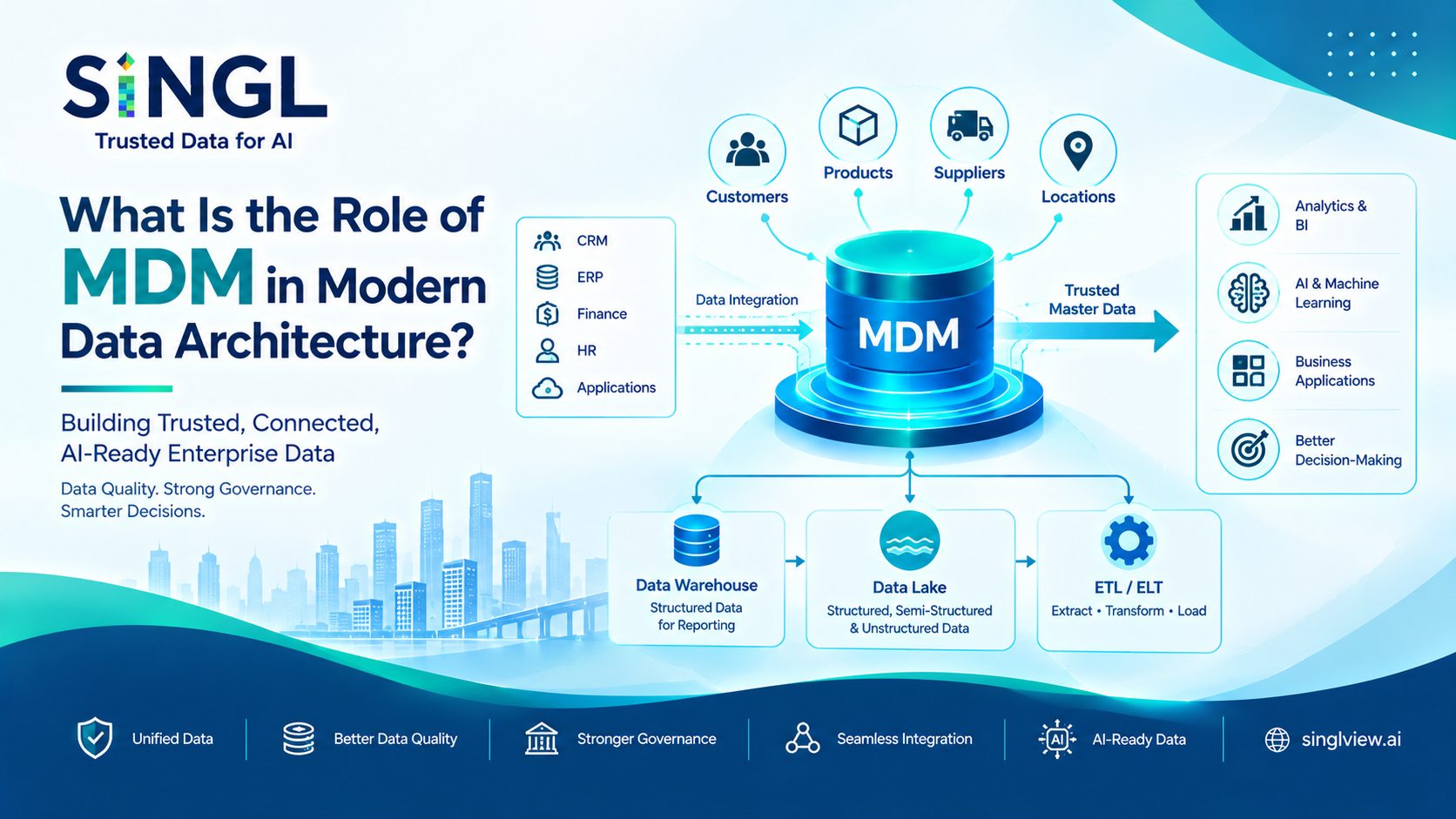
How MDM Fits into Modern Data Architecture
MDM is most effective when its responsibilities are clearly defined alongside other data architecture components.
A typical modern data environment may include:
Source systems: ERP, CRM, billing, supply chain, healthcare, and operational applications.
Data integration: APIs, ETL or ELT pipelines, messaging platforms, and data synchronization services.
Master Data Management: Matching, standardization, governance, entity resolution, and trusted master records.
Data storage: Data warehouses, data lakes, lakehouses, and operational databases.
Analytics and AI: Business intelligence, reporting, machine learning, and generative AI applications.
These components perform different functions. Integration technologies move and transform information; storage platforms retain data for operational or analytical purposes; and MDM manages the consistency and governance of critical shared business entities.
The architecture does not have to follow a single fixed sequence. In some environments, MDM operates before data enters analytical platforms. In others, it uses data from existing platforms and publishes trusted records back to operational systems.
The right design depends on data latency requirements, ownership, system capabilities, security needs, and business objectives.
MDM vs. Other Components of Data Architecture
MDM is often confused with data integration, data warehouses, and data governance. Although these areas overlap, their responsibilities differ.
These components are complementary rather than interchangeable. A mature data architecture combines them according to the organization's needs.
Industry Applications of MDM in Modern Data Architecture
The role of MDM becomes clearer when considered in the context of industries with complex data relationships and high requirements for accuracy.
Financial Services MDM
Financial institutions manage customer profiles, accounts, counterparties, legal entities, financial products, and regulatory reference data across multiple applications.
Financial Services MDM helps establish consistent records for these entities, making it easier to connect information across banking, wealth management, lending, risk, and compliance environments.
Potential applications include:
Creating more consistent customer and counterparty records.
Supporting customer identity resolution across business units.
Improving the consistency of legal entity reference data.
Reducing duplicate records across financial applications.
Supporting risk reporting and regulatory data processes.
Improving the quality of data used in financial analytics and AI.
MDM does not independently ensure regulatory compliance or eliminate financial risk. However, trusted master data can support the broader controls and reporting processes that financial institutions rely on.
Explore Financial Services MDM to learn more about managing trusted data in financial environments.
Healthcare MDM
Healthcare organizations manage patient identities, providers, facilities, medical services, insurance relationships, and other critical information across electronic health records, hospital information systems, laboratories, and administrative platforms.
Healthcare MDM helps improve consistency across these data sources and supports the accurate identification of patients, providers, and healthcare organizations.
Common applications include:
Reconciling duplicate patient records.
Maintaining consistent provider and facility information.
Improving data exchange across healthcare applications.
Supporting healthcare analytics and operational reporting.
Improving the reliability of data used in population health analysis.
Providing more consistent reference data for healthcare AI applications.
Healthcare MDM must be implemented with appropriate privacy, security, access controls, and patient identity safeguards. It complements clinical systems and interoperability standards rather than replacing them.
Master Data Management in New York
Organizations seeking Master Data Management in New York may operate across financial services, healthcare, retail, professional services, and large enterprise environments.
For these businesses, MDM can help standardize customer, supplier, product, and legal entity information across departments and applications. It can also support data governance initiatives and provide more consistent records for enterprise reporting and analytics.
Organizations evaluating MDM should consider integration with their existing systems, data ownership, security requirements, implementation complexity, and long-term scalability.
Master Data Management in Chicago
Businesses exploring Master Data Management in Chicago may need to coordinate information across manufacturing, logistics, healthcare, financial services, and multi-location operations.
MDM can help maintain consistent product specifications, supplier details, customer records, and organizational hierarchies across business units.
For organizations with complex supply chains or multiple operational systems, trusted master data can improve the consistency of inventory analysis, supplier reporting, and cross-departmental workflows.
Master Data Management in Dallas
Organizations considering Master Data Management in Dallas may include expanding enterprises, technology businesses, healthcare organizations, financial institutions, and companies managing distributed operations.
An MDM strategy can help these businesses establish consistent records across newly added applications, acquired business units, and growing data environments.
The focus should be on selecting the right master data domains, defining ownership, setting measurable data quality goals, and ensuring that trusted records reach the systems that need them.
These regional examples describe potential business needs rather than guarantees about specific providers or outcomes. The most suitable MDM approach depends on each organization's data landscape and objectives.
Key Benefits of MDM in Modern Data Architecture
A well-planned MDM program can deliver several business and technical benefits.
Better data quality: Standardization, validation, and matching processes help reduce duplicates and inconsistencies.
More reliable reporting: Consistent master records help teams interpret customer, product, supplier, and organizational data more accurately.
Improved operational efficiency: Shared definitions and trusted records can reduce repetitive data correction across departments.
Stronger governance: Clear ownership and stewardship processes help establish accountability for critical information.
Better system interoperability: Consistent identifiers and attributes make it easier to connect information across applications.
Improved customer understanding: Linking records across channels can support a more complete view of customer relationships.
AI readiness: Reliable master data can provide more consistent entity information for AI and machine learning workflows.
Scalable data management: Reusable standards and governance processes can help organizations manage increasing data complexity as they grow.
The actual results depend on implementation quality, business adoption, data complexity, and how MDM is integrated into the wider architecture.
Best Practices for Implementing MDM
Successful MDM implementation requires both technical planning and organizational commitment.
1. Identify the Most Valuable Data Domains
Begin with business-critical entities such as customers, products, suppliers, providers, or legal entities. Select domains based on measurable business problems rather than trying to centralize every data type immediately.
2. Define Ownership and Stewardship
Assign responsibility for data definitions, quality rules, conflict resolution, approvals, and ongoing maintenance. Clear ownership prevents master data from becoming an isolated IT project.
3. Establish Data Quality Standards
Define measurable standards for completeness, accuracy, consistency, uniqueness, and timeliness. Monitor these measures regularly and create workflows for resolving quality issues.
4. Integrate MDM with Existing Systems
Determine which applications create, consume, and update master data. Select appropriate integration methods, such as APIs, event-driven messaging, or scheduled pipelines, based on the business requirements.
5. Build Security into the Architecture
Apply role-based access, audit trails, appropriate encryption, privacy controls, and data retention policies. Sensitive information should only be available to authorized users and systems.
6. Plan for Change and Growth
Account for mergers, acquisitions, new applications, additional data domains, and changing business rules. A scalable architecture should accommodate these changes without creating unnecessary duplication.
7. Measure Business Outcomes
Track indicators such as duplicate record rates, data quality scores, record reconciliation time, master data adoption, and the time needed to resolve data issues.
Measuring these indicators helps organizations determine whether MDM is improving data reliability and supporting business goals.
Common Challenges in MDM Implementation
Although MDM can improve enterprise data architecture, organizations may face several challenges:
Fragmented source systems: Applications may use different identifiers, formats, and business definitions.
Poor source data quality: Incomplete or inaccurate records can complicate matching and consolidation.
Unclear ownership: Teams may disagree about who controls a record or approves changes.
Integration complexity: Legacy systems may not support modern APIs or real-time synchronization.
Resistance to change: Employees may continue using local spreadsheets or inconsistent data processes.
Unclear business objectives: An implementation without measurable outcomes can become overly technical.
Ongoing maintenance: Master data requires continuous monitoring, stewardship, and updates.
Organizations can address these challenges through phased implementation, strong executive sponsorship, clear governance, early stakeholder involvement, and continuous improvement.
How SiNGL Supports Master Data Management
Building a reliable data architecture requires a clear approach to data consistency, quality, and governance. SiNGL's Master Data Management Solutions are relevant to organizations seeking to establish trusted master data and improve how critical business information is managed across enterprise systems.
An MDM strategy should align with an organization's data domains, integration requirements, governance framework, and business priorities. It should also account for the way trusted master records are consumed by operational applications, analytics platforms, and AI systems.
For organizations in financial services and healthcare, domain-specific considerations are particularly important because their data environments involve complex relationships, sensitive information, and demanding quality requirements.
A structured approach to MDM can help businesses build a more consistent foundation for reporting, operational processes, and data-driven initiatives.
Conclusion
MDM plays a foundational role in modern data architecture by helping organizations maintain consistent, trusted, and governed records for critical business entities. It complements integration pipelines, data warehouses, data lakes, and analytics platforms rather than replacing them.
By improving data quality, connecting enterprise applications, supporting governance, and strengthening the reliability of information used in analytics and AI, MDM helps businesses make better use of their data assets.
Whether an organization is evaluating Financial Services MDM, Healthcare MDM, or Master Data Management in New York, Chicago, or Dallas, the first step is to identify its most important data challenges and establish a practical strategy for managing trusted master records.
Build a stronger foundation for trusted enterprise data with SiNGL. Explore Mas
ter Data Management Solutions to understand how an MDM approach can support your organization's data architecture and long-term data goals.
Frequently Asked Questions
1. What is the role of MDM in modern data architecture?
MDM helps maintain consistent, accurate, and governed records for critical business entities across enterprise systems. It supports data quality, integration, analytics, and AI readiness.
2. How does MDM differ from data integration?
Data integration moves and combines information between systems. MDM focuses on resolving, standardizing, governing, and maintaining trusted records for key business entities.
3. Does MDM replace a data warehouse or data lake?
No. MDM manages trusted master data, while data warehouses support structured analytics and data lakes store large volumes of data in different formats. They can work together within the same architecture.
4. How does MDM support AI applications?
MDM can improve the consistency and identity of core business entities used by AI systems. However, effective AI also requires appropriate data quality, security, governance, and model validation.
5. Why is MDM important for financial services?
Financial institutions use MDM to maintain consistent customer, counterparty, legal entity, and product information across systems. This can support more reliable reporting, analytics, and governance processes.
6. Why is MDM important in healthcare?
Healthcare MDM helps organizations maintain consistent patient, provider, facility, and service records. When implemented with suitable privacy and security controls, it can support interoperability and more reliable healthcare analytics.