How to Implement Master Data Management in an AI-Driven Organization
Discover how organizations can implement Master Data Management in an AI-driven environment. Explore AI-powered data governance, automated data matching, intelligent enrichment, scalable architecture, and data observability to build trusted, AI-ready enterprise data.
Introduction
Artificial Intelligence is changing how organizations collect, process, manage, and use business information. From predictive analytics and intelligent automation to generative AI and autonomous AI agents, modern enterprises increasingly depend on accurate, connected, and reliable data to support their operations.
However, AI systems are only as dependable as the information they use. When business data is duplicated, incomplete, outdated, or inconsistent across applications, AI models may generate inaccurate insights, make unreliable recommendations, or produce decisions based on conflicting information.
This is where Master Data Management (MDM) becomes essential.
Master Data Management helps organizations establish consistent, trusted records for critical business entities such as customers, products, suppliers, employees, and business locations. In an AI-driven organization, MDM goes beyond traditional data cleansing and record consolidation. It provides a structured foundation for data quality, governance, entity resolution, AI-powered enrichment, and reliable information sharing across enterprise systems.
Implementing MDM in an AI-driven organization requires a strategy that combines business accountability, intelligent automation, scalable architecture, and continuous monitoring.
In this guide, we explain how organizations can implement Master Data Management, explore the role of AI in modern MDM capabilities, and discuss how businesses can create a reliable data foundation for intelligent applications.
Who Can Benefit from Implementing MDM in an AI-Driven Organization?
Implementing MDM is particularly important for organizations that use multiple applications, manage large volumes of information, or plan to introduce AI across their business operations.
The following teams can benefit from a structured MDM strategy:
Business leaders: Improve decision-making through consistent and trusted business information.
Data architects: Build scalable data environments that support enterprise applications and AI systems.
Data engineers: Improve data ingestion, transformation, matching, and synchronization processes.
Data governance teams: Establish data ownership, quality standards, and accountability.
AI and machine learning teams: Access reliable and well-structured information for model development and deployment.
IT managers: Connect enterprise applications and reduce information silos.
Financial institutions: Maintain consistent customer, account, counterparty, and legal entity records.
Healthcare organizations: Improve the management of patient, provider, facility, and administrative information.
Organizations exploring AI adoption, cloud modernization, enterprise analytics, and intelligent automation should consider MDM an important part of their broader data strategy.
Why Choose SiNGL for Master Data Management Solutions?
An AI-driven organization needs more than advanced algorithms. It requires a dependable data foundation that supports accurate records, consistent information, and effective data management across business systems.
SiNGL's Master Data Management Solutions focus on helping organizations establish and maintain trusted master data across their enterprise environments.
A structured MDM approach can help businesses:
Create consistent master records across multiple data sources.
Identify and reduce duplicate customer, product, and supplier information.
Improve data standardization and quality.
Establish reliable information for enterprise applications.
Support data governance and stewardship workflows.
Prepare business information for analytics and AI applications.
Improve consistency across connected systems.
For organizations considering Financial Services MDM or Healthcare MDM, maintaining accurate and well-governed master records is particularly important because of the complexity and sensitivity of their information.
The goal is to make trusted data accessible to the systems and teams that need it while maintaining appropriate human oversight and accountability.
What Is Master Data Management in an AI-Driven Organization?
Master Data Management is a combination of processes, technologies, workflows, and governance practices used to create and maintain consistent records for an organization's most important business entities.
These entities typically include:
Customers
Products
Suppliers
Employees
Business partners
Financial accounts
Legal entities
Healthcare providers
Business locations
In traditional environments, MDM primarily focuses on consolidating information, identifying duplicate records, standardizing attributes, and creating a trusted representation known as a golden record.
In an AI-driven organization, these capabilities can be enhanced with machine learning, natural language processing, intelligent matching, automated classification, and AI-assisted data enrichment.
For example, an organization may receive customer information from its CRM, ERP, billing platform, and customer support application. Each system may contain slightly different details about the same individual.
AI-assisted MDM can help identify matching records, compare attributes, detect inconsistencies, and recommend potential merges. After applying defined business rules and appropriate approval workflows, the organization can maintain a more reliable customer record.
This helps AI systems access consistent business information rather than relying on conflicting versions of the same entity.
How to Implement Master Data Management in an AI-Driven Organization
A successful MDM implementation requires a phased approach. Organizations should first establish clear accountability and data requirements before introducing AI automation or changing their existing architecture.
The following steps provide a practical implementation framework.
Step 1: Establish AI-Ready Data Governance and Ownership
Before introducing AI into MDM workflows, organizations need to establish clear data ownership, accountability, and governance standards.
AI can accelerate data management activities, but it cannot replace business responsibility for important data decisions.
Without defined ownership and governance policies, automated systems may process incorrect information, apply inconsistent rules, or make changes that do not align with business requirements.
Define Data Ownership and Accountability
Start by identifying the critical data domains within the organization.
For example:
Customer data may be managed by customer operations or sales teams.
Product information may be owned by product management.
Supplier records may be managed by procurement.
Employee information may be controlled by human resources.
Financial entity information may be managed by finance or risk teams.
Assign data owners and data stewards who are responsible for defining standards, reviewing quality issues, and approving important changes.
Their responsibilities should include monitoring data quality, managing exceptions, and ensuring that automated processes follow approved business policies.
Map Business Context Using AI
Large Language Models (LLMs) and Natural Language Processing (NLP) can help organizations understand business definitions, internal documentation, data dictionaries, and policy documents.
For example, an AI system can assist with identifying how different departments define a customer, supplier, or active business account.
It can also help map business terminology to technical data fields across different applications.
This can reduce the manual effort involved in understanding complex data environments. However, business owners should validate AI-generated mappings before they become official enterprise standards.
Introduce Human-in-the-Loop Oversight
AI can automate routine activities such as record classification, high-confidence matching, and data tagging.
However, not every data management decision should be fully automated.
A human-in-the-loop approach allows AI systems to handle routine, high-confidence tasks while data stewards review uncertain matches, sensitive changes, and exceptions.
For example:
High-confidence duplicate matches can follow approved automated workflows.
Records with conflicting identification details can be sent for manual review.
Sensitive customer or financial record changes can require additional approval.
Uncertain product classifications can be reviewed by domain specialists.
This approach balances automation with human accountability.
Step 2: Leverage AI for Core MDM Capabilities
Once governance and ownership structures are established, organizations can introduce AI into important MDM processes.
Traditional MDM implementations often depend on manually configured matching rules, data mapping, standardization, and validation workflows.
AI and machine learning can improve these processes by identifying patterns, detecting similarities, and assisting with complex data transformations.
1. Automated Schema Matching and Data Modeling
Organizations often store similar information using different field names, formats, and structures.
For example, one application may use the field "Customer_Name", while another uses "Client_Full_Name" or "Account_Holder".
AI-assisted schema matching can analyze field names, metadata, sample values, and business context to recommend relationships between these attributes.
Machine learning and probabilistic methods can help identify possible mappings across different source systems.
This can support the development of a unified master data model and reduce manual mapping effort.
However, proposed mappings should be validated against business definitions and technical requirements before implementation.
2. AI-Powered Entity Resolution and Deduplication
Entity resolution is one of the most important capabilities in MDM.
It involves identifying records that refer to the same real-world entity, even when their information differs slightly.
For example:
John Smith
J. Smith
John A. Smith
These records may represent the same individual, but a traditional exact-match rule may not identify them as duplicates.
AI-powered matching can use several signals, including:
Name similarity.
Address similarity.
Contact information.
Identification attributes.
Transaction or relationship patterns.
Semantic similarity between records.
Probabilistic matching and fuzzy logic can help estimate whether two records represent the same entity.
After matching, the system can recommend record consolidation and help maintain a golden record according to approved business rules.
For uncertain matches, human review remains important to prevent incorrect record merging.
3. Unstructured Data Normalization
Enterprise information does not always arrive in structured database formats.
Organizations also manage PDFs, contracts, invoices, emails, scanned documents, product specifications, and other unstructured information.
AI technologies can help convert relevant information from these sources into structured data attributes.
For example:
Optical Character Recognition (OCR) can extract text from scanned documents.
Natural Language Processing can identify important entities and attributes.
Named Entity Recognition (NER) can identify names, organizations, locations, and other relevant information.
Language models can help classify and interpret extracted information.
These capabilities can support the enrichment of customer, supplier, product, and other master data records.
Extracted information should still pass through validation and appropriate quality checks before being accepted into trusted master records.
4. Intelligent Data Enrichment
Master data records may contain missing or incomplete attributes.
AI-assisted enrichment can help identify these gaps and recommend additional information based on approved internal sources or authorized reference datasets.
For example, a product record may contain a product name and category but lack important descriptive attributes.
An AI system can analyze available product documentation and suggest missing details.
Similarly, supplier records may be enriched with standardized business classifications when reliable source information is available.
Organizations should establish clear rules about which sources are trusted, how information is validated, and which attributes require human approval.
5. Continuous Data Quality Monitoring
Traditional data quality checks often depend on predefined validation rules and scheduled review processes.
AI can extend these capabilities by identifying unusual patterns, detecting potential anomalies, and highlighting records that may require attention.
For example, an AI-assisted monitoring system may identify:
Unexpected changes in customer information.
Unusual product attribute combinations.
Inconsistent supplier details.
Duplicate records appearing across systems.
Sudden increases in incomplete data fields.
These insights can help data teams investigate issues earlier and maintain more consistent master records.
Step 3: Move Towards an AI-Enabled and Scalable MDM Architecture
An AI-driven organization should design its MDM architecture to support automation, flexibility, integration, and continuous data management.
Traditional implementations may rely on centralized platforms with predefined workflows. Modern environments often combine cloud data platforms, APIs, event-driven integration, AI services, and governance tools.
One architectural approach is to separate the data plane from the control plane.
Understand the Data Plane and Control Plane
Data Plane
The data plane contains the platforms and infrastructure where enterprise information is stored, processed, and accessed.
It may include:
Cloud data warehouses.
Data lakes and lakehouses.
Operational databases.
Enterprise applications.
CRM and ERP systems.
Data processing environments.
Control Plane
The control plane manages the policies, workflows, rules, and processes that determine how information is governed and maintained.
It may include:
Data governance policies.
MDM workflows.
Data quality rules.
Entity matching logic.
Access controls.
Approval processes.
Data stewardship activities.
Separating these responsibilities can help organizations manage master data consistently without unnecessarily duplicating all enterprise information in a separate repository.
The appropriate architecture depends on business requirements, data ownership, latency, security, and integration needs. A centralized MDM platform can still be appropriate for many organizations.
Integrate AI Agents into MDM Workflows
AI agents can assist with selected data management activities across ingestion, cleansing, validation, and monitoring workflows.
For example, specialized agents may help:
Identify incomplete or inconsistent records.
Recommend schema mappings.
Detect potential duplicate entities.
Suggest attribute standardization.
Identify unusual data patterns.
Prepare exception reports.
Recommend updates to master records.
An agent can also coordinate with other enterprise tools to gather information and initiate approved workflows.
However, autonomous updates should be limited by permissions, validation rules, and risk controls. High-impact changes, sensitive information, and uncertain entity merges should follow appropriate human approval processes.
Connect CRM, ERP, BI, and AI Applications
MDM should not operate as an isolated data repository.
It needs to work with the applications that create, maintain, and consume business information.
Integration can be implemented through:
APIs.
ETL and ELT pipelines.
Event-driven messaging.
Batch synchronization.
Application connectors.
Cloud integration services.
For example, an approved customer master record may be shared with CRM, billing, customer support, and analytics platforms.
This helps downstream applications use more consistent information and reduces the risk of conflicting customer records.
Step 4: Operationalize Data Observability, Lineage, and AI Auditing
Implementing MDM is not a one-time activity. Organizations need continuous monitoring to understand how information changes, where it travels, and how automated systems use it.
Data observability and lineage are particularly important in AI-driven environments because master records may influence multiple downstream applications and machine learning workflows.
Track End-to-End Data Lineage
Data lineage provides visibility into where information originates, how it changes, and where it is used.
For example, a customer master record may begin in a CRM system, pass through an MDM platform, and then become available to analytics tools or AI applications.
Lineage tracking can help organizations understand:
Original data sources.
Transformation steps.
Matching and merging activities.
Changes made to master records.
Downstream applications receiving the information.
Data dependencies in analytics and AI workflows.
This information is useful when investigating data quality issues or understanding the impact of a particular record change.
Monitor AI Decisions and Automated Changes
AI-powered MDM systems should maintain appropriate records of important automated decisions.
Organizations can monitor:
Model confidence scores.
Matching and deduplication decisions.
Recommended record merges.
Approved and rejected changes.
Human review outcomes.
Data quality alerts.
Workflow execution history.
These records help teams understand why a particular action was recommended or performed.
Establish Explainability and Auditability
Organizations should be able to review important AI-assisted decisions and understand the information and rules behind them.
For example, if an AI system recommends merging two customer records, the organization should be able to inspect the matching attributes, confidence level, and applicable business rules.
Appropriate audit trails and access controls are also important when managing sensitive financial, customer, employee, or healthcare information.
Organizations operating across different regions should evaluate applicable privacy and regulatory requirements rather than assuming that one compliance framework applies everywhere.
Monitor Data Quality Continuously
Useful metrics include:
Duplicate record rate.
Data completeness.
Data accuracy.
Matching precision.
Matching recall.
Unresolved exception volume.
Master record update frequency.
Data synchronization success.
Time taken to resolve quality issues.
These measurements help organizations evaluate whether their MDM implementation is improving data reliability over time.
Step 5: Prepare Master Data for AI and Machine Learning Applications
After establishing governance, improving core MDM capabilities, and implementing monitoring, organizations can focus on making trusted master data available to AI applications.
AI systems need more than large volumes of information. They require data that is relevant, consistent, sufficiently complete, and appropriately governed.
Create Reliable Data for AI Model Training
Inconsistent customer, product, supplier, and organizational records can affect the quality of machine learning datasets.
MDM helps establish consistent identifiers and trusted entity information that can be used when preparing datasets for model training.
For example, a financial institution may use consistent customer and legal entity records when preparing data for risk analytics.
A healthcare organization may use standardized provider and facility information when preparing operational datasets.
Improve Context for Generative AI and RAG Systems
Generative AI systems and Retrieval-Augmented Generation (RAG) applications rely on relevant information to produce useful responses.
MDM can help provide consistent business entities, identifiers, relationships, and attributes that improve the context available to these systems.
For example, an enterprise AI assistant may need to identify the correct customer, product, or supplier when retrieving information from multiple business applications.
Trusted master data can reduce confusion caused by duplicate or inconsistent entity information.
However, MDM does not replace document retrieval, vector search, knowledge management, or the other components required to build a complete RAG architecture.
Support AI-Powered Business Decisions
When master data is consistent, AI applications can work with a more reliable representation of important business entities.
Potential applications include:
Customer segmentation.
Product recommendations.
Supplier risk analysis.
Fraud detection support.
Predictive maintenance.
Business process automation.
Enterprise reporting and forecasting.
The quality of these outcomes still depends on the relevance, completeness, and suitability of the underlying data and models.
Industry Applications of AI-Driven Master Data Management
Different industries have different master data requirements. The implementation strategy should reflect the nature of the information, business processes, and regulatory environment.
Financial Services MDM
Financial institutions manage large volumes of customer, account, product, counterparty, and legal entity information across multiple platforms.
Financial Services MDM helps establish consistent records for these entities and supports reliable information sharing across financial applications.
AI-enabled MDM can assist with:
Identifying duplicate customer and counterparty records.
Standardizing financial entity information.
Supporting legal entity data management.
Improving master data quality monitoring.
Identifying inconsistent attributes.
Preparing trusted information for analytics and AI applications.
Data Governance remains important for defining ownership, access, validation requirements, and approval processes.
Explore Financial Services MDM to learn more about managing trusted data in financial environments.
Healthcare MDM
Healthcare organizations manage patient, provider, hospital, facility, insurance, and medical service information across multiple systems.
Healthcare MDM helps improve consistency across these important data domains.
AI-assisted capabilities can support:
Identifying potential duplicate patient records.
Standardizing healthcare provider information.
Enriching facility and service records.
Detecting incomplete administrative information.
Improving data quality monitoring.
Supporting healthcare analytics and interoperability initiatives.
Because healthcare information can be highly sensitive, automated matching and enrichment must be implemented with appropriate privacy, security, validation, and human oversight.
Learn more about Healthcare MDM.
Master Data Management in New York
Organizations evaluating Master Data Management in New York may operate across financial services, healthcare, retail, technology, and professional services.
These businesses often manage information across several applications, departments, and business locations.
An AI-driven MDM strategy can help identify duplicate records, standardize customer and supplier information, and maintain consistent master data across enterprise systems.
Combining MDM with governance and integration practices can also support more reliable reporting and AI initiatives.
Master Data Management in Chicago
Businesses exploring Master Data Management in Chicago may include organizations in manufacturing, logistics, healthcare, finance, and supply chain management.
These industries often depend on consistent product, supplier, inventory, customer, and organizational information.
AI-assisted MDM can help identify inconsistencies, recommend data mappings, and improve record matching across different operational platforms.
With appropriate governance and integration, organizations can establish a more dependable foundation for supply chain analytics and enterprise decision-making.
Master Data Management in Dallas
Organizations considering Master Data Management in Dallas may include growing enterprises, technology companies, healthcare providers, financial institutions, and businesses with distributed operations.
As organizations expand, they may introduce new systems, acquire other businesses, and manage information across additional locations.
An AI-enabled MDM strategy can help maintain consistent business records, improve data quality, and support the integration of newly introduced applications.
The implementation should be aligned with each organization's business priorities, technology environment, and data governance requirements.
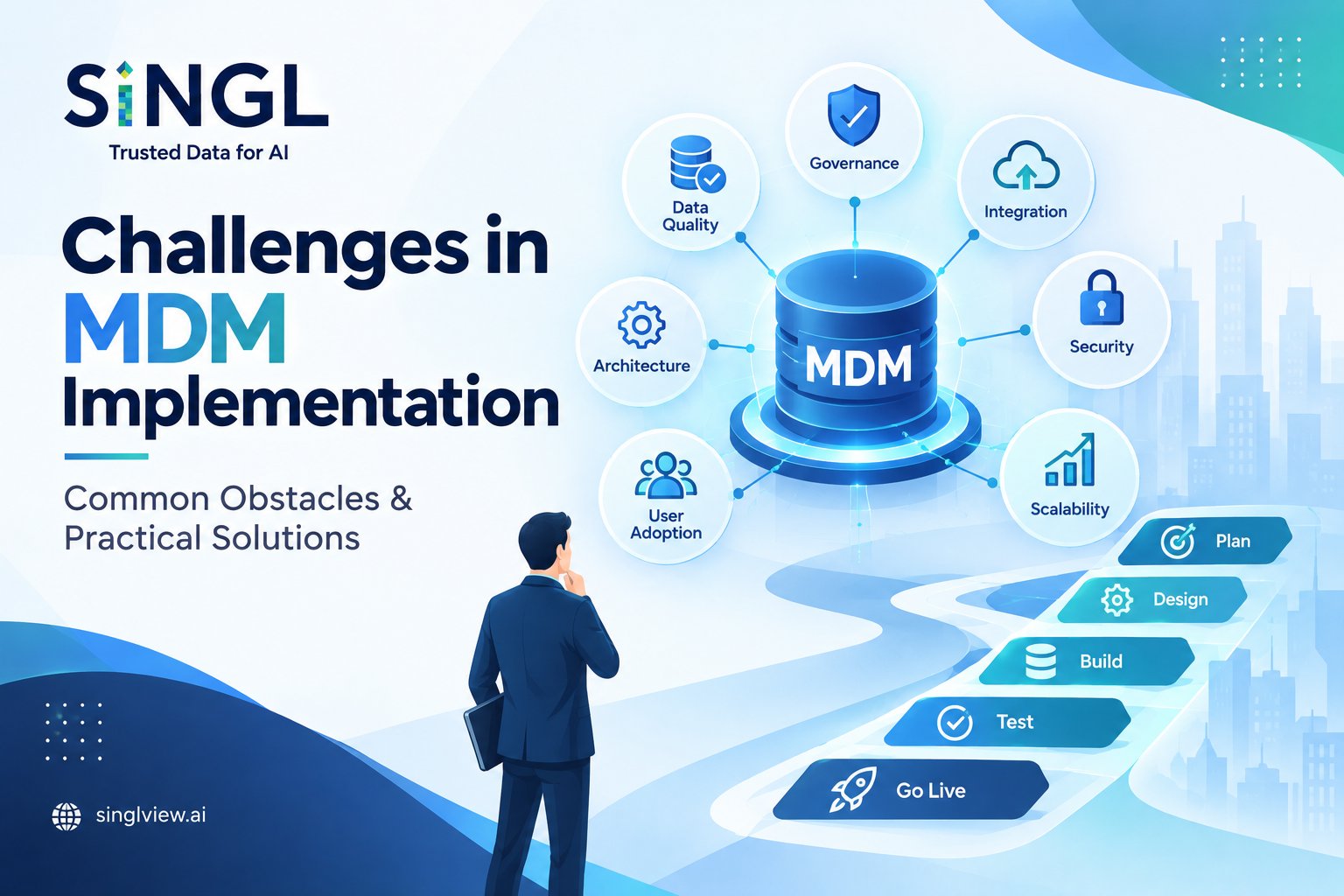
Common Challenges in Implementing AI-Driven MDM
Although AI can improve many MDM activities, implementation requires careful planning.
1. Poor Existing Data Quality
AI cannot automatically turn every inaccurate or incomplete source record into reliable information. Organizations need to assess existing data quality and establish correction processes.
2. Unclear Data Ownership
Without defined ownership, teams may disagree about which records are authoritative and who can approve changes.
3. Incorrect Automated Matching
AI-based entity resolution may generate false matches or miss genuine duplicates. Organizations should test matching models, establish confidence thresholds, and introduce manual review for uncertain cases.
4. Integration Complexity
Legacy applications, inconsistent data formats, and disconnected platforms can make it difficult to implement a unified MDM environment.
5. Data Privacy and Security Risks
AI systems may process sensitive customer, financial, or healthcare information. Organizations must implement appropriate access controls, encryption, monitoring, and data protection practices.
6. Lack of Explainability
If automated decisions cannot be reviewed, teams may struggle to understand why records were classified, enriched, or merged.
7. Overdependence on Automation
Not every data management task should be automated. Human review remains important for high-impact decisions, complex exceptions, and sensitive business information.
Best Practices for Successful MDM Implementation
Organizations can improve implementation outcomes by following a structured and business-focused approach.
Start with clear business objectives: Identify the data problems MDM should solve and define measurable outcomes.
Prioritize critical data domains: Begin with high-value entities such as customers, products, suppliers, or providers.
Establish ownership early: Assign data owners and stewards before introducing automated workflows.
Assess existing data quality: Understand duplication, missing information, inconsistent formats, and source system limitations.
Introduce AI gradually: Start with low-risk use cases such as classification, schema recommendations, and high-confidence matching.
Maintain human oversight: Define approval requirements for uncertain or sensitive data changes.
Choose a scalable architecture: Ensure that MDM can connect with existing applications, cloud platforms, and AI environments.
Track lineage and decisions: Maintain visibility into data movement, transformations, and important automated actions.
Monitor performance: Measure quality, matching accuracy, exception rates, and synchronization reliability.
Review the strategy continuously: Update business rules, models, and governance practices as organizational requirements change.
How to Measure the Success of an AI-Driven MDM Implementation
A successful MDM implementation should deliver measurable improvements rather than simply introduce new technology.
Organizations can evaluate performance using the following indicators:
These indicators help organizations identify areas that need improvement and evaluate the business value of their MDM investment.
How SiNGL Supports Master Data Management Solutions
As organizations adopt AI and modernize their data environments, maintaining trusted master information becomes increasingly important.
SiNGL's Master Data Management Solutions are designed to help organizations establish a more consistent and reliable approach to managing critical business information.
An effective MDM strategy should consider:
Identifying important master data domains.
Establishing trusted records across source systems.
Improving data quality and standardization.
Managing duplicate and conflicting information.
Defining data governance and stewardship workflows.
Supporting integration with enterprise applications.
Preparing consistent data for analytics and AI use cases.
Organizations in financial services and healthcare may also require specialized approaches for managing their industry-specific data requirements.
By aligning MDM with governance, integration, and AI-readiness objectives, businesses can build a stronger foundation for intelligent enterprise operations.
Conclusion
Implementing Master Data Management in an AI-driven organization requires more than adopting an MDM platform or introducing machine learning tools. It involves establishing clear data ownership, improving data quality, integrating intelligent automation, designing scalable architecture, and continuously monitoring how information is managed and used.
The most effective approach combines human accountability with AI-assisted capabilities.
Governance defines the rules, MDM maintains trusted business records, AI improves matching and enrichment processes, and integration makes consistent information available across enterprise systems. Observability and lineage help organizations understand and audit how data moves through their environment.
Whether an organization is evaluating Financial Services MDM, Healthcare MDM, or Master Data Management in New York, Chicago, or Dallas, a well-planned MDM strategy can help establish a reliable foundation for analytics, automation, and AI adoption.
Build a stronger foundation for trusted enterprise data with SiNGL. Explore Master Data Management Solutions and discover how a structured approach to master data can support your organization's data management goals.
Frequently Asked Questions
1. How do you implement Master Data Management in an AI-driven organization?
Start by defining data ownership, governance standards, and critical master data domains. Then introduce AI-assisted matching, data cleansing, enrichment, and integration workflows, supported by human oversight and continuous monitoring.
2. How does AI improve Master Data Management?
AI can support automated schema matching, entity resolution, duplicate detection, data classification, intelligent enrichment, and anomaly detection. These capabilities can reduce manual effort and improve the consistency of master records.
3. What is a golden record in MDM?
A golden record is a trusted representation of a business entity, such as a customer, supplier, or product. It is created by reconciling relevant information from different source records using defined matching and business rules.
4. What is human-in-the-loop MDM?
Human-in-the-loop MDM combines AI automation with human review. AI handles suitable routine tasks, while data stewards review uncertain matches, sensitive changes, and exceptions requiring business judgment.
5. What role do AI agents play in MDM?
AI agents can assist with data ingestion, classification, anomaly detection, record matching, and exception reporting. Their permissions and actions should be controlled through validation rules, audit trails, and appropriate approval workflows.
6. Why is Data Governance important for AI-driven MDM?
Data Governance establishes data ownership, quality standards, access controls, and accountability. These rules help ensure that AI-assisted MDM processes operate within approved business and security requirements.
7. Why is MDM important for financial services?
Financial Services MDM helps maintain consistent customer, account, counterparty, and legal entity information across financial applications. It can support data quality, analytics, reporting, and risk management processes.
8. Why is MDM important in healthcare?
Healthcare MDM helps maintain consistent patient, provider, facility, and service information across healthcare systems. It can support data quality, interoperability, and healthcare analytics when implemented with appropriate privacy and security safeguards.
9. Does MDM replace a data warehouse or data lake?
No. MDM manages trusted master records, while data warehouses and data lakes support data storage, processing, analytics, and reporting. These technologies can work together within a modern enterprise data architecture.