MDM vs Data Governance vs Data Integration: Understanding the Key Differences
Understand the differences between Master Data Management, Data Governance, and Data Integration. Explore their roles, benefits, and how they work together to improve enterprise data quality, consistency, governance, and AI readiness.
Introduction
Modern organizations depend on data to manage customers, products, suppliers, employees, financial operations, and business processes. However, as businesses adopt multiple applications, cloud platforms, databases, and analytics tools, managing information consistently becomes increasingly challenging.
Different departments may maintain separate versions of the same customer record. Product information may vary between inventory and sales systems, while important business data may be duplicated or outdated. These inconsistencies can affect reporting accuracy, operational efficiency, compliance, and decision-making.
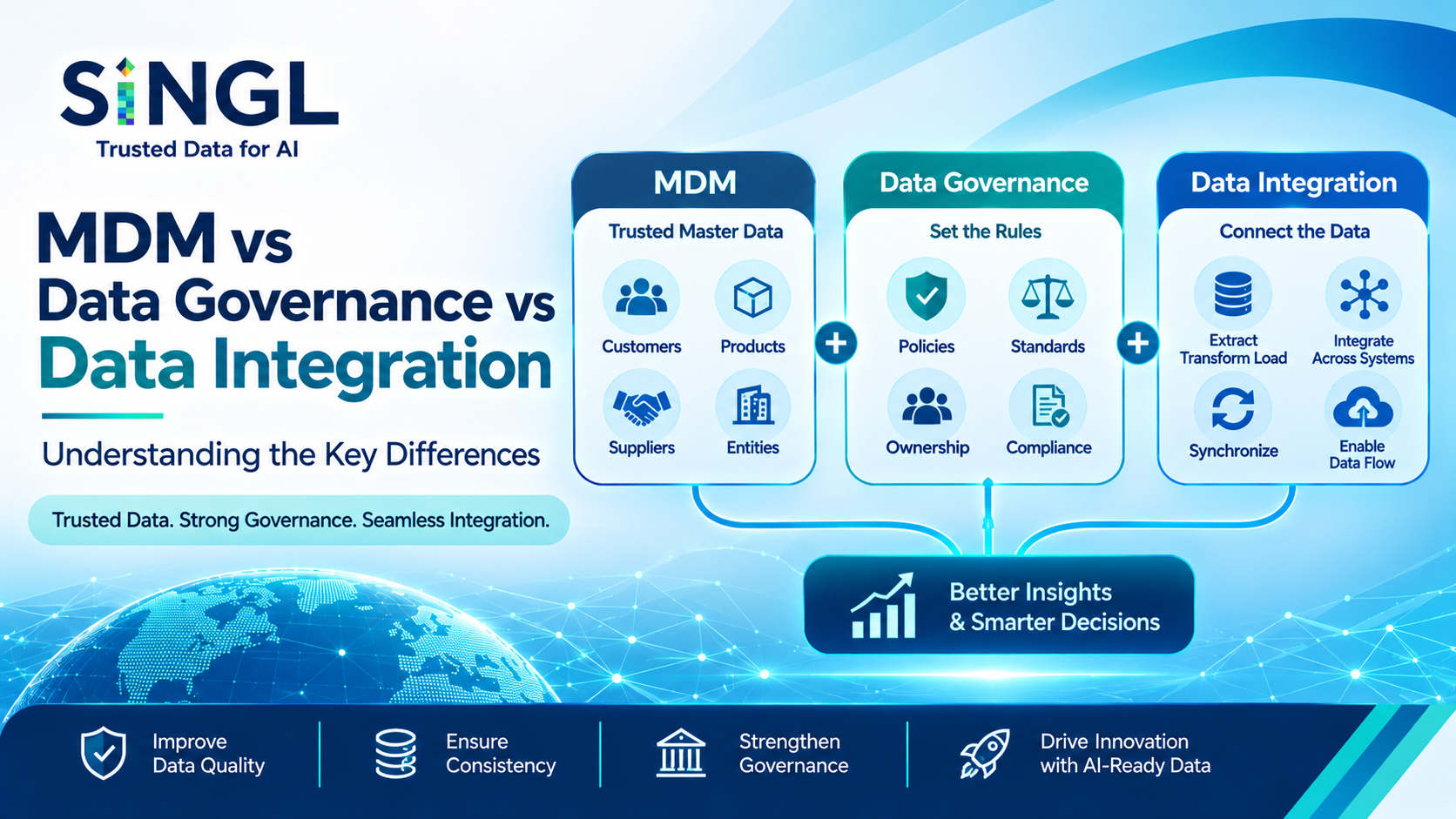
Three important concepts help organizations address these challenges: Master Data Management (MDM), Data Governance, and Data Integration. Although these concepts are closely connected, each serves a different purpose within an enterprise data strategy.
Data Governance establishes the policies, standards, responsibilities, and accountability for managing information. Master Data Management applies processes and technologies to create and maintain consistent, trusted records for critical business entities. Data Integration connects different systems by moving, combining, and transforming information between them.
Understanding MDM vs Data Governance vs Data Integration helps organizations determine how to manage their data effectively rather than treating these practices as interchangeable solutions.
In this guide, we explore their definitions, key differences, core responsibilities, industry applications, and how they work together to create a reliable data management environment.
Who Can Benefit from Understanding MDM, Data Governance, and Data Integration?
These three disciplines are important for organizations that manage information across multiple applications, departments, and business locations.
Understanding their differences can benefit:
Business leaders: Make informed decisions about enterprise data strategies and technology investments.
Data architects: Design reliable data environments that support business requirements.
Data engineers: Build and maintain data pipelines between applications and platforms.
Data governance teams: Establish data ownership, quality standards, and accountability.
IT managers: Improve coordination between business applications and data infrastructure.
Business intelligence teams: Access consistent information for reporting and analytics.
AI and machine learning teams: Work with reliable data for intelligent applications.
Financial and healthcare organizations: Manage complex, sensitive, and business-critical information.
Organizations planning digital transformation, cloud migration, application modernization, or AI adoption can particularly benefit from understanding how these three disciplines complement one another.
Why Choose SiNGL for Master Data Management Solutions?
Building a reliable data environment requires more than connecting applications or creating databases. Organizations also need a structured approach to maintaining consistent, accurate, and trusted business information.
SiNGL's Master Data Management Solutions focus on helping organizations establish reliable master data across their enterprise environments.
A well-planned MDM strategy can help businesses:
Create consistent records for customers, products, suppliers, and other important entities.
Identify and reduce duplicate or conflicting records.
Improve data quality through standardization and validation.
Establish trusted master records for business applications.
Support enterprise reporting, analytics, and AI initiatives.
Improve the consistency of information shared across connected systems.
For organizations evaluating Financial Services MDM or Healthcare MDM, domain-specific data requirements make reliable master data particularly important.
The right MDM approach should align with an organization's existing architecture, business objectives, governance policies, and integration requirements.
What Is Data Governance?
Data Governance is the overall framework of policies, standards, roles, responsibilities, and processes that determines how an organization manages, protects, and uses its data.
It establishes who owns the data, who can access or modify it, what quality standards it must meet, and how the organization ensures that information is handled appropriately.
For example, a company may maintain customer information across its CRM, billing platform, marketing database, and customer support application. Data Governance defines the rules for maintaining this information, including which department owns customer records, how changes are approved, and what information can be accessed by different employees.
Data Governance applies to more than master data. It can cover transactional, operational, analytical, reference, and other categories of enterprise information.
Core Responsibilities of Data Governance
1. Defining Data Ownership
Data Governance identifies the individuals or teams responsible for maintaining specific data domains. Data owners make important decisions about how information should be managed, while data stewards help monitor quality and resolve issues.
2. Establishing Data Quality Standards
Organizations define acceptable standards for accuracy, completeness, consistency, uniqueness, and timeliness. These standards help teams understand what reliable data should look like.
3. Managing Data Access and Security
Governance policies establish who can access, view, modify, or share information. They help organizations implement appropriate access controls and protect sensitive business data.
4. Maintaining Data Definitions
A data glossary and standardized business definitions help different departments interpret information consistently. For example, the definition of an active customer should be understood similarly across sales, finance, and marketing.
5. Supporting Compliance and Accountability
Data Governance helps organizations establish processes for handling information according to applicable legal, regulatory, and internal requirements. It also supports auditability by defining responsibilities and documenting important data-related decisions.
Key Benefits of Data Governance
Greater accountability for enterprise information.
More consistent data definitions across departments.
Better control over data access and usage.
Improved data quality monitoring.
Stronger support for privacy and compliance processes.
More confidence in reporting and business decisions.
Greater accountability for enterprise information.
More consistent data definitions across departments.
Better control over data access and usage.
Improved data quality monitoring.
Stronger support for privacy and compliance processes.
More confidence in reporting and business decisions.
Data Governance provides the rules and accountability that guide an organization's overall data management practices.
What Is Master Data Management (MDM)?
Master Data Management is a combination of processes, workflows, governance rules, and technologies used to create and maintain consistent, trusted records for critical business entities.
These entities, commonly known as master data, include:
Customers
Products
Suppliers
Employees
Business locations
Legal entities
Healthcare providers
Financial counterparties
Organizations often store information about the same entity across multiple applications. For instance, a customer may have different names, contact details, or identification numbers in the CRM, billing, and customer support systems.
MDM helps identify records that represent the same entity, standardize their attributes, resolve inconsistencies, and establish a trusted representation commonly known as a golden record.
Depending on the MDM architecture, this record may be maintained centrally, or trusted information may be linked and shared across connected systems.
Core Responsibilities of MDM
1. Creating Golden Records
MDM consolidates information from different systems to establish a trusted representation of important business entities. This helps reduce conflicting records and improve consistency.
2. Identifying and Removing Duplicate Records
Matching and deduplication processes identify records that refer to the same customer, product, supplier, or other entity. Appropriate matching rules help prevent duplicate information from spreading across applications.
3. Standardizing Business Information
MDM applies consistent formats, naming conventions, identifiers, and business rules. For example, customer addresses, product descriptions, and supplier names can be standardized.
4. Improving Master Data Quality
Validation, enrichment, and quality monitoring help identify incomplete, incorrect, or outdated records.
5. Managing Relationships Between Entities
MDM can maintain relationships between customers, accounts, products, suppliers, and organizational structures. These connections provide useful context for business operations and analytics.
6. Distributing Trusted Master Data
Approved master records can be shared with connected applications through APIs, integration pipelines, event-based messaging, or other synchronization methods.
Key Benefits of MDM
Creates consistent records across enterprise systems.
Reduces duplicate and conflicting information.
Improves master data quality.
Supports more reliable reporting and analytics.
Improves coordination between departments.
Establishes a stronger foundation for AI and machine learning.
Supports scalable enterprise data management.
While Data Governance defines how information should be managed, MDM applies those rules to the creation and maintenance of trusted master records.
What Is Data Integration?
Data Integration is the technical process of collecting, combining, transforming, and transferring information from different source systems into a target application, database, data warehouse, data lake, or another platform.
Modern organizations use multiple applications to manage business operations. These applications may store information in different formats and databases, making it difficult to access a consistent view of enterprise information.
Data Integration connects these environments and enables information to move between them.
For example, a business may need to combine customer information from its CRM, transaction details from its ERP, and payment information from a billing platform. Data Integration processes bring this information together for operational workflows or analytical purposes.
Core Responsibilities of Data Integration
1. Connecting Different Data Sources
Integration technologies connect databases, cloud applications, enterprise platforms, APIs, and other information sources.
2. Extracting and Transferring Data
Data can be collected from source systems and transferred to target platforms through scheduled or real-time processes.
3. Transforming Information
Transformation processes convert data into required formats, standardize fields, and apply technical or business rules.
4. Synchronizing Applications
Integration helps ensure that information is shared or updated across connected systems according to defined synchronization requirements.
5. Supporting ETL and ELT Pipelines
ETL and ELT are common approaches to data integration.
ETL (Extract, Transform, Load): Data is extracted from source systems, transformed, and then loaded into the target environment.
ELT (Extract, Load, Transform): Data is extracted and loaded into the target platform before transformation takes place there.
6. Supporting Data Warehousing and Analytics
Integration processes bring together information from different sources so it can be used for reporting, business intelligence, and advanced analytics.
Key Benefits of Data Integration
Connects information across different applications.
Reduces manual data transfer.
Supports operational data synchronization.
Enables centralized reporting and analysis.
Improves information availability across departments.
Supports cloud migration and application modernization.
Provides data movement capabilities for MDM and other enterprise platforms.
Data Integration makes information accessible across systems, but moving data does not automatically make it accurate, governed, or consistent. That is where Data Governance and MDM become important.
MDM vs Data Governance vs Data Integration: Key Differences
Although these three disciplines work closely together, their primary responsibilities and outputs are different.
Understanding the Difference in Simple Terms
The easiest way to understand MDM vs Data Governance vs Data Integration is to consider the different questions each discipline answers:
Data Governance: What rules should we follow, who is responsible, and how should data be managed?
MDM: How do we create and maintain consistent, trusted records for important business entities?
Data Integration: How do we move and synchronize information between different systems?
All three solve different parts of the same enterprise data management challenge.
How Data Governance, MDM, and Data Integration Work Together
These disciplines are most effective when implemented as connected parts of an enterprise data strategy.
Data Governance establishes the rules. MDM applies relevant rules to critical business records. Data Integration connects the systems that provide and consume this information.
Consider a company that manages customer information across its CRM, billing, ERP, and customer service platforms.
Step 1: Data Governance Sets the Rules
The organization establishes a common definition of a customer and identifies which department is responsible for maintaining customer information.
It also defines:
Required customer attributes.
Acceptable data quality standards.
Rules for identifying duplicates.
Access permissions.
Approval processes for important changes.
These standards provide the foundation for managing customer information consistently.
Step 2: MDM Applies the Rules
The MDM platform collects relevant customer records and applies matching, standardization, and validation processes.
If the same customer appears in multiple systems, MDM identifies the matching records and creates or maintains a trusted representation based on approved business rules.
Data stewards can review exceptions or conflicts where automated matching is insufficient.
Step 3: Data Integration Connects the Systems
Integration processes transfer information between the source applications, MDM platform, and downstream systems.
Once master records are approved, relevant information can be synchronized with the CRM, ERP, billing platform, reporting environment, and other authorized applications.
Step 4: Business Teams Use Consistent Information
Different departments can work with more consistent customer information.
Sales teams can access reliable customer profiles, finance teams can use consistent customer identifiers, and reporting teams can analyze customer activity across business systems with fewer duplicate records.
This example demonstrates why MDM, Data Governance, and Data Integration should not be treated as competing solutions. They perform complementary functions.
Real-World Applications Across Industries
The importance of MDM, Data Governance, and Data Integration becomes more visible in industries that manage complex information across multiple systems.
Financial Services MDM
Financial institutions manage customer profiles, accounts, counterparties, financial products, legal entities, and transaction-related information across multiple platforms.
Financial Services MDM helps establish consistent records for important financial entities, while Data Governance defines ownership, quality standards, access controls, and accountability. Data Integration connects banking applications, CRM systems, finance platforms, and reporting environments.
Common applications include:
Maintaining consistent customer and counterparty records.
Supporting customer identity resolution across business units.
Improving legal entity reference data.
Reducing duplicate records across financial applications.
Supporting risk data and regulatory reporting processes.
Providing more consistent information for financial analytics.
These disciplines complement one another, but MDM alone does not guarantee regulatory compliance or eliminate financial risk. Appropriate security, privacy, and regulatory controls are also required.
Explore Financial Services MDM to understand how trusted master data supports financial data management.
Healthcare MDM
Healthcare organizations manage patient, provider, facility, insurance, and medical service information across electronic health records, hospital information systems, laboratories, and administrative platforms.
Healthcare MDM helps establish consistent patient and provider information across these systems. Data Governance defines the responsibilities and policies for managing sensitive healthcare information, while Data Integration supports information exchange between connected healthcare applications.
Common applications include:
Identifying and reconciling duplicate patient records.
Maintaining consistent provider and facility information.
Supporting healthcare data interoperability.
Improving the quality of administrative and operational reporting.
Connecting information across hospital departments.
Supporting healthcare analytics and AI initiatives.
Healthcare implementations must include appropriate privacy, security, access, and patient identity safeguards.
Master Data Management in New York
Organizations exploring Master Data Management in New York may operate across financial services, healthcare, retail, professional services, and large enterprise environments.
These organizations often manage customer, supplier, product, and legal entity information across several applications and business units.
MDM can help create consistent records, Data Governance can establish ownership and quality standards, and Data Integration can connect information across enterprise platforms.
A coordinated approach can support more reliable reporting, customer information management, and enterprise-wide data processes.
Master Data Management in Chicago
Businesses considering Master Data Management in Chicago may include organizations in manufacturing, logistics, healthcare, financial services, and supply chain operations.
These industries often depend on consistent product specifications, supplier details, inventory references, and customer information.
MDM can help standardize important business entities, while Data Governance establishes clear responsibilities and Data Integration connects operational and analytical systems.
Together, these practices can support more reliable supplier reporting, product information management, and cross-departmental workflows.
Master Data Management in Dallas
Organizations evaluating Master Data Management in Dallas may include growing enterprises, technology companies, healthcare providers, financial institutions, and businesses managing distributed operations.
As these organizations expand, they may introduce new applications, acquire other businesses, or manage information across additional departments.
A coordinated MDM, Data Governance, and Data Integration strategy can help maintain consistent master records, establish clear data responsibilities, and connect newly added systems.
The appropriate approach depends on each organization's data landscape, business requirements, and technology environment.
Key Benefits of Combining MDM, Data Governance, and Data Integration
Using these disciplines together helps organizations address data management challenges more comprehensively.
1. Improved Data Quality
Governance defines quality standards, MDM applies them to master records, and integration processes help distribute information between connected systems.
2. Greater Data Consistency
Organizations can reduce conflicting customer, supplier, product, and organizational information across departments.
3. Better Operational Efficiency
Automated integration and master data workflows can reduce manual corrections, repetitive data entry, and avoidable reconciliation work.
4. Stronger Accountability
Clear governance roles help identify who owns information, who maintains it, and who approves changes.
5. More Reliable Analytics
Consistent master records and integrated datasets help improve the reliability of business intelligence and reporting.
6. Improved Customer Experience
Connected and consistent customer information can help organizations understand interactions across sales, billing, support, and other business channels.
7. Better AI Readiness
Trusted master data, clear governance, and reliable integration provide a stronger foundation for AI and machine learning applications.
Best Practices for Implementing These Three Disciplines
Organizations should approach MDM, Data Governance, and Data Integration as a coordinated strategy rather than implementing disconnected tools.
1. Identify Business-Critical Data Domains
Start with important entities such as customers, products, suppliers, providers, and legal entities. Prioritize domains based on their business value and existing data quality challenges.
2. Establish Clear Data Ownership
Assign data owners and stewards who are responsible for defining standards, monitoring quality, and resolving data conflicts.
3. Define Consistent Data Standards
Establish common formats, identifiers, definitions, validation rules, and quality thresholds across relevant systems.
4. Select the Right MDM Approach
Evaluate the organization's business requirements, source systems, data volumes, integration needs, and governance maturity before choosing an MDM architecture.
5. Build Reliable Integration Pipelines
Use suitable APIs, ETL/ELT processes, event-driven messaging, or other integration methods to transfer and synchronize information.
6. Include Security and Privacy Controls
Implement appropriate access restrictions, encryption, audit trails, retention policies, and privacy safeguards.
7. Monitor Data Quality Continuously
Track duplicate records, incomplete fields, inconsistent identifiers, and other quality indicators. Create workflows to investigate and resolve issues.
8. Measure Business Outcomes
Monitor improvements in data quality, record reconciliation time, integration reliability, governance adoption, and reporting consistency.
Common Challenges in Managing MDM, Data Governance, and Data Integration
Even when organizations understand the differences between these disciplines, implementation can be challenging.
Some common obstacles include:
Fragmented systems: Different applications maintain separate versions of business information.
Poor source data quality: Inaccurate or incomplete records make matching and integration difficult.
Unclear ownership: Departments may disagree about who controls or approves changes to important data.
Integration complexity: Legacy applications may not support modern integration methods.
Inconsistent standards: Different teams may use different definitions, identifiers, and naming conventions.
Limited user adoption: Employees may continue using local spreadsheets or informal data processes.
Lack of ongoing monitoring: Data quality can deteriorate if records are not reviewed and maintained regularly.
Organizations can address these challenges through phased implementation, clear accountability, business involvement, suitable technology, and continuous improvement.
How SiNGL Supports Master Data Management Solutions
For organizations looking to improve enterprise data consistency, a structured MDM strategy can provide an important foundation.
SiNGL's Master Data Management Solutions are relevant to businesses seeking to manage critical business entities, improve master data quality, and establish trusted information across their enterprise environments.
A practical MDM approach should consider:
The organization's most important master data domains.
Existing applications and data sources.
Data matching and standardization requirements.
Governance rules and data stewardship responsibilities.
Integration with operational and analytical systems.
Future requirements for enterprise analytics and AI.
Organizations in financial services and healthcare may also need domain-specific approaches to managing complex and sensitive information.
By aligning master data management with broader governance and integration practices, businesses can work towards a more reliable and scalable enterprise data environment.
Conclusion
MDM, Data Governance, and Data Integration are three essential but distinct components of modern enterprise data management.
Data Governance establishes the policies, standards, ownership, and accountability required to manage information responsibly. Master Data Management applies relevant rules to create and maintain consistent, trusted records for important business entities. Data Integration connects applications and moves information between systems.
When these disciplines work together, organizations can improve data quality, reduce inconsistencies, strengthen accountability, and build a more dependable foundation for analytics and AI.
Whether an organization is evaluating Financial Services MDM, Healthcare MDM, or Master Data Management in New York, Chicago, or Dallas, understanding how these disciplines complement one another is an important step towards building a successful data strategy.
Build a stronger foundation for trusted enterprise data with SiNGL. Explore Master Data Management Solutions to understand how a structured MDM approach can support your organization's data management goals.
Frequently Asked Questions
1. What is the difference between MDM and Data Governance?
Data Governance establishes policies, standards, ownership, and accountability for enterprise information. MDM uses processes and technologies to create and maintain consistent records for important business entities such as customers, products, and suppliers.
2. What is the difference between MDM and Data Integration?
MDM focuses on maintaining trusted and consistent master records. Data Integration focuses on moving, combining, transforming, and synchronizing information between different systems.
3. Is Data Governance part of MDM?
Data Governance and MDM are closely connected, but they are not the same. Governance provides rules and accountability for enterprise data, while MDM applies relevant governance requirements to the management of master data.
4. Can MDM work without Data Integration?
MDM can operate within a limited environment, but integration is generally important when information must be collected from multiple systems or trusted records must be distributed to connected applications.
5. Can Data Integration replace MDM?
No. Data Integration can move and combine information, but it does not automatically resolve duplicate entities, establish golden records, or manage master data ownership and quality.
6. Why is MDM important for financial services?
Financial Services MDM helps maintain consistent customer, account, counterparty, and legal entity information across financial applications. It can support data quality, reporting, analytics, and governance processes.
7. Why is MDM important in healthcare?
Healthcare MDM helps maintain consistent patient, provider, facility, and service information across healthcare applications. It can support interoperability and more reliable healthcare analytics when implemented with appropriate privacy and security controls.
8. How do MDM, Data Governance, and Data Integration support AI?
Governance defines how data should be managed, MDM improves the consistency of core business entities, and Integration connects the information sources and AI platforms. Together, they can provide a stronger foundation for reliable AI applications.
9. Which should an organization implement first: MDM, Data Governance, or Data Integration?
There is no universal sequence. Organizations should first assess their business objectives, data maturity, and existing architecture. Clear governance responsibilities are important from the beginning, while MDM and integration can be introduced in phases based on business priorities.