
Is MDM Part of Data Engineering? Understanding the Connection
Understand whether MDM is part of data engineering, how the two disciplines differ, and how they work together to create trusted, integrated, and governed enterprise data.
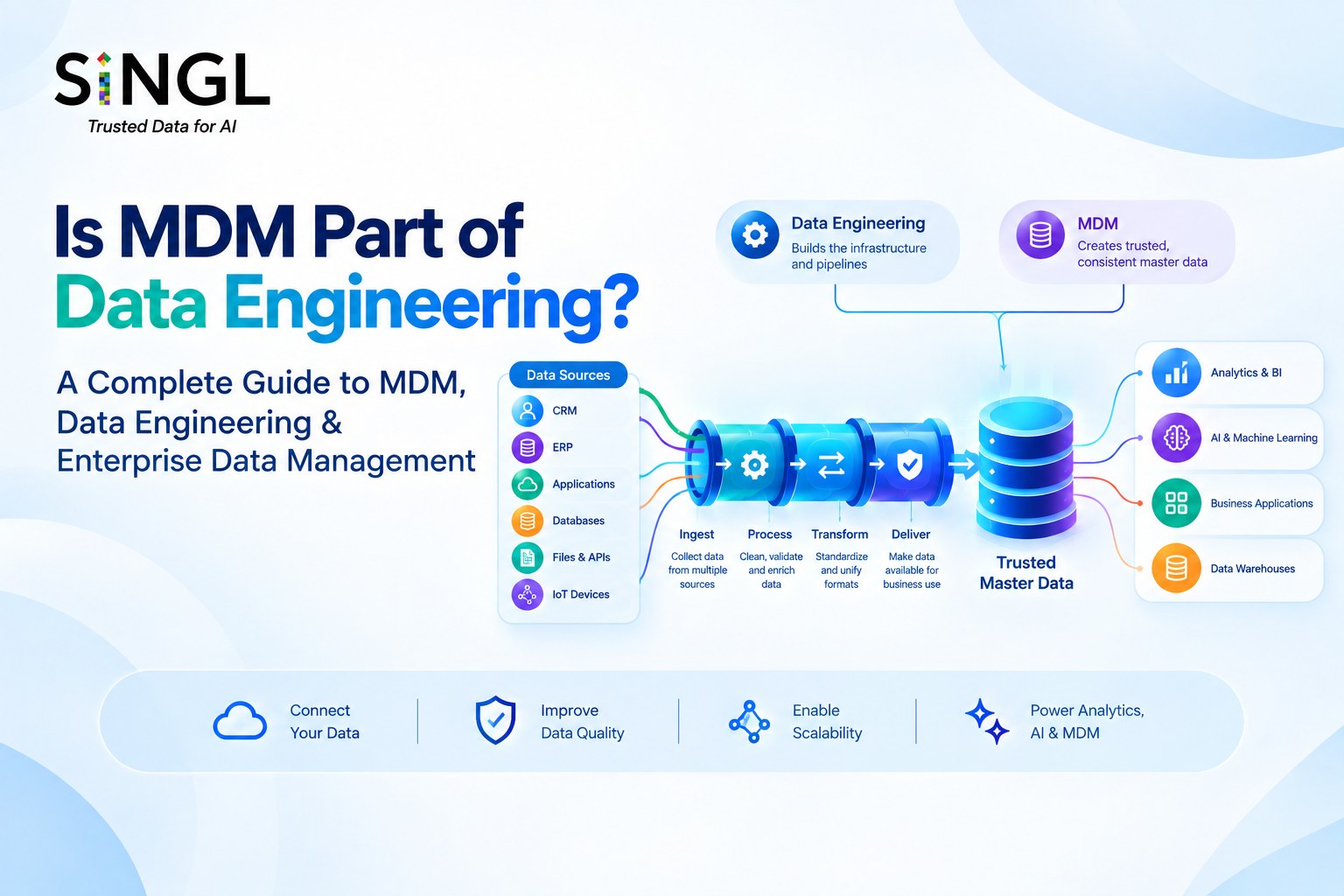
Master Data Management (MDM) and data engineering are closely connected disciplines in modern data environments, but they are not the same thing. Data engineering focuses on building the infrastructure, pipelines, integrations, and processing systems that move and prepare data. Master Data Management focuses on ensuring that critical business data—such as customers, products, suppliers, locations, and financial entities—is accurate, consistent, governed, and trusted across the organization.
So, is MDM part of data engineering? MDM can be an important component of a broader data engineering ecosystem, but it is not simply a subset of data engineering. The two functions work together to create reliable enterprise data.
For organizations implementing Master Data Management Solutions, understanding this relationship is important because MDM depends on many of the technical capabilities that data engineering provides.
What Is Data Engineering?
Data engineering is the discipline of designing and maintaining the systems that collect, move, store, process, transform, and deliver data.
A data engineer may work with information coming from:
CRM platforms
ERP systems
Databases
Cloud applications
APIs
Files and spreadsheets
IoT devices
Third-party applications
Data warehouses and data lakes
The goal is to create dependable data pipelines and infrastructure so that information can reach analytics platforms, business applications, AI systems, and other destinations in a usable form.
Data engineering typically involves areas such as:
Data ingestion
Data integration
ETL and ELT
Data transformation
Data pipelines
Data storage
Data quality
Data orchestration
Cloud data platforms
Data monitoring
In simple terms, data engineering builds the pathways through which enterprise data moves and is processed.
What Is Master Data Management?
Master Data Management is a business and technology discipline used to create a consistent and trusted view of an organization's most important data.
Master data commonly includes:
Customer information
Product information
Supplier information
Employee information
Location data
Organization data
Financial entities
Reference data
Large organizations often store the same entity in several systems. A customer might exist in a CRM, billing system, marketing platform, support application, and data warehouse.
Each system may use slightly different formats.
For example:
CRM:
ABC Corporation Ltd.
Billing system:
ABC Corp.
ERP:
A.B.C. Corporation Limited
Although these records may refer to the same organization, the differences can create duplication and inconsistency.
MDM helps identify, standardize, match, govern, and maintain these records so that the organization can work with a reliable master representation.
Is MDM Part of Data Engineering?
MDM is not exactly a part of data engineering, but the two disciplines overlap significantly.
Data engineering provides many of the technical capabilities required to implement MDM. At the same time, MDM introduces business rules, governance requirements, stewardship processes, matching logic, and master-data-specific controls.
A simple way to understand the relationship is:
Data Engineering → Moves, integrates, transforms, and delivers data
MDM → Establishes trusted, consistent, governed master data
Therefore, MDM can operate alongside data engineering as part of an organization's broader data management architecture.
How Data Engineering Supports MDM
Data engineering plays several important roles in an MDM environment.
1. Data Ingestion
Before master data can be managed, it must be collected from different sources.
Data engineers build ingestion pipelines that bring information from systems such as CRM, ERP, databases, applications, and external sources into the appropriate data environment.
Without reliable ingestion, an MDM platform may not receive complete or current information.
2. Data Integration
Organizations rarely maintain all their information in one system.
Data integration connects different applications and makes information available across the enterprise. Data engineering technologies can move information between source systems, data platforms, MDM environments, and downstream applications.
For example, a customer record may move through a pipeline like this:
CRM → Data Pipeline → MDM Platform → Trusted Customer Record → Analytics & Business Applications
This creates a technical foundation for maintaining consistent master data.
3. Data Transformation
Different systems often represent information differently.
One application may store a country as:
United States
while another may use:
US
A data engineering process can transform values into a common format before they are processed by an MDM system.
Transformation may involve:
Standardizing formats
Converting data types
Normalizing values
Mapping fields
Applying business rules
Removing unwanted characters
Structuring inconsistent records
This makes downstream matching and master-data processing more effective.
4. Data Quality
Data engineering and MDM both contribute to data quality, although they approach it from different perspectives.
Data engineering can identify technical issues such as:
Missing fields
Invalid formats
Failed pipeline records
Duplicate ingestion
Schema inconsistencies
Unexpected values
MDM can focus on business-level quality, including:
Duplicate customers
Duplicate products
Incorrect master records
Inconsistent entity definitions
Conflicting business attributes
Together, these capabilities improve the reliability of enterprise data.
MDM and Data Engineering: What Is the Difference?
Although the two disciplines work closely together, their primary responsibilities differ.
The distinction becomes especially important in large organizations.
A data engineer may build a pipeline that transfers customer records from multiple systems. An MDM solution may then use matching and survivorship rules to determine which information should become part of the trusted customer record.
Where MDM Fits in a Modern Data Architecture
MDM can be viewed as one layer within a broader enterprise data ecosystem.
A simplified architecture may look like:
Source Systems
↓
Data Integration & Engineering
↓
Data Quality & Transformation
↓
MDM / Master Data Layer
↓
Trusted Enterprise Data
↓
Analytics | AI | Reporting | Business Applications
This does not mean every organization will use exactly this architecture. Some MDM platforms may integrate directly with source applications, while others may work alongside data lakes, warehouses, integration platforms, or data fabrics.
The important point is that MDM and data engineering often operate together rather than independently.
Is MDM a Data Engineering Skill?
MDM knowledge can be valuable for data engineers, particularly those working with enterprise data integration and data platforms.
However, becoming a data engineer does not necessarily require specializing in MDM.
A data engineer may focus primarily on:
SQL
Python
ETL/ELT
Cloud platforms
Data warehouses
Data lakes
APIs
Data orchestration
Streaming systems
Distributed processing
An MDM professional may focus more heavily on:
Master-data models
Data governance
Entity resolution
Matching and merging
Survivorship rules
Data stewardship
Business definitions
Reference data
Domain ownership
There is considerable overlap, but the responsibilities are distinct.
The Role of MDM in Data Engineering Projects
MDM becomes particularly valuable when data engineering projects involve multiple systems containing overlapping business entities.
Imagine a multinational organization with:
5 CRM platforms
3 ERP systems
Multiple regional databases
Several e-commerce platforms
Numerous reporting environments
A data engineering team can create pipelines that bring information from these systems together.
But simply combining the records does not automatically create a trusted customer or product view.
MDM can provide additional capabilities such as:
Entity Matching
Determining whether records from different systems represent the same real-world entity.
Deduplication
Identifying and reducing duplicate records.
Standardization
Creating common representations for important business attributes.
Survivorship
Determining which values should be retained when multiple records contain conflicting information.
Governance
Defining who can create, modify, approve, and manage master records.
These capabilities complement the infrastructure and pipelines built by data engineering teams.
MDM and Data Engineering for Financial Services
Financial institutions manage large volumes of customer, account, product, branch, organization, and regulatory data.
Data engineering helps connect information across banking platforms, CRM systems, transaction systems, reporting environments, and other applications.
MDM can then help create consistent views of critical entities.
For example, a financial organization may need to determine whether customer information appearing across multiple systems belongs to the same individual or organization.
This is where Financial Services MDM becomes relevant. It can support consistent customer, organization, product, and other master-data domains while working alongside integration, data quality, and governance processes.
The combination of data engineering and MDM can therefore support reporting, analytics, regulatory processes, customer experiences, and operational decision-making.
MDM and Data Engineering in Healthcare
Healthcare organizations work with complex data across hospitals, clinics, laboratories, pharmacies, insurance systems, medical applications, and other platforms.
Data engineering helps move and process information across these environments.
MDM can help create consistent representations of entities such as:
Patients
Providers
Healthcare organizations
Locations
Medical products
Payers
For organizations implementing Healthcare MDM, the connection with data engineering is particularly important because master data often needs to be integrated from multiple operational systems.
Reliable master data can help downstream applications and analytics work with more consistent information.
MDM in Different Business Environments
The way organizations implement MDM can vary depending on their systems, business processes, regulatory requirements, and data domains.
For example, organizations evaluating Master Data Management in New York may be dealing with complex enterprise applications, financial services environments, healthcare organizations, or multinational operations. Their MDM architecture may need to connect numerous systems while maintaining governance and data quality.
Similarly, companies considering Master Data Management in Chicago may have requirements involving manufacturing, financial services, healthcare, retail, logistics, or other industries. The specific MDM approach depends on the organization's data landscape rather than simply its geographic location.
Organizations exploring Master Data Management in Dallas may also have complex data environments spanning multiple business units and applications. In such situations, integrating MDM with data engineering capabilities can help create a more connected enterprise data ecosystem.
Can Data Engineers Implement MDM?
Data engineers can contribute significantly to MDM implementations, but an effective MDM program usually involves multiple roles.
A typical project may involve:
Data Engineers
Build pipelines, integrations, transformations, and technical workflows.
MDM Specialists
Design and configure master-data processes, matching logic, and domain models.
Data Stewards
Define and maintain business rules and monitor data quality.
Data Governance Teams
Establish ownership, policies, standards, and accountability.
Business Teams
Define what constitutes a trusted customer, product, supplier, or other master entity.
This cross-functional approach is important because MDM is not only a technical problem. It also involves business definitions, ownership, governance, and operational processes.
How MDM Supports Analytics and AI
One of the biggest reasons organizations connect MDM with data engineering is the need for reliable information downstream.
Analytics and AI systems depend on the quality of the data they receive.
If the same customer appears multiple times under different names, analytics may incorrectly calculate customer counts. If product information is inconsistent, sales and inventory reports may become difficult to reconcile.
MDM can provide a more consistent master representation, while data engineering delivers that information to analytical and operational environments.
This creates a relationship such as:
Data Engineering → Reliable Data Movement
MDM → Trusted Master Data
Analytics & AI → Business Insights
The three capabilities can therefore work together as part of a broader data strategy.
Benefits of Combining MDM and Data Engineering
Organizations that bring these disciplines together can address several common enterprise data challenges.
Better Data Connectivity
Data engineering connects information across applications and platforms.
More Consistent Master Data
MDM establishes standardized and governed representations of important entities.
Improved Data Quality
Both disciplines can contribute to identifying and correcting different types of data problems.
Reduced Duplication
MDM can identify duplicate entities while data engineering helps move and process the relevant records.
Better Analytics
Consistent master data can make reporting and analytical outputs easier to interpret.
Stronger AI Data Foundations
AI applications benefit from reliable, well-integrated, and consistently defined enterprise information.
Greater Operational Consistency
Business applications can use shared definitions for important entities rather than maintaining disconnected versions of the same information.
Is MDM Necessary for Every Data Engineering Project?
No.
Not every data engineering project requires a dedicated MDM platform.
A small organization with a limited number of applications and relatively simple data may be able to manage its data using conventional integration, transformation, and quality processes.
MDM becomes more relevant when organizations have challenges such as:
Multiple systems containing the same entities
Significant duplicate records
Conflicting customer or product information
Multiple business units
Complex data governance requirements
Mergers and acquisitions
Global operations
Large-scale regulatory or reporting requirements
Multiple applications requiring a shared master record
The decision depends on the organization's data complexity and business requirements.
MDM, Data Engineering, and the Future of Enterprise Data
Modern businesses increasingly operate across cloud applications, SaaS platforms, APIs, data warehouses, data lakes, AI platforms, and automated business systems.
This creates a growing need for both strong data engineering and reliable master data.
Data engineering provides the infrastructure needed to move and process information at scale. MDM provides a framework for creating consistent and governed representations of critical business entities.
As organizations expand their use of AI, this relationship becomes increasingly important. AI systems need access to connected and trustworthy data, while enterprise applications need consistent definitions of customers, products, suppliers, and other important entities.
For this reason, MDM and data engineering should generally be viewed as complementary disciplines within a broader enterprise data strategy.