Is SAP MDG Part of SAP ECC? Understanding the Relationship Between MDG and SAP ERP
Learn whether SAP MDG is part of SAP ECC, how Master Data Governance works with SAP ERP, and how MDG supports trusted, governed, and consistent enterprise master data.
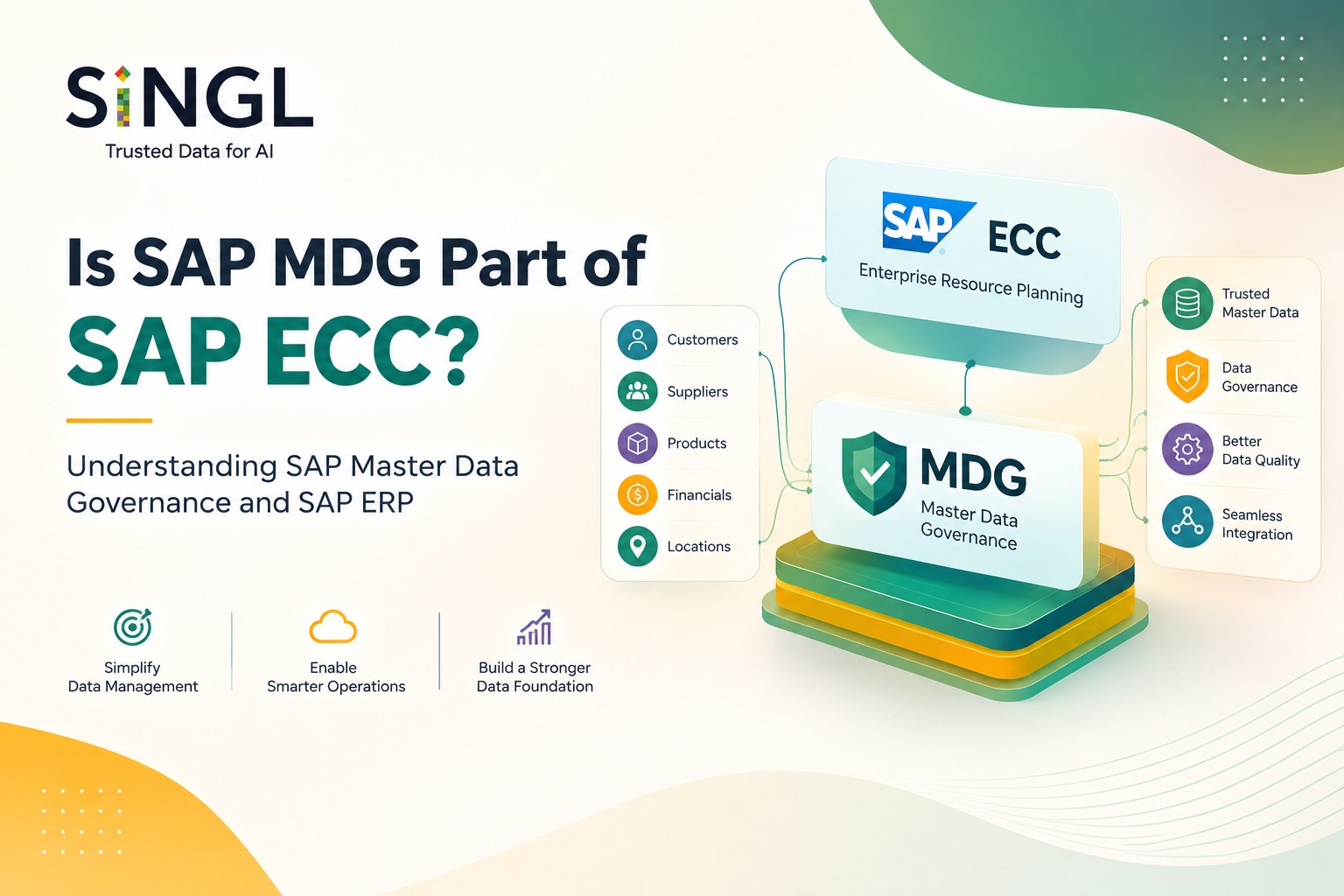
SAP Master Data Governance (MDG) and SAP ECC are closely related technologies, but they are not the same thing. SAP ECC, or SAP ERP Central Component, is an enterprise resource planning platform used to manage core business processes such as finance, procurement, sales, materials management, and supply chain operations. SAP MDG, on the other hand, is focused on governing, validating, consolidating, and maintaining business-critical master data.
So, is SAP MDG part of SAP ECC? Historically and technically, SAP MDG was delivered for and could be deployed on SAP ERP/ECC environments. SAP's documentation for SAP ERP Enhancement Packages explicitly states that MDG is part of SAP ERP and that SAP ERP must be installed to use the MDG applications.
However, this does not mean that every SAP ECC system automatically includes or uses MDG. MDG is a separate governance capability that has to be implemented and configured according to the organization's requirements.
Understanding this distinction is especially important for companies evaluating Master Data Management Solutions, planning an SAP transformation, or deciding how to manage master data across SAP and non-SAP systems.
What Is SAP ECC?
SAP ECC, short for SAP ERP Central Component, is the traditional SAP ERP platform used by organizations to run their core business operations.
It supports business functions such as:
Financial accounting
Controlling
Materials management
Sales and distribution
Production planning
Plant maintenance
Procurement
Inventory management
Human resources
Supply chain processes
These business processes depend heavily on accurate master data.
For example, a procurement process may require reliable supplier and material information, while a sales process depends on customer, product, pricing, and organizational data.
This makes master-data quality an important consideration for organizations running SAP ECC.
What Is SAP Master Data Governance?
SAP Master Data Governance, commonly known as SAP MDG, is designed to provide controlled governance of important master data.
SAP describes MDG as providing central ownership of master data according to business rules and processes. It supports capabilities such as change requests, workflow, staging, approval, activation, validation, and distribution.
Master data can include entities such as:
Customers
Suppliers
Materials
Products
Business partners
Financial data
Organizational data
For example, when a company wants to create a new supplier, MDG can support a process where the information is submitted, validated, reviewed, approved, and then activated.
A simplified process looks like:
Request → Validate → Enrich → Approve → Activate → Distribute
This gives organizations more control over how important master records are created and maintained.
Is SAP MDG Part of SAP ECC?
The answer depends on what “part of” means.
SAP's documentation confirms that MDG was designed to run on SAP ERP and that MDG could be deployed co-deployed with SAP ERP or as a separate hub system.
For specific SAP ERP Enhancement Package releases, SAP documentation lists the SAP ECC/ERP server as a required component for MDG applications. For example, SAP's documentation for MDG for Customer identifies the SAP ECC server and SAP ERP EHP7 as mandatory components.
Therefore, a useful way to understand the relationship is:
SAP ECC → ERP platform
SAP MDG → Master-data governance capability
MDG on SAP ERP/ECC → MDG deployed within an SAP ERP-based environment
So, MDG was not simply an ordinary ECC transaction or standard master-data screen. It provided an additional governance framework for managing master data.
SAP ECC vs SAP MDG
The distinction becomes clearer when their responsibilities are compared.
The two therefore work together rather than being interchangeable.
How Does MDG Work With SAP ECC?
A typical architecture can involve SAP ECC as the operational ERP system and MDG as the governance layer.
For example:
Business Request
↓
SAP MDG
↓
Validation & Business Rules
↓
Approval
↓
Master Data Activation
↓
SAP ECC
↓
Business Processes
In a hub scenario, MDG can also govern master data that is distributed to several systems.
SAP documentation describes MDG as capable of being deployed as a separate hub system or co-deployed with SAP ERP.
This makes MDG useful in environments where organizations need to manage master data across multiple applications rather than only within one ECC system.
What Types of Master Data Can SAP MDG Manage?
SAP MDG has supported multiple master-data domains depending on the release and implementation.
Common domains include:
Customer Data
Customer information can be validated, standardized, governed, and distributed to relevant business systems.
Supplier Data
Supplier records can be managed through controlled creation and change processes.
Material Data
Material information can be governed to support consistency across procurement, inventory, manufacturing, and other processes.
Financial Data
Financial master data can be governed according to organizational rules and financial requirements.
Custom Master Data
Organizations can also extend MDG to support custom objects and business-specific master-data requirements.
SAP's documentation for SAP ERP-based MDG includes applications for customer, supplier, material, financials, and custom objects.
Why Is MDG Important for SAP ECC?
SAP ECC can store and use master data, but organizations may have challenges when different departments or systems create and maintain the same information independently.
For example, consider a supplier that appears in several systems:
System A:
ABC Manufacturing Ltd.
System B:
ABC Manufacturing Limited
System C:
ABC Mfg. Ltd.
These records may represent the same organization.
Without appropriate governance, duplicate or inconsistent information can affect:
Procurement
Reporting
Financial processes
Supplier analysis
Compliance
Analytics
Data integration
MDG can introduce processes for validation, matching, approval, and controlled maintenance.
MDG and Data Quality in SAP ECC
Data quality is one of the important reasons organizations implement master-data governance.
MDG can help organizations establish rules around:
Required fields
Valid values
Duplicate detection
Data validation
Approval processes
Data ownership
Data enrichment
Distribution
SAP's MDG documentation describes change-request processing with workflow, staging, approval, activation, and distribution.
This means that master data does not have to be treated simply as static information stored in ECC. Organizations can establish structured processes for maintaining it.
Can MDG Be a Separate Hub From ECC?
Yes.
One of the important characteristics of SAP MDG is that it does not have to operate only as a co-deployed application.
SAP documents MDG as supporting both a separate hub deployment and co-deployment with SAP ERP.
The MDG hub can provide centralized governance while distributing approved master data to connected systems.
This approach can be useful for organizations with multiple SAP instances or a mixture of SAP and non-SAP applications.
MDG and SAP ECC During an ERP Transformation
Organizations that still operate SAP ECC may eventually evaluate migration or transformation options, including SAP S/4HANA.
Master data becomes an important part of that process.
An ECC environment may contain years of accumulated:
Customer records
Supplier records
Material records
Financial information
Organizational data
Duplicate records
Incomplete records
Simply transferring all existing data into a new environment does not automatically solve historical data-quality issues.
SAP provides documentation specifically addressing the conversion of an ERP-based SAP MDG hub to SAP MDG on SAP S/4HANA, demonstrating the relationship between the ERP-based and S/4HANA-based MDG environments.
This makes master-data governance relevant not only for organizations staying on ECC but also for organizations preparing for an ERP transformation.
SAP MDG and Master Data Management Solutions
SAP MDG is part of the broader master-data-management landscape.
Organizations may operate environments containing:
SAP ECC
SAP S/4HANA
CRM platforms
Data warehouses
Cloud applications
E-commerce systems
Legacy databases
External applications
In such environments, Master Data Management Solutions can provide a broader approach to maintaining consistent and trusted information across enterprise systems.
MDG can serve as the governance layer for selected master-data domains, while integration technologies connect the governed data to operational and analytical systems.
The exact architecture depends on the organization's systems, data domains, governance requirements, and integration strategy.
SAP MDG and Financial Services
Financial institutions often manage complex customer, account, organizational, product, and financial information across multiple systems.
This makes master-data governance an important consideration for organizations working toward consistent enterprise information.
Financial Services MDM can address broader requirements around managing and governing critical financial-sector master data.
Within an SAP landscape, MDG can support financial master-data governance and controlled distribution. SAP's ERP documentation includes a dedicated Master Data Governance for Financials application for SAP ERP environments.
For organizations operating ECC alongside other banking, financial, or analytical systems, the broader MDM architecture can determine how governed information moves between platforms.
SAP MDG and Healthcare Data
Healthcare organizations often work with information distributed across hospitals, clinics, laboratories, pharmacies, insurance systems, and other applications.
Important master-data domains can include:
Patients
Healthcare providers
Organizations
Locations
Products
Suppliers
Payers
Healthcare MDM can support broader initiatives focused on creating consistent and governed healthcare master data across multiple systems.
When SAP ECC or other SAP applications form part of the technology landscape, MDG can contribute to structured governance of selected master-data domains while integration technologies connect information with other applications.
Master Data Management in New York
Organizations evaluating Master Data Management in New York may operate complex enterprise environments across financial services, healthcare, retail, professional services, manufacturing, and other industries.
For businesses with multiple ERP instances or applications, master-data governance can help establish consistent definitions for customers, suppliers, products, and other important entities.
The specific architecture depends on the organization's systems and governance requirements rather than its location alone.
Master Data Management in Chicago
Organizations considering Master Data Management in Chicago may have data environments spanning manufacturing, logistics, healthcare, financial services, retail, or other sectors.
In such environments, SAP ECC may coexist with other ERP systems, CRM platforms, cloud applications, and analytical systems.
An MDM strategy can therefore involve both SAP-specific governance and broader enterprise data-management processes.
Master Data Management in Dallas
Businesses exploring Master Data Management in Dallas may also have complex technology landscapes involving ERP modernization, cloud adoption, analytics, and AI initiatives.
For organizations operating SAP ECC alongside other business systems, a master-data strategy can help establish consistent and governed information across applications.
MDG may form one part of that strategy, while broader integration and MDM capabilities can connect the organization's complete data ecosystem.
Is SAP MDG the Same as SAP MDM?
No. The terms are related but should not be treated as interchangeable.
Master Data Management (MDM) is the broader discipline of managing important business data across an organization.
SAP MDG is SAP's master-data-governance solution.
SAP MDG provides capabilities such as governance workflows, validation, consolidation, duplicate detection, and distribution.
SAP's documentation also describes MDG consolidation as a capability for loading master data from different sources, standardizing it, detecting duplicates, and creating best records based on survivorship rules.
Therefore:
MDM = broader discipline
SAP MDG = SAP's governance solution within that discipline
Is SAP MDG Still Relevant When Moving From ECC to S/4HANA?
This depends on the organization's transformation strategy.
SAP has documented both ERP-based MDG and MDG on S/4HANA. SAP also provides a specific guide for converting an ERP-based MDG hub to MDG on S/4HANA.
Therefore, an organization moving from ECC does not necessarily need to abandon its master-data governance strategy.
Instead, it may evaluate:
Current master-data quality
Existing MDG configuration
Master-data domains
Integration architecture
S/4HANA migration plans
Governance processes
Data ownership
Future cloud strategy
The resulting architecture will depend on the organization's specific transformation plan.
What Are the Benefits of Combining ECC and MDG?
When properly designed and implemented, an ECC and MDG environment can support several objectives.
Controlled Master-Data Creation
Business users can follow defined workflows rather than creating important records without governance.
Better Data Quality
Validation and standardization can help improve the quality of master records.
Reduced Duplication
Matching and consolidation capabilities can help identify duplicate information.
Consistent Business Information
Governed master data can be distributed to relevant systems.
Better Reporting
Consistent master data can provide a stronger foundation for enterprise reporting and analytics.
Improved Governance
Organizations can establish ownership, approval processes, and business rules around critical data.