
Is MDG Part of S/4HANA? Understanding SAP Master Data Governance and S/4HANA
Learn whether SAP MDG is part of S/4HANA, how MDG works with S/4HANA, and the role of master data governance in SAP ERP transformation and enterprise data management.
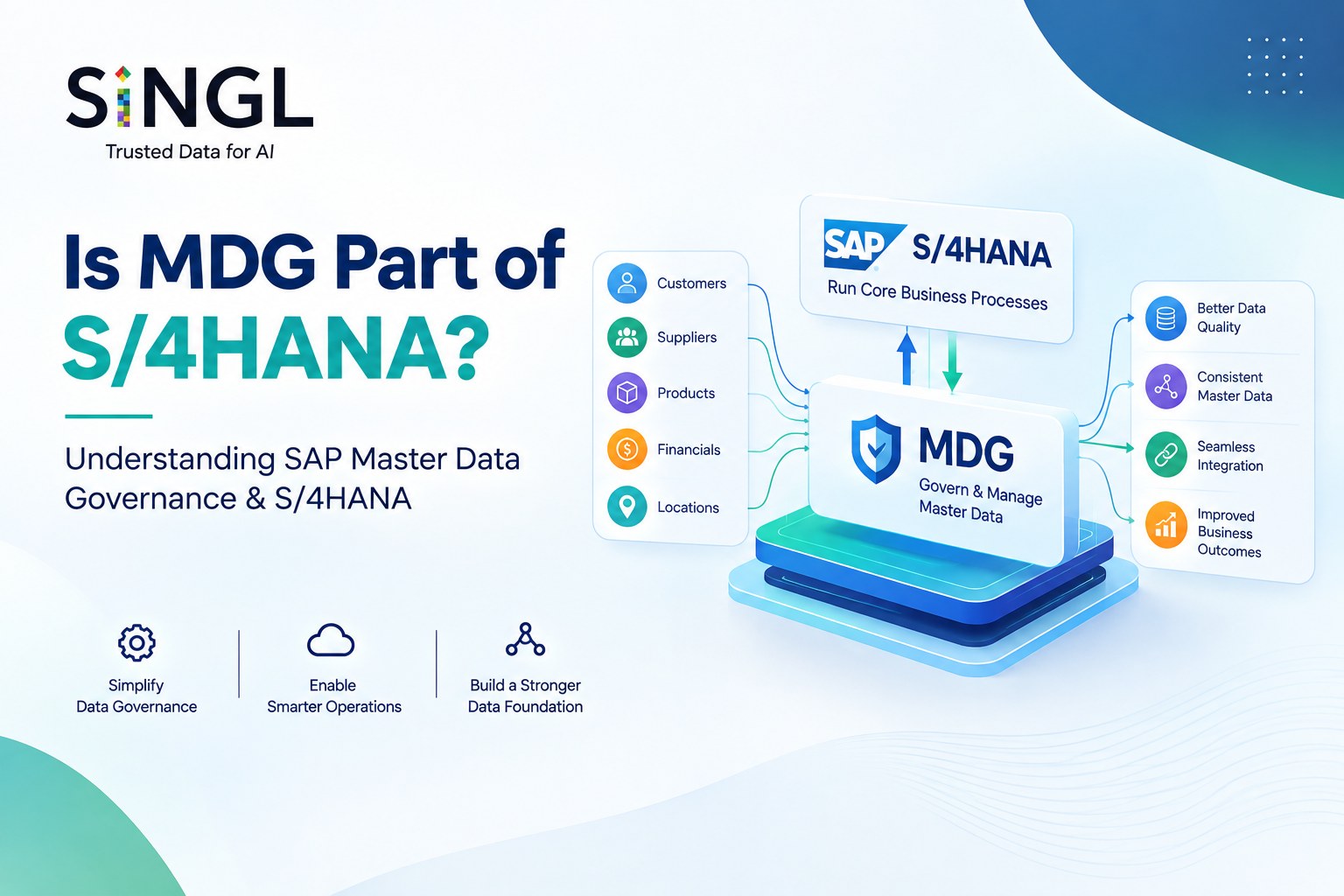
SAP S/4HANA is an enterprise resource planning (ERP) platform designed to support core business processes such as finance, procurement, sales, manufacturing, supply chain, and asset management. SAP Master Data Governance (MDG), on the other hand, is focused specifically on governing, consolidating, and improving the quality of business-critical master data.
So, is MDG part of S/4HANA? The answer depends on what is meant by “part of.” SAP MDG can be deployed on SAP S/4HANA, including as a co-deployed solution in certain deployment models, but MDG and S/4HANA are not the same product. SAP also supports MDG as a hub that can govern and distribute data across S/4HANA, other SAP systems, and non-SAP systems.
Understanding this distinction is important for organizations planning an S/4HANA transformation, evaluating Master Data Management Solutions, or deciding how master data governance should fit into their broader enterprise architecture.
What Is SAP S/4HANA?
SAP S/4HANA is SAP's ERP platform for managing core business operations. It brings together processes across areas such as:
Finance
Procurement
Sales
Manufacturing
Supply chain
Asset management
Human resources integrations
Product and business partner processes
S/4HANA uses the SAP HANA database and provides an architecture designed for real-time business processing and analytics.
During an S/4HANA implementation or migration, organizations often need to address master data because business processes depend on accurate information about customers, suppliers, products, materials, financial entities, and organizational structures.
SAP itself highlights master data quality as an important foundation for S/4HANA transformation.
What Is SAP Master Data Governance?
SAP Master Data Governance, commonly called SAP MDG, is SAP's solution for governing important master data.
It supports processes such as:
Central governance
Master data consolidation
Data quality management
Workflow and approvals
Validation
Data matching
Duplicate identification
Data distribution
Mass processing
SAP describes MDG as supporting the centralized management of master data and providing capabilities for consolidation, governance, and data quality.
For example, a company may have customer information stored across CRM, ERP, regional applications, and external systems. MDG can provide processes for creating, reviewing, validating, approving, and distributing trusted master records.
Is MDG Part of S/4HANA?
The most accurate answer is:
SAP MDG is not simply another name for S/4HANA or an inseparable component of S/4HANA. However, SAP MDG can be deployed on and integrated with S/4HANA, and SAP provides MDG capabilities specifically for S/4HANA environments.
SAP documents two important deployment approaches for MDG on S/4HANA.
1. MDG as a Hub
MDG can operate as a central governance system. Master data from one or more systems can be brought into the MDG environment for validation and governance before being distributed to other systems.
The landscape can include:
SAP S/4HANA → SAP MDG Hub → SAP S/4HANA / SAP ERP / Non-SAP Systems
SAP states that MDG can act as a hub and distribute or consolidate master data across SAP S/4HANA, other SAP systems, and non-SAP systems.
2. MDG Co-Deployed on S/4HANA
SAP also supports deploying MDG on an operational S/4HANA system in applicable environments. SAP's documentation specifically describes MDG on SAP S/4HANA and notes that MDG can be co-deployed on S/4HANA in an on-premise deployment.
Therefore, the relationship can be summarized as:
S/4HANA = ERP platform
MDG = Master data governance solution
MDG can run on/in conjunction with S/4HANA depending on the deployment architecture.
Why Is MDG Important for S/4HANA?
S/4HANA business processes rely heavily on master data.
Consider a procurement process. The system needs reliable information about:
Suppliers
Materials
Purchasing organizations
Plants
Company codes
Payment information
Similarly, sales processes rely on customer and product information.
If this information is incomplete, duplicated, or inconsistent, the problem can affect multiple business processes.
MDG provides governance processes that help organizations establish rules around the creation and maintenance of important master data.
SAP describes central governance as a process that manages master data according to business rules, including workflows, staging, approvals, and distribution.
How Does MDG Work with S/4HANA?
A typical governance process can look like this:
Data Request
↓
Validation
↓
Duplicate Check
↓
Data Enrichment
↓
Business Approval
↓
Activation
↓
Distribution
For example, when a new supplier needs to be created, the organization can define a workflow in which the request is checked and approved before the master record becomes active.
This approach can help reduce uncontrolled creation of duplicate or incomplete records.
SAP's current MDG documentation describes capabilities including workflows, staging, approval, validation, derivation, consolidation, matching, merging, and data quality management.
MDG vs S/4HANA: What Is the Difference?
It is useful to distinguish the two technologies based on their primary roles.
This means an organization can have S/4HANA without treating MDG as the same product.
At the same time, MDG can become an important part of the organization's S/4HANA data strategy.
What Types of Data Can MDG Govern?
SAP MDG supports multiple master-data domains, depending on the product version and deployment scenario.
Common examples include:
Customer and Business Partner Data
Organizations can establish governance processes around customer and business partner records, including validation, approvals, and duplicate checks.
Supplier Data
Supplier information can be governed to create more consistent records across procurement and related business processes.
Material and Product Data
Material and product information can be standardized and governed before being used across operational systems.
Financial Data
Financial master data can include organizational and financial structures that support consistent financial processes.
SAP documentation includes dedicated MDG capabilities for customer, supplier, material, business partner, and financial master data.
MDG During an S/4HANA Migration
Master data is one of the important considerations during an S/4HANA migration.
Organizations moving from older SAP ERP environments may have years of accumulated master data, including duplicate, outdated, incomplete, or inconsistently formatted records.
Simply transferring all existing records into a new system may carry these problems forward.
This is where MDG consolidation and data-quality capabilities can become useful.
SAP specifically describes using MDG consolidation to prepare a high-quality master-data repository before an S/4HANA move, including identifying duplicates and improving data quality.
A simplified approach can be:
Legacy Systems
→ Data Assessment
→ Cleansing & Standardization
→ Duplicate Identification
→ MDG Consolidation
→ Validated Master Data
→ S/4HANA
This can help organizations establish better-quality data before or during transformation.
What Is the Role of Master Data Management Solutions?
Organizations operating complex technology environments may need more than a single ERP system to manage enterprise data.
They may have:
SAP S/4HANA
CRM platforms
Data warehouses
E-commerce systems
Cloud applications
Legacy applications
External databases
Regional systems
In such environments, Master Data Management Solutions can provide a broader framework for maintaining consistent and trusted master data across systems.
SAP MDG is one approach within the wider MDM landscape. The right architecture depends on the organization's systems, master-data domains, governance requirements, integration strategy, and operating model.
MDG and Data Integration
Master data governance and data integration often work together.
Integration moves information between systems, while governance determines how important master records should be created, validated, maintained, and distributed.
For example:
CRM
↓
Integration Layer
↓
MDG
↓
Validation & Approval
↓
S/4HANA
↓
Other Enterprise Systems
This separation of responsibilities can help organizations build a structured enterprise data environment.
MDG can also operate as a central hub and distribute governed master data to multiple systems.
MDG and Financial Services
Financial organizations typically manage large amounts of business-critical information across banking, finance, customer, regulatory, and operational systems.
In such environments, governance of financial entities and organizational structures can be particularly important.
Financial Services MDM can support broader initiatives around consistent financial and customer-related master data, while SAP MDG provides capabilities specifically for financial master data governance.
SAP documents MDG capabilities for financial master data and organizational units, including centralized governance and controlled replication to decentralized systems.
For a financial organization adopting S/4HANA, the relationship between ERP processes, financial master data, governance, and downstream systems therefore needs to be considered as part of the overall architecture.
MDG and Healthcare Data
Healthcare organizations often operate across hospitals, clinics, laboratories, pharmacies, insurance systems, and other applications.
Master data can include:
Patients
Providers
Healthcare organizations
Locations
Products
Suppliers
Payers
In a complex healthcare environment, inconsistent records can make it harder to maintain a reliable view of important entities.
Healthcare MDM can support initiatives focused on creating consistent and governed healthcare-related master data across multiple systems.
When SAP environments are involved, MDG and S/4HANA can form part of a wider architecture in which operational processes and master-data governance work together.
Master Data Management in Different Business Environments
The need for master-data governance is not limited to one industry or geography.
Organizations evaluating Master Data Management in New York may have complex enterprise environments involving financial services, healthcare, retail, professional services, or multinational operations. Their requirements may include connecting multiple applications while maintaining consistent customer, supplier, product, or financial data.
Similarly, organizations considering Master Data Management in Chicago may need to manage master data across manufacturing, logistics, healthcare, financial services, and other business environments. The appropriate architecture depends on the number of systems, data domains, governance requirements, and integration patterns.
For organizations exploring Master Data Management in Dallas, MDM may also form part of a larger enterprise data strategy involving ERP modernization, cloud adoption, analytics, and AI initiatives.
In all three cases, geography does not determine the technology architecture by itself. Business processes, data complexity, existing systems, and governance objectives are more relevant factors.
Does S/4HANA Already Have Master Data Management?
This is another common source of confusion.
S/4HANA contains and manages master data that is required for its business processes. However, having master data within an ERP system is not the same as implementing an enterprise-wide MDM strategy.
For example, S/4HANA may contain customer, supplier, material, and financial information needed for its own processes.
An organization may still need broader governance if the same entities are also maintained in:
CRM systems
Legacy ERP systems
Data warehouses
Regional applications
E-commerce platforms
External business systems
SAP's documentation distinguishes MDG's governance and consolidation capabilities from ordinary master-data integration.
This distinction is important when designing an enterprise-wide data architecture.
Can MDG Be Used Without S/4HANA?
Yes, depending on the specific SAP MDG deployment and version.
SAP documentation describes MDG as capable of operating as a separate master data hub as well as being deployed on an operational system. SAP also documents MDG scenarios involving SAP ERP and other systems.
This means MDG does not simply exist as a feature that is available only because an organization has S/4HANA.
Instead, organizations can select an architecture based on their enterprise landscape.
What Happens to MDG When an Organization Moves to S/4HANA?
An S/4HANA transformation does not automatically eliminate the need for master-data governance.
In fact, master-data governance can be relevant before, during, and after the transformation.
Before Migration
Organizations can assess existing records, identify duplicates, and prepare data for migration.
During Migration
Validated master data can be transferred into the new environment according to the migration strategy.
After Go-Live
Governance processes can help maintain data quality and control future master-data changes.
SAP specifically describes using MDG consolidation before an S/4HANA migration and central governance before or alongside S/4HANA go-live.
MDG, S/4HANA, and AI-Ready Data
Modern organizations are increasingly connecting ERP modernization with analytics and AI initiatives.
AI applications depend on data that is accessible, consistent, and meaningful.
If a business has multiple records for the same customer or inconsistent product information across systems, analytical and AI workloads can inherit those inconsistencies.
MDG can contribute by governing and consolidating critical master data, while S/4HANA provides operational business data and processes.
This can create a broader architecture:
Enterprise Applications
→ Integration
→ Master Data Governance
→ S/4HANA & Data Platforms
→ Analytics & AI
The exact architecture will vary by organization, but the underlying principle is consistent: trusted master data supports reliable downstream business processes and analytics.