Is MDM Part of Informatica? Understanding Informatica MDM and Master Data Management
Learn whether MDM is part of Informatica, how Informatica MDM works, and the difference between MDM as a discipline and Informatica as an MDM technology provider.
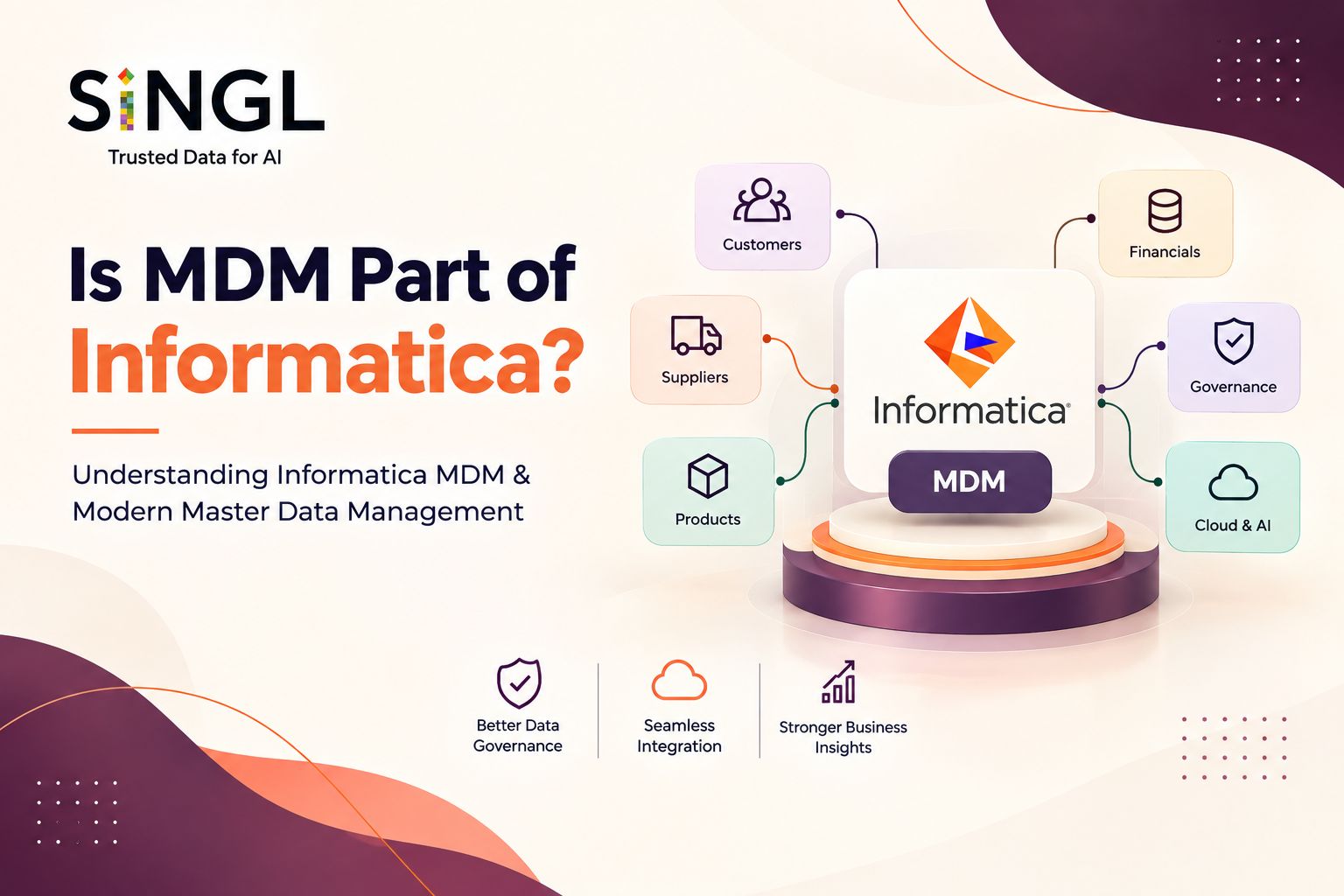
If you are researching Master Data Management (MDM), you may come across Informatica frequently. This often leads to a common question: Is MDM part of Informatica?
The short answer is MDM is not a concept owned by Informatica. Master Data Management is a broader data management discipline used by organizations to create, maintain, govern, and share trusted information about customers, products, suppliers, locations, and other important business entities. Informatica is a technology provider that offers MDM products and services as part of its broader enterprise data management portfolio.
Informatica's current portfolio includes Master Data Management and 360 applications alongside data integration, data quality, governance, catalog, and other capabilities. Its MDM offerings are designed to create trusted, unified views of business-critical data across systems.
Understanding this distinction is important for businesses and professionals evaluating MDM platforms, planning data modernization, or comparing enterprise data management approaches.
What Is Master Data Management?
Master Data Management is a business and technology discipline focused on creating and maintaining consistent, trusted records for important business entities.
Examples of master data include:
Customers
Suppliers
Products
Locations
Employees
Assets
Financial entities
Organizations
Reference data
In a typical enterprise, the same customer or supplier may appear in several systems. A CRM platform might contain one version of a customer, while an ERP system contains another. A data warehouse may contain yet another version.
MDM helps reconcile these records and establish a trusted representation of the entity.
Informatica describes MDM as a process for creating a single master record from internal and external data sources through activities such as deduplication, reconciliation, enrichment, and governance.
This is why MDM should be understood as a discipline and capability, rather than simply the name of one software product.
So, Is MDM Part of Informatica?
MDM is a part of Informatica's product portfolio, but MDM itself is not an Informatica-specific concept.
A useful way to understand the relationship is:
Master Data Management → broader discipline
Informatica → enterprise data management technology provider
Informatica MDM → Informatica's MDM technology and applications
Informatica currently positions MDM and 360 Applications as one part of its broader Intelligent Data Management Cloud portfolio. The portfolio also includes data integration, data quality and observability, governance and privacy, data catalog, and other capabilities.
Therefore, saying "MDM is part of Informatica" can be misleading if it implies that Informatica created or owns the MDM discipline.
A more accurate statement is:
Informatica provides MDM solutions as part of its enterprise data management portfolio.
What Is Informatica MDM?
Informatica MDM is designed to help organizations bring together master data from different systems and create trusted, unified business views.
Its capabilities can include:
Informatica's current MDM platform emphasizes multidomain MDM, AI-assisted matching and merging, agentic data stewardship, and 360 applications for customers, products, suppliers, finance, and reference data.
What Is a Golden Record in Informatica MDM?
One of the central concepts in MDM is the golden record.
Suppose a company has these three customer records:
ABC Corporation — New York
ABC Corp. — NY
A.B.C. Corporation — New York
They may represent the same organization even though the names and other attributes differ.
An MDM system can use matching and data quality processes to determine whether these records belong to the same entity. Relevant information can then be consolidated into a trusted master representation.
The resulting record can become the authoritative version used by business applications.
This helps organizations reduce duplicate information and create a consistent view of critical business entities. Informatica describes its MDM capabilities around creating trusted master records and unified views across business data.
How Does Informatica MDM Work?
Although implementations vary, an MDM process commonly follows several stages.
1. Collect Data From Multiple Sources
Data can come from ERP systems, CRM platforms, databases, applications, cloud systems, spreadsheets, and other sources.
For example, customer information could originate from Salesforce, SAP, an e-commerce platform, and a legacy customer database.
The first step is to bring relevant information into the MDM environment.
2. Profile and Assess the Data
Before records can be mastered, organizations need to understand what the data looks like.
Data profiling can identify:
Missing values
Duplicate records
Invalid formats
Inconsistent addresses
Different naming conventions
Conflicting attributes
This gives data teams a clearer picture of the organization's data quality.
3. Match and Consolidate Records
MDM technologies compare records to identify potential duplicates and relationships.
Matching may use multiple attributes rather than relying on an exact name match.
For example, customer name, address, phone number, email, organization identifier, and other attributes may help determine whether two records represent the same entity.
4. Create a Trusted Master Record
Once records are matched and consolidated, the organization can establish a trusted master representation.
This does not necessarily mean deleting all source records.
Instead, the MDM system can maintain relationships between source records and the mastered entity while preserving relevant lineage and information.
5. Govern and Maintain the Data
Master data changes continuously.
A customer changes its address. A supplier changes its legal name. A company acquires another organization. A product is discontinued.
MDM therefore needs ongoing governance rather than a one-time cleansing exercise.
Informatica MDM vs. MDM as a Business Strategy
It is important to distinguish MDM technology from an MDM strategy.
An MDM strategy includes:
Data ownership
Data stewardship
Governance policies
Data quality standards
Business rules
Data architecture
Integration requirements
Security and access controls
Processes for creating and changing master records
A software platform can support these activities, but technology alone does not create an effective MDM program.
For example, an organization could purchase an MDM platform but still have poor data governance if nobody is responsible for approving customer or supplier changes.
This is why organizations should define their business requirements and governance model before selecting an MDM platform.
What Are Informatica MDM's Major Data Domains?
Modern MDM platforms can manage multiple types of master data.
Customer MDM
Customer MDM focuses on creating a consistent view of customers across sales, marketing, service, finance, and other applications.
Informatica's Customer 360 offering is designed to unify customer information and provide a broader view for business users.
Product MDM
Product data can include descriptions, classifications, specifications, identifiers, categories, and other attributes.
Informatica's Product 360 offering connects product information with other domains and supports product data management for commerce and related business processes.
Supplier MDM
Supplier MDM helps organizations maintain consistent vendor information across procurement, finance, supply chain, and other applications.
This can be especially important for large enterprises with thousands of suppliers.
Financial MDM
Financial master data can include organizational structures, legal entities, charts of accounts, and other information used in financial processes and reporting.
Informatica also provides Finance 360 capabilities within its MDM and 360 Applications portfolio.
Why Is MDM Important for Financial Services?
Financial institutions often operate complex technology environments containing customer, account, organizational, legal entity, and reference information.
Financial Services MDM can help organizations establish consistent information across applications and business units.
For example, a financial institution may need to connect information about a legal entity across risk, compliance, finance, and customer management systems.
Informatica has specifically highlighted financial-services use cases within its MDM portfolio, including legal-entity data models and risk-related information.
Organizations can also evaluate broader Master Data Management Solutions when they need to manage master data across diverse enterprise environments.
How Does MDM Apply to Healthcare?
Healthcare organizations manage information across providers, facilities, suppliers, patients, products, payers, and other entities.
Healthcare MDM can help create consistent business information across systems and departments.
For example, the same healthcare provider may appear differently across credentialing, procurement, billing, and administrative applications. An MDM approach can help identify relationships and establish a trusted representation.
However, healthcare MDM should not be confused with a complete clinical data management or patient privacy strategy. Healthcare organizations have additional requirements around security, privacy, clinical information, and regulatory compliance.
Master Data Management in New York
Organizations researching Master Data Management in New York may encounter MDM requirements across financial services, healthcare, retail, technology, and other enterprise sectors.
For large organizations with multiple applications and business units, MDM can provide a structured approach to maintaining consistent customer, supplier, product, and organizational information.
The specific MDM platform required depends on the company's data architecture, governance requirements, industry, and existing technology environment.
Master Data Management in Chicago
Master Data Management in Chicago can be relevant to organizations managing complex information across manufacturing, healthcare, financial services, logistics, retail, and other industries.
For example, a company operating several facilities may need to maintain consistent supplier and product information across procurement, inventory, finance, and reporting systems.
An MDM platform can help establish common definitions and improve the consistency of information shared between those applications.
Master Data Management in Dallas
Businesses evaluating Master Data Management in Dallas may have requirements involving technology, healthcare, telecommunications, energy, manufacturing, and other data-intensive operations.
When organizations operate multiple systems that contain overlapping customer, supplier, product, or organizational records, MDM can provide a framework for reconciling and governing that information.
Is Informatica the Only MDM Platform?
No.
MDM is a broader technology category, and organizations can evaluate different MDM platforms based on their business requirements.
The appropriate choice can depend on:
Data domains
Number of source systems
Data volume
Integration requirements
Cloud and on-premises architecture
Data governance maturity
Industry requirements
Existing technology investments
Implementation model
Total cost of ownership
Informatica is one provider in the MDM market. Its current portfolio includes multidomain MDM and specialized 360 applications, but businesses should evaluate platforms against their own requirements rather than assuming that one MDM technology is appropriate for every organization.
Informatica MDM and Cloud Data Management
Cloud adoption has changed how organizations deploy and consume MDM.
Informatica offers MDM SaaS capabilities within its Intelligent Data Management Cloud environment. Its documentation describes cloud-based MDM applications for areas including Customer 360, Supplier 360, and Product 360.
Informatica also announced availability of its MDM service on Oracle Cloud Infrastructure, allowing organizations to use Informatica MDM natively within that cloud environment.
This illustrates an important change in MDM: organizations increasingly need master data platforms that can operate across cloud, on-premises, and hybrid environments.
MDM and AI: Why the Connection Matters
AI has increased the importance of trusted enterprise data.
An AI application may be able to process huge amounts of information, but fragmented or inconsistent business data can reduce the quality of the context available to the application.
For example:
Without MDM:
Customer A → CRM record
Customer A → ERP record
Customer A → Support record
These records may contain different names, addresses, identifiers, or classifications.
With MDM:
Multiple source records → Matching and governance → Trusted master record → Business applications and analytics
Informatica currently positions MDM as a foundation for AI-ready data and offers AI-assisted capabilities for matching, enrichment, and stewardship.
However, MDM is only one component of an AI data foundation. Organizations also need appropriate data quality, governance, security, metadata, integration, and AI controls.
Frequently Asked Questions
Is MDM owned by Informatica?
No. Master Data Management is a broader data management discipline. Informatica provides MDM technology as part of its enterprise data management portfolio.
Is Informatica an MDM tool?
Yes. Informatica offers MDM products and applications designed to manage and govern master data across multiple domains.
What does Informatica MDM do?
Informatica MDM helps organizations consolidate, match, enrich, govern, and distribute master data to create trusted views of business entities.
Is Informatica MDM cloud-based?
Informatica offers cloud-based MDM SaaS capabilities as part of its broader Intelligent Data Management Cloud portfolio.
Is Informatica MDM only for customer data?
No. Informatica supports multidomain MDM, including customer, product, supplier, finance, and reference data capabilities.
What is the difference between Informatica and MDM?
Informatica is a technology provider and platform ecosystem. MDM is the broader discipline of managing critical master data. Informatica MDM is the company's technology offering within that discipline.