
Is MDG Still Relevant Today? The Role of Master Data Governance in Modern Enterprises
Discover why SAP MDG remains relevant in 2026, how it supports SAP S/4HANA migration, cloud integration, AI-ready data, and modern enterprise data governance.
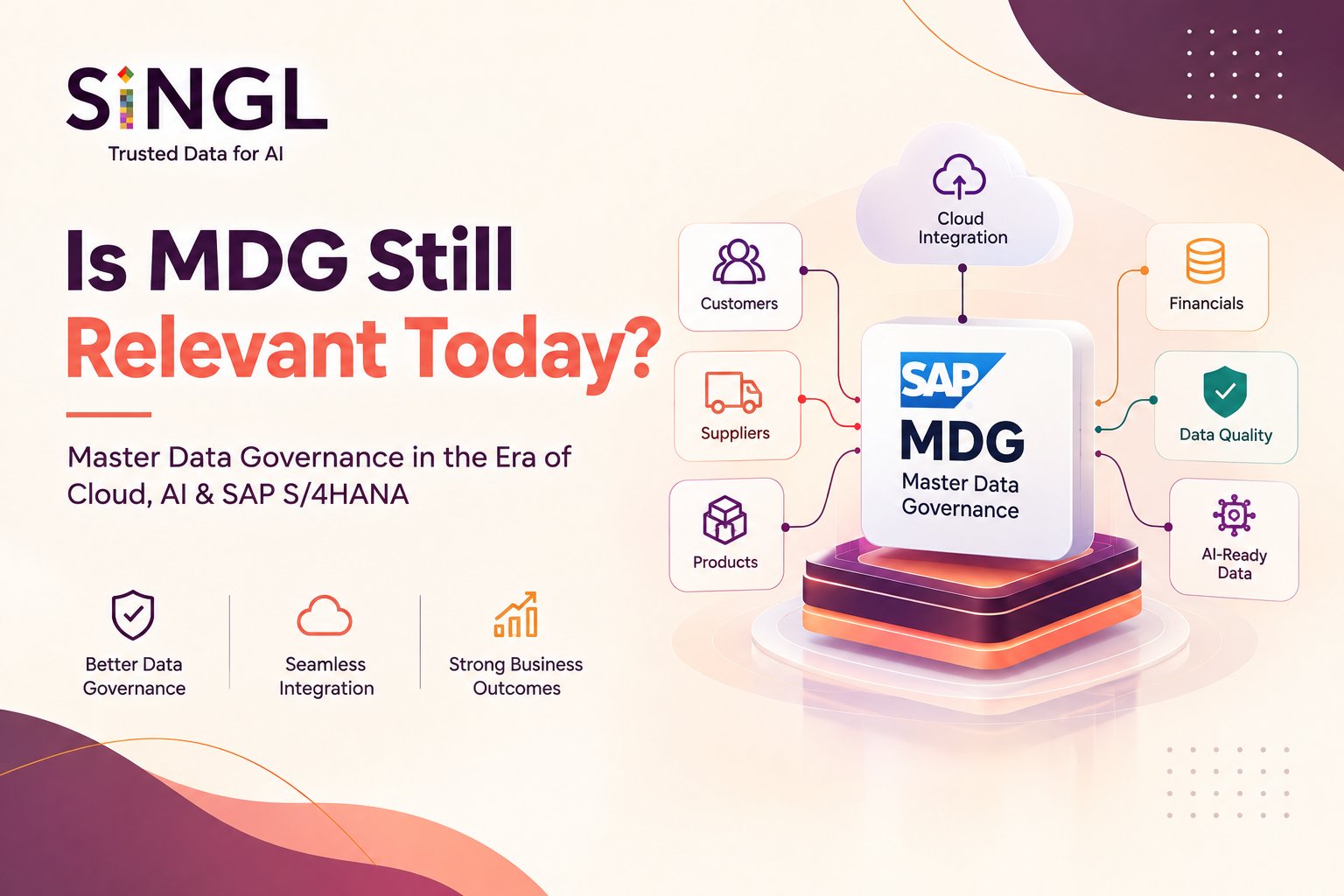
In 2026, Master Data Governance (MDG) remains relevant as businesses modernize their ERP systems, integrate cloud applications, and prepare enterprise data for analytics and artificial intelligence. Although technology continues to evolve, the need for accurate, consistent, and well-governed master data has not disappeared.
Organizations today manage customer information, supplier records, product catalogs, financial data, and operational information across multiple systems. Without effective governance, this information can become duplicated, inconsistent, outdated, or difficult to manage.
SAP Master Data Governance (SAP MDG) provides structured processes for maintaining and distributing trusted master data. As businesses transition toward SAP S/4HANA and adopt more complex data architectures, understanding the role of MDG is increasingly important.
This article explores whether MDG is still relevant, how it supports modern enterprise data management, its applications across industries, and how it fits into cloud, AI, and digital transformation strategies.
What Is Master Data Governance (MDG)?
Master Data Governance is the process of establishing policies, responsibilities, standards, and controls for managing an organization's critical master data.
In an SAP environment, SAP MDG is a solution that supports centralized governance, validation, approval workflows, data quality management, and the distribution of approved master data.
Common master data domains include customer records, suppliers, materials, products, and financial structures.
For example, an organization operating multiple ERP systems may maintain several versions of the same supplier record. SAP MDG can establish a controlled process for creating, validating, approving, and distributing supplier information.
The objective is not simply to store data in one location. It is to ensure that important business information remains accurate, consistent, appropriately controlled, and available to authorized systems.
Is SAP MDG Still Relevant in 2026?
Yes. SAP MDG remains relevant in 2026 because it addresses ongoing enterprise requirements involving data consistency, governance, integration, and regulatory controls.
SAP continues to support Master Data Governance as part of its S/4HANA ecosystem, including central governance, consolidation, and data quality capabilities.
Several developments help explain its continued relevance.
1. SAP S/4HANA Migration Requires Reliable Master Data
Organizations moving from SAP ECC to SAP S/4HANA must evaluate the quality and consistency of their existing master data.
Migration projects can uncover duplicate customer records, outdated suppliers, inconsistent material classifications, and incomplete financial information. Transferring these problems into a new ERP environment can affect reporting and business operations.
SAP MDG can support migration preparation by establishing governance rules, standardizing records, and implementing approval processes. It can also support ongoing governance after the migration is complete.
2. Enterprises Operate Multiple Connected Applications
Modern organizations rarely depend on a single software platform. They may operate SAP ERP, CRM applications, procurement systems, cloud platforms, data warehouses, and industry-specific applications.
Each system may maintain overlapping business information. Without governance, different departments can develop conflicting versions of important records.
SAP MDG helps organizations define controlled processes for maintaining master data and distributing approved information across connected systems.
3. AI and Analytics Depend on Trusted Data
AI applications and analytical systems depend on the quality of their underlying information.
For example, duplicate customer records may distort customer analytics, while inconsistent product classifications can affect inventory forecasting and reporting.
MDG provides governance processes that can improve the consistency and traceability of master data. However, it is one component of a broader data quality strategy rather than a guarantee of accurate AI outputs.
4. Data Governance Remains an Ongoing Business Requirement
Data governance does not end after an ERP implementation. Organizations continuously create new customers, onboard suppliers, introduce products, restructure business units, and update financial information.
These activities require appropriate validation, ownership, approval, and monitoring.
MDG provides structured processes that can support ongoing data management as business requirements change.
How Does MDG Support Modern Master Data Management?
Master Data Governance and Master Data Management are closely connected, but they are not identical.
MDM is the broader discipline of creating and maintaining consistent business information across an organization. MDG establishes the policies, responsibilities, workflows, and controls that govern how that information is managed.
Modern Master Data Management Solutions can combine data integration, matching, consolidation, data quality, and governance to create a dependable enterprise data foundation.
SAP MDG supports several important capabilities:
SAP's documentation describes these capabilities in its current S/4HANA MDG offering.
The Role of MDG Across Different Industries
Financial Services MDM
Financial institutions manage customer, organizational, financial, and reference data across multiple departments and applications. Inconsistent records can complicate reporting, customer management, and internal controls.
Financial Services MDM helps institutions maintain consistent information across business systems. SAP MDG can complement these initiatives by establishing governance processes for relevant customer, supplier, and financial master data.
For example, a financial institution operating multiple business units may use MDG to standardize financial structures and control changes to important reference records.
Healthcare MDM
Healthcare organizations depend on accurate information across administrative, financial, procurement, and operational systems.
Healthcare MDM can help maintain consistent provider, supplier, facility, and organizational information across connected applications.
Where SAP is used for enterprise operations, MDG can support the governance of supplier, material, and financial master data. Clinical and patient data governance requires additional healthcare-specific systems, safeguards, and regulatory considerations.
Manufacturing and Supply Chain
Manufacturers often operate multiple production facilities, warehouses, procurement platforms, and distribution networks.
Without consistent material and supplier information, businesses may experience duplicate purchasing records, inconsistent product descriptions, and unreliable inventory reporting.
SAP MDG supports centralized material and supplier governance, helping organizations standardize information across operational systems.
Retail and E-commerce
Retailers manage large product catalogs, supplier networks, customer records, and distribution locations.
Master data governance helps establish consistent product classifications, controlled supplier onboarding, and reliable information across different sales channels.
Master Data Management Across Major US Business Locations
Enterprise data requirements differ according to industry, organizational structure, and technology infrastructure.
Master Data Management in New York
Organizations exploring Master Data Management in New York may have complex requirements involving financial services, insurance, healthcare, and multinational operations.
SAP MDG can help businesses establish consistent financial and customer master data across connected systems while supporting controlled approval and change-management processes.
Master Data Management in Chicago
Businesses implementing Master Data Management in Chicago may need to govern information across manufacturing, logistics, healthcare, and financial operations.
Organizations operating multiple facilities can use SAP MDG to standardize supplier and material information, improve data consistency, and establish common governance procedures.
Master Data Management in Dallas
Companies considering Master Data Management in Dallas may operate across technology, telecommunications, healthcare, manufacturing, and other data-intensive industries.
SAP MDG can support organizations managing complex ERP environments by providing controlled processes for maintaining and distributing important business information.
These examples illustrate industry applications rather than verified city-level adoption or employment statistics.
Is MDG Still Relevant in the Cloud Era?
Cloud adoption has changed enterprise technology architectures, but it has not eliminated the need for master data governance.
Businesses using cloud applications still need to establish data ownership, validate important records, prevent unnecessary duplication, and manage changes across connected platforms.
SAP provides both classic and cloud-ready MDG capabilities on SAP S/4HANA. Classic mode supports a broad range of master data domains, while cloud-ready mode introduces a modern framework for governance, consolidation, and data quality management. SAP's February 2026 documentation identifies business partners as the supported domain for cloud-ready mode in that release.
Cloud-ready MDG also supports federated governance, enabling different systems and responsible teams to manage appropriate portions of business partner information.
These developments demonstrate how MDG is adapting to distributed enterprise environments rather than being limited to traditional ERP deployments.
How Does MDG Support AI-Ready Data?
Artificial intelligence can process large volumes of information, but its outputs depend partly on the quality of the data it receives.
If an organization has duplicate customers, inconsistent supplier information, or incorrect product classifications, AI applications may reproduce or amplify those problems.
MDG can strengthen an enterprise's AI data foundation through three activities.
Data standardization: Establishing consistent formats, classifications, and business rules helps applications interpret records more reliably.
Data quality management: Validation, duplicate detection, and correction processes help reduce errors in important business information.
Data ownership and accountability: Defined responsibilities and approval procedures make it easier to identify who maintains records and how changes are authorized.
SAP's current MDG capabilities include data quality management and consolidation, while its documentation also describes machine-learning-assisted rule mining.
Nevertheless, organizations still need appropriate data security, AI governance, monitoring, and application-specific quality controls.
Challenges Businesses Should Consider Before Implementing MDG
Although MDG offers useful governance capabilities, implementation requires careful planning.
Defining Data Ownership
Organizations must identify who is responsible for creating, approving, maintaining, and correcting each type of master data.
Without clearly assigned responsibilities, even a technically successful implementation may struggle to maintain consistent information.
Integrating Existing Systems
Businesses frequently operate legacy applications alongside modern ERP and cloud platforms.
Implementing MDG requires appropriate integration architecture, data mapping, replication processes, and decisions about which systems own particular records.
Managing Organizational Change
Introducing standardized governance can change how departments create and maintain business information.
Employees may need training, updated procedures, and clear explanations of their responsibilities. Organizations should also monitor whether new approval processes introduce unnecessary delays.
Maintaining Data Quality Over Time
Initial data cleansing is only the beginning.
Organizations need ongoing monitoring, regular rule reviews, stewardship processes, and appropriate controls for new and modified records.
Frequently Asked Questions
Is SAP MDG becoming obsolete?
SAP MDG is not obsolete. SAP continues to develop its S/4HANA and cloud-ready MDG offerings, including governance, consolidation, and data quality capabilities.
Is SAP MDG relevant after S/4HANA migration?
Yes. Migration may address existing data problems, but businesses still need to govern new records and ongoing changes after implementation.
Can SAP MDG work with non-SAP systems?
Yes. SAP MDG can distribute or consolidate master data across SAP and non-SAP applications, subject to the available integration architecture and configuration.
What is the difference between SAP MDG and SAP MDM?
SAP MDG is SAP's master data governance product. MDM is the broader enterprise discipline of managing consistent master data across applications, processes, and business units.
Does every organization need SAP MDG?
Not necessarily. The appropriate solution depends on the organization's technology landscape, data complexity, governance requirements, budget, and existing MDM capabilities.
Conclusion: MDG Remains Important for Modern Enterprises
Master Data Governance continues to serve an important purpose in 2026. As businesses adopt cloud technologies, modernize ERP systems, and expand their use of analytics and AI, they still need reliable processes for maintaining critical business information.
SAP MDG supports these requirements through controlled workflows, data consolidation, validation, and integration. Its continued development within the SAP S/4HANA ecosystem also makes it relevant to organizations planning long-term ERP and data management strategies.
The central question for businesses is not simply whether MDG is still relevant, but how its capabilities fit their existing systems, governance requirements, and enterprise data objectives.