Career in Master Data Management: Skills, Opportunities, and Future Scope
Explore a career in Master Data Management, including job opportunities, essential technical skills, industry applications, career growth, and future scope in the evolving data management landscape.
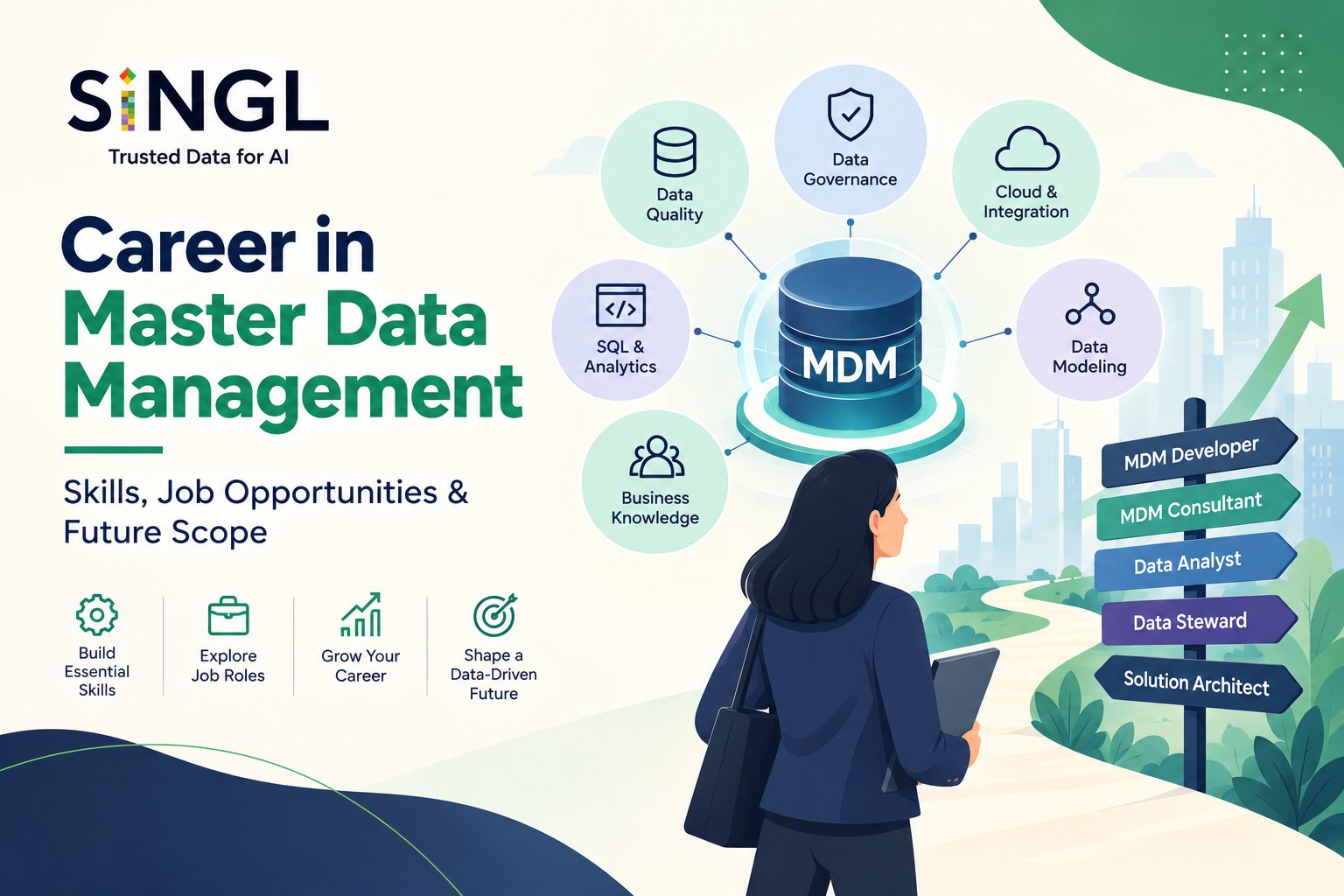
Every business depends on accurate information to make decisions, serve customers, and manage daily operations. However, when customer details differ across systems, product records contain errors, or supplier information is duplicated, organizations can struggle to maintain consistency. This is where Master Data Management (MDM) becomes important.
A career in Master Data Management offers opportunities for professionals who enjoy working with data, solving business problems, improving data quality, and connecting information across enterprise systems. MDM brings together technology, business processes, and data governance to create reliable, consistent records that organizations can trust.
As businesses adopt cloud platforms, advanced analytics, and artificial intelligence (AI), the importance of accurate and well-governed data continues to grow. Professionals who understand data integration, data quality, governance, and MDM platforms can explore opportunities across industries, including banking, healthcare, retail, manufacturing, and technology.
Whether you are a recent graduate, a database professional, a data analyst, or an experienced IT consultant, understanding the career opportunities in MDM can help you plan your next professional step.
What Is Master Data Management?
Master Data Management is the practice of creating, maintaining, and governing consistent records for important business entities, such as customers, products, suppliers, employees, and locations.
Large organizations often store information across multiple applications, databases, and departments. Without proper management, the same customer may have several records, product descriptions may differ between systems, and supplier details may become outdated.
MDM addresses these issues by establishing consistent data definitions, improving data quality, identifying duplicate records, and supporting a reliable view of critical business information.
For example, a bank may maintain customer information across its mobile banking application, loan processing system, and customer relationship management platform. An MDM solution helps reconcile those records so that authorized teams can work with consistent customer information.
Professionals in this field help organizations manage these processes through data modeling, matching and merging, governance workflows, integration, and ongoing data quality monitoring.
Why Choose a Career in Master Data Management?
A career in MDM can suit people who want to combine technical expertise with an understanding of business operations. Unlike roles focused on a single database or application, MDM professionals often work across departments and systems to solve organization-wide data challenges.
1. Opportunities Across Multiple Industries
MDM is relevant wherever organizations need accurate, consistent information. Banks use it to manage customer, account, and reference data. Healthcare organizations rely on it to improve the consistency of patient, provider, and facility records. Retailers and manufacturers use it to maintain product, supplier, and inventory-related information.
This broad applicability allows professionals to develop industry-specific expertise while building transferable data management skills.
2. A Combination of Technical and Business Skills
MDM careers are not limited to programming. Some roles focus on SQL, data integration, and platform configuration, while others involve business analysis, data stewardship, governance, and process improvement.
This variety can benefit professionals from different educational and career backgrounds. Candidates with technical skills can pursue implementation and development roles, while those with strong communication and analytical abilities may prefer functional consulting or governance positions.
3. Opportunities to Work With Modern Data Technologies
Organizations increasingly connect data management with cloud infrastructure, analytics, automation, and AI initiatives. These technologies require dependable information, making data quality and governance important parts of digital transformation.
The US Bureau of Labor Statistics projects that employment of database administrators and architects will grow by 4% from 2025 to 2035, with database architect employment projected to grow by 9%. These are related occupational categories, not direct forecasts for MDM jobs, but they illustrate the wider need for professionals who can design, organize, and secure enterprise data
Top Career Opportunities in Master Data Management
MDM includes several career paths. The right role depends on your technical knowledge, business experience, preferred responsibilities, and familiarity with enterprise systems.
1. MDM Developer
An MDM Developer works on the technical implementation and maintenance of master data management platforms. Responsibilities may include configuring data models, building integration workflows, implementing matching rules, and supporting data cleansing processes.
Developers may also troubleshoot data processing issues, test platform changes, and help distribute trusted records to connected applications.
Skills to develop: SQL, data modeling, ETL and data integration, APIs, troubleshooting, and hands-on experience with an MDM platform.
2. MDM Consultant
An MDM Consultant helps organizations plan, implement, improve, or modernize their master data management capabilities. The role often involves understanding business requirements, identifying data quality problems, designing governance processes, and recommending suitable platform configurations.
Consultants work with technical teams, business stakeholders, and data owners to ensure that the solution meets organizational requirements. Communication and problem-solving skills are especially important because projects often involve multiple departments.
Skills to develop: Requirements gathering, business process analysis, data governance, MDM architecture, stakeholder communication, and implementation methods.
3. MDM Business Analyst
An MDM Business Analyst connects business requirements with technical implementation. They study how information is created and used across departments, document data definitions, identify inconsistencies, and help teams establish rules for managing critical records.
For example, a business analyst may work with sales, finance, and customer support teams to agree on a standard definition of an active customer.
Skills to develop: Business analysis, documentation, data profiling, SQL fundamentals, process mapping, and communication.
4. Data Quality Analyst
A Data Quality Analyst checks whether enterprise data is accurate, complete, consistent, valid, and up to date. The role may involve identifying duplicate records, investigating missing fields, monitoring quality rules, and reporting recurring data issues.
Data quality analysts can work closely with MDM developers, business analysts, data stewards, and governance teams. Their work helps prevent unreliable information from affecting reporting and business decisions.
Skills to develop: Data profiling, SQL, Excel, quality metrics, data cleansing, root-cause analysis, and reporting tools.
5. Data Governance Analyst or Data Steward
A Data Governance Analyst helps establish policies, standards, ownership, and accountability for enterprise data. A Data Steward typically focuses on the practical management of data within a specific business domain.
Responsibilities can include maintaining data definitions, documenting ownership, reviewing quality exceptions, supporting compliance requirements, and coordinating data correction activities.
These roles may suit professionals who understand business processes and prefer governance and coordination over extensive programming.
Skills to develop: Data governance frameworks, metadata management, data catalog concepts, policy documentation, data stewardship, and stakeholder management.
6. MDM Solution Architect
An MDM Solution Architect designs how master data management fits into an organization's wider technology environment. They evaluate source systems, data flows, integration patterns, security needs, data models, and platform capabilities.
Architects often guide implementation teams and make decisions about how data should be consolidated, governed, and shared across applications. This is generally a more advanced role that benefits from significant experience with enterprise data systems and implementation projects.
Skills to develop: MDM architecture, system integration, data modeling, cloud platforms, security, scalability, and enterprise solution design.
Essential Skills Required for an MDM Career
A successful MDM professional needs a balanced combination of technical knowledge, data management expertise, and business understanding. You do not need to master every technology at the beginning; build foundational skills first and expand according to your target role.
SQL and Database Fundamentals
SQL helps professionals query, compare, validate, and analyze records stored in relational databases. Understanding joins, filtering, grouping, subqueries, and data manipulation can make it easier to investigate duplicates and reconcile information across systems.
You should also understand primary keys, foreign keys, relationships, normalization, and the purpose of different database structures.
Data Modeling and Master Data Concepts
Data modeling involves defining how information is structured and how different entities relate to one another. MDM professionals should understand entities such as customers, products, suppliers, and locations, along with their attributes, identifiers, and relationships.
Knowledge of golden records, reference data, hierarchies, matching rules, and survivorship rules is also useful. These concepts help explain how organizations select trusted values when several systems contain conflicting information.
Data Integration and ETL
Master data often originates in multiple applications. Data integration enables information to move between these systems, while ETL—extract, transform, and load—describes a common approach to preparing and loading data.
MDM professionals should understand source-to-target mapping, data pipelines, transformation logic, validation, and error handling. Knowledge of APIs and event-driven integration can also help when working with modern systems.
Data Quality and Governance
Data quality involves assessing whether information meets defined standards. Governance establishes how data is owned, maintained, protected, and used.
Professionals should learn how to define quality rules, track exceptions, document data ownership, manage metadata, and establish processes for correcting errors. These capabilities are important for building trust in enterprise information.
MDM Platforms and Cloud Technologies
Practical platform experience can help candidates demonstrate their knowledge. Depending on the employer, useful exposure may include Informatica MDM, SAP Master Data Governance (SAP MDG), other MDM platforms, and the surrounding data integration ecosystem.
Cloud knowledge is also valuable because many organizations are modernizing their data infrastructure. Learn the fundamentals of cloud storage, identity and access management, integration services, and scalable data processing.
Communication and Analytical Thinking
MDM projects involve business users, data owners, developers, architects, and compliance teams. Professionals must explain data issues clearly, ask the right questions, document decisions, and help stakeholders agree on common definitions.
Analytical thinking is equally important because a duplicate record or inconsistent value may result from a deeper process problem rather than a simple technical error.
Educational Background and Certifications for MDM Careers
A degree in computer science, information technology, information systems, engineering, or a related field can provide a useful foundation for technical MDM roles. However, some functional, governance, and business analyst positions may also suit candidates with relevant business or domain experience.
Certifications are not mandatory for every MDM position, but targeted training can help you structure your learning and demonstrate platform knowledge.
Consider the following learning areas:
Database and SQL training: Build confidence in querying and validating enterprise data.
Data governance and quality: Learn data ownership, quality dimensions, metadata, and stewardship.
MDM platform training: Explore the tools commonly used in your target industry or employer.
Cloud and integration training: Understand how data moves between cloud and on-premises systems.
Business analysis: Practise requirements gathering, process mapping, and stakeholder communication.
Choose certifications based on the roles you are applying for and the technologies used by those employers. Hands-on projects and the ability to explain your design decisions are often just as important as formal credentials.
Industries Offering MDM Career Opportunities
MDM skills can be applied across many sectors. Industry knowledge helps professionals understand which records matter most, which rules apply, and how data quality affects daily operations.
Financial Services MDM
Banks, insurance companies, lending organizations, and financial institutions manage large volumes of customer, account, product, and reference data. Inconsistent records can affect customer onboarding, reporting, risk assessment, and regulatory processes.
Professionals working in Financial Services MDM may support customer data consolidation, party identification, reference data management, data quality controls, and governance initiatives. They may also work with teams responsible for risk, compliance, fraud prevention, and reporting.
Understanding financial products, customer lifecycle processes, data privacy, and regulatory expectations can be useful for professionals seeking specialized MDM roles in this sector.
Healthcare MDM
Healthcare organizations must manage information related to patients, providers, facilities, medical services, and healthcare products. When records are inconsistent across systems, it can create administrative challenges and complicate the coordination of information.
Healthcare MDM focuses on improving consistency and governance across these data domains. Professionals may work on provider master data, patient identity matching, facility records, terminology management, and data integration between healthcare applications.
Because healthcare information can be sensitive, professionals should also understand privacy, access control, data security, and the importance of following applicable healthcare data policies.
Retail and Manufacturing
Retailers depend on consistent product, supplier, location, and customer information to support commerce, inventory management, and reporting. Manufacturers often need standardized material, supplier, and product specifications across procurement, production, and distribution systems.
MDM professionals in these sectors may work on product hierarchies, supplier onboarding, product information management, and data synchronization across enterprise resource planning (ERP), supply chain, and commerce platforms.
Technology and Consulting
Technology companies and consulting firms often help organizations implement MDM platforms, integrate data sources, modernize legacy systems, and improve governance processes.
These environments may offer exposure to different industries and implementation approaches. They can be a useful place to build practical experience, particularly for consultants, developers, business analysts, and solution architects.
MDM Career Opportunities Across Major US Business Hubs
The demand for data management skills can vary by employer, industry, and project requirements. Professionals exploring the US market should assess current job descriptions rather than assuming that every city offers the same opportunities.
Master Data Management in New York
New York has a substantial financial services ecosystem, alongside healthcare, retail, media, and technology businesses. Candidates exploring Master Data Management in New York may find relevant roles in financial data governance, customer master data, enterprise integration, data quality, and consulting.
For finance-focused opportunities, knowledge of customer and account data, reference data, regulatory reporting, and governance workflows can be particularly useful. Review individual job requirements to identify the platforms and domain knowledge employers expect.
Master Data Management in Chicago
Chicago has business activity across financial services, manufacturing, logistics, retail, and professional services. Professionals researching Master Data Management in Chicago can look for roles involving supplier data, product information, customer records, data integration, and enterprise system modernization.
Experience with ERP systems, data modeling, quality management, and cross-functional business processes may be helpful when applying for these positions.
Master Data Management in Dallas
Dallas and the broader North Texas region have technology, financial services, healthcare, telecommunications, and business services employers. Those exploring Master Data Management in Dallas can investigate opportunities in MDM implementation, data governance, platform support, and enterprise data integration.
Candidates may improve their readiness by combining SQL and data quality skills with experience in cloud environments, enterprise applications, or a relevant industry domain.
Across all three locations, verify whether roles require local presence, hybrid work, or remote work, and check visa or work authorization requirements where applicable.
How to Start a Career in Master Data Management
If you are new to the field, a structured learning plan can make the transition more manageable.
Step 1: Learn the Fundamentals
Start with relational databases, SQL, data modeling, data quality, data integration, and data governance. Understand how customer, product, supplier, and reference data are used across business systems.
Step 2: Choose a Career Path
Decide whether you prefer a technical role, such as MDM Developer, a functional role, such as MDM Business Analyst, or a governance-focused role, such as Data Steward. Your preferred path will determine which skills deserve the most attention.
Step 3: Practise With Realistic Data Problems
Create a small project using sample customer or product data. Identify duplicate records, standardize inconsistent values, validate required fields, define matching rules, and document how a trusted record would be selected.
You can also map how data would move between two sample applications. A clear project demonstrates practical thinking even if you have not yet worked on a production MDM implementation.
Step 4: Learn an MDM Platform
Once you understand the core concepts, explore a platform that matches your target job market. Practise configuring data models, quality rules, matching logic, workflows, or integrations where the training environment permits it.
Step 5: Build a Focused Resume
Highlight SQL, data quality, integration, governance, data modeling, and any platform experience relevant to the job. Describe projects in terms of the problem, your approach, the tools used, and the result. Avoid listing technologies you cannot confidently discuss during an interview.
Step 6: Apply for Entry-Level and Related Roles
Search for positions such as Junior MDM Developer, Data Quality Analyst, MDM Support Analyst, Data Governance Analyst, and MDM Business Analyst. Related experience in data analysis, ETL, databases, ERP systems, or business process support can provide a useful entry point.
Career Growth and Future Scope of MDM
The future of MDM is closely connected to the growing importance of trusted enterprise data. As organizations adopt AI, analytics, cloud services, and automated business processes, they need information that is consistent, traceable, and appropriately governed.
AI-assisted matching and anomaly detection may help teams identify potential duplicates, suggest corrections, and prioritize quality issues. However, these capabilities still require sound data definitions, validation, human oversight where appropriate, and clear accountability.
Cloud-based platforms and real-time integrations are also changing how organizations maintain and distribute master data. Professionals who understand both foundational MDM concepts and modern data architecture can prepare for projects involving these technologies.
Career progression may lead from analyst or developer roles to senior consultant, technical lead, data governance manager, or MDM solution architect. Advancement depends on experience, technical depth, industry knowledge, leadership ability, and the complexity of projects handled.
Rather than relying on a single tool, build a strong foundation in data quality, governance, integration, and business requirements. These skills are transferable across platforms and can help you adapt as technologies evolve.
How Master Data Management Solutions Support Enterprise Data Careers
Working with Master Data Management Solutions gives professionals the opportunity to solve practical problems involving inconsistent records, fragmented applications, and unclear data ownership.
MDM solutions may provide capabilities for matching and merging records, defining trusted values, managing hierarchies, applying governance workflows, monitoring data quality, and distributing standardized information to connected systems. The exact capabilities depend on the platform and implementation.
For professionals, understanding how these capabilities support business outcomes is just as important as knowing how to configure the technology. A successful MDM project should improve data consistency, reduce avoidable manual correction, support reliable reporting, and establish clear accountability for critical information.
Explore SiNGL Master Data Management Solutions to learn more about the role of master data management in building trusted, consistent enterprise data.
Conclusion
A career in Master Data Management can be a strong option for people interested in data technology, business processes, governance, and enterprise problem-solving. The field offers varied paths, including MDM development, consulting, business analysis, data quality, governance, and solution architecture.
To build a foundation, focus on SQL, data modeling, data integration, data quality, and governance. Add platform experience and industry knowledge as you progress, and use practical projects to demonstrate your abilities.
As organizations continue to invest in analytics, cloud systems, and AI, professionals who can help maintain accurate and trusted data will remain relevant to many enterprise data initiatives. A clear learning plan and hands-on experience can help you prepare for opportunities in this field.