Future of MDM: How Master Data Management Is Evolving in the AI Era
Explore the future of MDM and discover how AI, cloud, real-time data, automation, knowledge graphs, and governance are transforming Master Data Management.
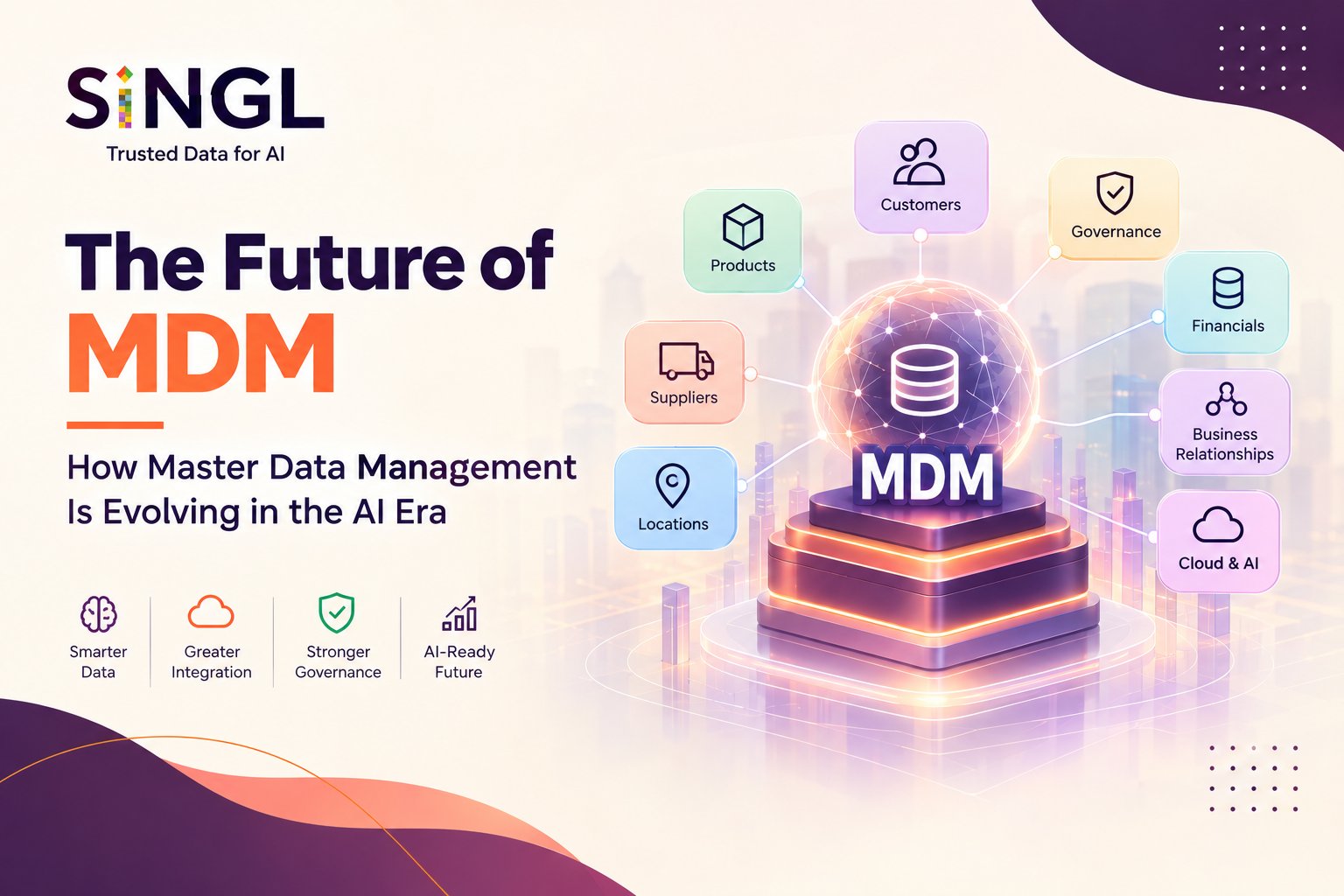
Master Data Management (MDM) is entering a new phase. For years, organizations primarily used MDM to consolidate duplicate records, standardize business information, improve data quality, and create trusted master records. Today, those capabilities remain important, but the role of MDM is expanding.
Cloud adoption, real-time data, automation, generative AI, and AI agents are changing how businesses create, govern, and consume enterprise data. As a result, the future of Master Data Management is moving from simply maintaining a reliable master record toward creating continuously updated, governed business context that can support applications, analytics, automation, and AI.
SAP describes modern MDM as a discipline and technology capability for creating a trusted view of critical entities such as customers, suppliers, products, materials, and assets across systems. Current MDM platforms are increasingly combining this foundation with real-time data, AI-assisted entity resolution, knowledge graphs, and AI-ready data products.
So, what will MDM look like over the next few years? Let's explore the major trends shaping its future.
What Is the Future of MDM?
The future of Master Data Management is about making trusted data more connected, intelligent, automated, real-time, and accessible.
Traditional MDM typically focused on creating a consistent version of an entity across multiple systems. Modern MDM is expanding that role by connecting entities, relationships, business rules, metadata, governance policies, and operational context.
This shift is important because enterprises now operate across ERP systems, CRM platforms, cloud applications, data warehouses, data lakes, SaaS applications, and AI environments.
Instead of asking only:
“Which customer record is correct?”
modern MDM increasingly needs to answer:
“Who is this customer, what are their relationships, what products or services are associated with them, what information can be trusted, and can an AI system safely act on this context?”
That is a much broader responsibility.
1. AI Will Become a Core Part of MDM
One of the biggest trends shaping the future of MDM is artificial intelligence.
Traditional MDM relies heavily on predefined rules for data matching, validation, classification, and quality management. AI can help augment these processes by identifying patterns and relationships that may be difficult to capture through rules alone.
For example, AI-assisted entity resolution can help determine whether two records refer to the same customer or organization, even when names, addresses, or other attributes are slightly different.
Modern platforms are already moving in this direction. SAP describes AI-augmented matching and merging, while its current MDM strategy connects unified master data with AI agents and real-time business context.
AI can increasingly support:
Duplicate detection
Entity resolution
Data classification
Data quality recommendations
Attribute enrichment
Data issue prioritization
Metadata discovery
Relationship identification
Data stewardship assistance
However, AI does not eliminate the need for governance. In fact, the more organizations rely on AI, the more important trustworthy and governed master data becomes.
2. MDM Will Become the Foundation for AI-Ready Data
AI systems depend on data, but simply having large amounts of data is not enough.
If customer records are duplicated, supplier information is outdated, or product attributes conflict across systems, AI applications can inherit those problems.
This is why the future of MDM is closely connected to the future of enterprise AI.
Recent industry research from Informatica found that data reliability remains a significant barrier to moving AI initiatives into production, while many organizations are also struggling to keep AI governance aligned with rapidly increasing AI usage.
MDM can provide AI systems with:
Trusted entities
Standardized attributes
Consistent identifiers
Governed relationships
Data quality rules
Business hierarchies
Metadata
Traceable information
In this environment, MDM becomes more than a back-office data management function. It becomes part of the data foundation for AI.
3. Real-Time MDM Will Become More Important
Traditional MDM environments often depended on scheduled data loads and batch processing.
That approach can still be useful, but businesses increasingly need information that reflects current conditions.
Consider a customer changing an address, a supplier being placed on a risk list, or a product becoming unavailable. Waiting until the next scheduled data synchronization may not be sufficient for applications making decisions in real time.
Modern MDM is therefore moving toward:
Real-time synchronization
Event-driven updates
APIs
Streaming data
Low-latency data delivery
Continuous data quality monitoring
SAP's current MDM direction emphasizes real-time unified master data that can be used across operational, analytical, and AI workloads.
This means future MDM architectures will increasingly need to operate as part of an organization's real-time data ecosystem rather than as an isolated master-data repository.
4. Cloud-First MDM Will Continue to Grow
Cloud adoption is another major factor influencing the future of MDM.
Organizations are moving applications and data environments to cloud platforms to gain scalability, flexibility, faster deployment, and easier integration with modern technologies.
MDM is following the same direction.
Cloud-based MDM can help organizations:
Scale across business units
Connect distributed applications
Support hybrid environments
Reduce infrastructure management
Integrate with cloud analytics
Support global data operations
Deliver master data through APIs
Cloud-first MDM is also becoming closely connected to broader data platforms. Informatica's cloud-first MDM research highlights cloud modernization as a major strategic direction for organizations, with flexibility and cost efficiency among the reported drivers.
The future is therefore unlikely to be limited to traditional on-premises MDM deployments. Instead, businesses will increasingly operate MDM across cloud, hybrid, and multicloud environments.
5. Multidomain MDM Will Become More Connected
Organizations rarely manage only one type of master data.
A business may need to connect:
Customer → Product → Supplier → Location → Organization → Financial Entity
Traditional domain-specific approaches can make these relationships difficult to understand.
Multidomain MDM addresses this by managing multiple master data domains within a connected framework.
The future of multidomain MDM will focus not only on mastering individual entities but also on understanding relationships between those entities.
For example:
A customer may purchase a product supplied by a particular vendor through a specific distribution location.
Understanding these relationships can provide useful context for analytics, risk management, customer service, supply-chain decisions, and AI.
6. Knowledge Graphs Will Strengthen MDM
Another important development is the growing role of relationships and knowledge graphs.
A conventional master record tells an organization about an entity.
A connected data model can also explain how that entity relates to other entities.
For example:
Customer → Owns Account → Buys Product → Purchased From Supplier → Delivered Through Location
This connected context can be valuable for both people and AI systems.
SAP's current MDM capabilities highlight dynamic knowledge graphs that map relationships and interactions so AI agents can understand business context.
As this approach matures, MDM may increasingly function as a knowledge layer for enterprise data, rather than simply a database containing golden records.
7. MDM Will Become More Automated
Manual data stewardship will continue to be important, but organizations are looking for ways to automate repetitive activities.
Future MDM platforms are likely to automate more of the data lifecycle, including:
Profiling
Classification
Matching
Duplicate detection
Data enrichment
Quality monitoring
Issue prioritization
Workflow recommendations
Metadata discovery
Data remediation
The role of the data steward may therefore shift.
Instead of manually reviewing thousands of records, stewards may focus on exceptions, complex decisions, policy management, and higher-value data quality issues.
This creates a model in which automation handles routine decisions while humans manage exceptions and governance.
8. Data Governance Will Move From Control to Continuous Enablement
Governance has always been important to MDM, but its role is becoming even more strategic.
In the past, governance was sometimes viewed primarily as a compliance function.
In the future, governance will increasingly be integrated directly into data workflows.
This means organizations will need to define:
Who owns the data?
Who can change it?
What makes a record trustworthy?
Which attributes are mandatory?
How should duplicates be resolved?
Which systems are authoritative?
How should data be accessed by AI?
How can changes be audited?
SAP's 2026 data strategy emphasizes governance as part of the foundation for AI and business data rather than treating it as a separate control layer.
This is an important change because trustworthy AI requires trustworthy governance.
9. MDM Will Support AI Agents and Autonomous Business Processes
The emergence of AI agents may have one of the biggest impacts on MDM.
An AI agent can potentially analyze information, recommend actions, and execute business processes with limited human intervention.
But an agent needs reliable business context.
For example, a procurement agent may need to understand:
Which supplier is being discussed?
Is the supplier approved?
What products does the supplier provide?
Where does the supplier operate?
What is the supplier's relationship with other entities?
Which supplier record is authoritative?
If the underlying data is fragmented, the agent may make an incorrect decision.
Current SAP and Informatica strategies both show MDM becoming increasingly connected to agentic AI architectures and trusted business context.
This means MDM could become an important context layer for enterprise AI agents.
10. MDM Will Become More Embedded in Enterprise Data Platforms
The future of MDM will not necessarily involve users opening a separate MDM application for every data-related activity.
Instead, MDM capabilities will increasingly be embedded into broader data ecosystems.
MDM may connect directly with:
Data warehouses
Data lakes
Lakehouses
Data fabrics
CRM systems
ERP systems
Analytics platforms
AI platforms
Data catalogs
Governance platforms
For example, Informatica's 2026 announcements describe deeper integrations with platforms including Google Cloud, Microsoft, Databricks, and Snowflake, with a focus on governed data and AI use cases.
This signals a broader industry direction: MDM is becoming part of an interconnected enterprise data architecture.
MDM in Financial Services
The future of Financial Services MDM will increasingly involve real-time customer, account, organization, product, and reference data.
Financial institutions need accurate data for:
Customer identity
Risk management
Regulatory reporting
Product management
Account relationships
Fraud detection
Analytics
AI-driven services
As financial organizations adopt more AI and automated decision-making, trusted master data can become increasingly important for ensuring that systems operate on consistent business entities.
The future therefore points toward MDM that is more connected to governance, analytics, real-time operations, and AI.
MDM in Healthcare
Healthcare MDM is another area where accurate and connected master data can become increasingly important.
Healthcare organizations may need to manage relationships between:
Patients
Providers
Healthcare organizations
Facilities
Locations
Payers
Medical products
Reference data
As healthcare organizations adopt digital platforms and AI-based applications, fragmented information can create challenges for analytics, operations, and decision-making.
Future healthcare MDM will therefore likely place greater emphasis on data quality, interoperability, privacy, governance, identity resolution, and connected entity relationships.
What Does the Future of MDM Look Like in Major Business Hubs?
The evolution of MDM is not limited to a particular region. Organizations across major business markets are facing similar challenges around data fragmentation, cloud modernization, governance, and AI readiness.
Businesses evaluating Master Data Management in New York may increasingly look at MDM as part of broader financial services, healthcare, technology, and enterprise AI initiatives.
Organizations exploring Master Data Management in Chicago may focus on connecting data across manufacturing, healthcare, logistics, retail, and professional services environments.
Meanwhile, companies considering Master Data Management in Dallas may use MDM to support distributed operations, customer data, supply-chain information, financial data, and cloud transformation.
In all three markets, the underlying direction is similar: organizations need master data that is trusted, connected, governed, and available where business decisions are made.
How Master Data Management Solutions Will Evolve
The next generation of Master Data Management Solutions will need to address more than duplicate records.
Businesses will increasingly expect MDM solutions to provide:
This evolution does not mean traditional MDM capabilities are disappearing. Instead, those capabilities are becoming the foundation for a broader and more intelligent MDM architecture.
Challenges That Could Shape the Future of MDM
Despite the opportunities, organizations will face several challenges.
Data Complexity
Enterprises increasingly operate across hundreds of applications and distributed data environments. Maintaining consistent master data across these systems can be difficult.
Governance Complexity
As data is consumed by humans, applications, analytics systems, and AI agents, organizations need clearer rules around ownership, access, privacy, and accountability.
AI Trust
AI can increase automation, but inaccurate master data can also increase the scale of errors. Organizations need strong controls around AI-assisted data decisions.
Legacy Systems
Many organizations still depend on older ERP and business applications. Connecting these systems to modern cloud MDM architectures can require significant planning.
Change Management
MDM is not simply a technology implementation. It changes how organizations create, own, maintain, and use business data. Successful programs therefore require collaboration across business and IT teams.
How Businesses Can Prepare for the Future of MDM
Organizations do not need to wait for the next generation of MDM technology to begin preparing.
A practical approach includes:
1. Identify Critical Data Domains
Start with the business entities that have the greatest operational and strategic impact.
2. Establish Data Ownership
Define who is responsible for each master data domain.
3. Improve Data Quality
Identify duplicates, missing information, inconsistent values, and outdated records.
4. Modernize Integration
Connect MDM with ERP, CRM, cloud applications, analytics platforms, and other important systems.
5. Build Governance Into Workflows
Make governance part of data creation and modification rather than treating it as a separate process.
6. Prepare Data for AI
Ensure master data is accurate, traceable, connected, and governed before using it to support AI applications.
7. Think Beyond the Golden Record
A golden record is important, but organizations should also understand relationships, hierarchies, metadata, and business context.
The Future of MDM: From Data Management to Business Context
The biggest change in MDM is not simply that platforms are becoming more automated or moving to the cloud.
The deeper change is that MDM is becoming a strategic source of trusted business context.
In the past, MDM primarily answered:
“What is the correct version of this business entity?”
The future will increasingly require MDM to answer:
“What is this entity, how is it connected to the rest of the business, can we trust this information, and how can people, applications, and AI safely use it?”
That shift will make MDM increasingly relevant to enterprise AI, automation, analytics, cloud modernization, and digital transformation.
Current industry developments already point in this direction, with real-time master data, AI-assisted entity resolution, knowledge graphs, cloud-native architectures, and agentic AI becoming part of modern MDM strategies.
Conclusion
The future of MDM is moving toward a more intelligent, connected, automated, and real-time approach to enterprise data management.
AI will help improve matching, classification, enrichment, and data quality. Cloud and API-driven architectures will make master data more accessible across distributed systems. Knowledge graphs will provide greater visibility into relationships, while embedded governance will help organizations maintain trust and accountability.
Most importantly, MDM will increasingly serve as a foundation for AI and automation.
Organizations that invest in high-quality, governed, connected master data today will be better positioned to take advantage of tomorrow's analytics, cloud, automation, and AI capabilities.
Trusted data is no longer just an MDM objective—it is becoming a prerequisite for intelligent enterprise operations.