
Is ETL the Same as SQL? Understanding the Key Differences in Data Management
ETL and SQL are often confused, but they serve different purposes in data management. Learn how ETL, SQL, and ELT work, their key differences, and how they support data integration, Master Data Management, analytics, and AI.
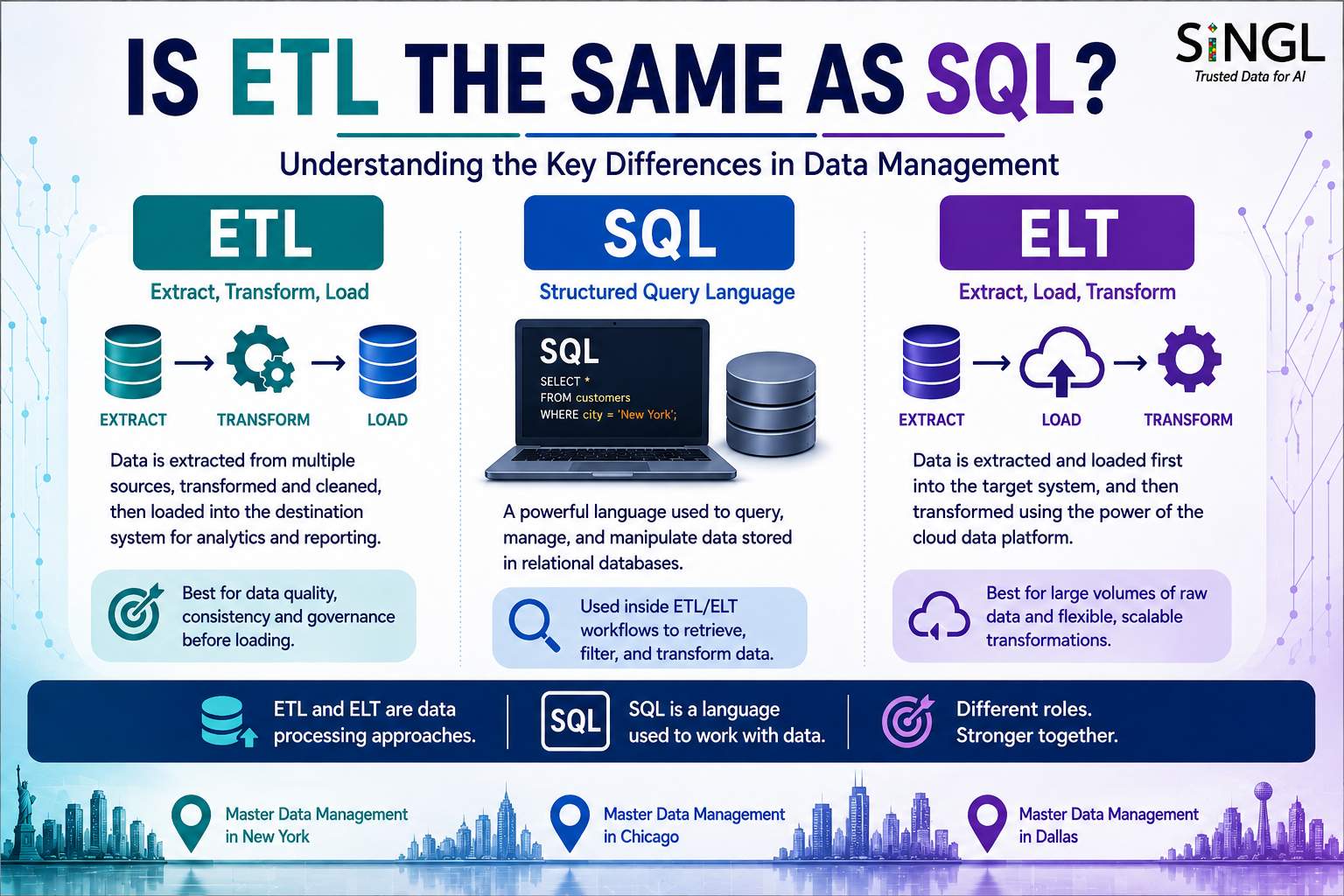
Understanding the Difference Between ETL and SQL
Organizations rely on large volumes of data from databases, CRM platforms, ERP systems, cloud applications, and other business systems. To make this information useful, businesses need ways to extract, transform, query, organize, and manage their data.
Two terms that are often mentioned in this process are ETL and SQL.
Although ETL and SQL are closely related and can work together, ETL is not the same as SQL. ETL refers to a process used to move and prepare data, while SQL is a language used to communicate with and manage relational databases.
Understanding the difference between ETL and SQL is important for organizations building modern data integration, analytics, Master Data Management (MDM), and AI initiatives.
What Is ETL?
ETL stands for Extract, Transform, and Load.
It is a data integration process used to collect data from one or more sources, prepare it for use, and move it into a target system.
The three stages include:
Extract
Data is collected from different sources, such as:
CRM systems
ERP platforms
Relational databases
Cloud applications
Spreadsheets
APIs
Legacy systems
Transform
The extracted data is cleaned and prepared before being used.
Common transformation activities include:
Removing duplicates
Standardizing formats
Correcting errors
Validating data
Combining information from multiple sources
Applying business rules
Load
The prepared data is then loaded into a destination, such as:
A data warehouse
A cloud database
An analytics platform
A business intelligence system
A Master Data Management platform
In simple terms, ETL is a complete process for moving and preparing data.
What Is SQL?
SQL, or Structured Query Language, is a programming language used to communicate with relational databases.
SQL allows users and applications to:
Retrieve data
Insert new records
Update existing information
Delete records
Create tables
Join data from multiple tables
Filter and analyze information
For example, a simple SQL query can retrieve customer information from a database:
SELECT *
FROM customers
WHERE city = 'New York';
SQL focuses on working with data stored in databases, while ETL focuses on the broader process of moving, transforming, and integrating data.
Is ETL the Same as SQL?
No. ETL and SQL are not the same.
However, SQL can be used as part of an ETL process.
For example, an ETL workflow may use SQL to extract information from a relational database. SQL can also be used to transform data before loading it into another system.
The key difference is simple:
ETL is a process or workflow.
SQL is a language used to work with databases.
An ETL pipeline may use SQL along with APIs, Python, data integration tools, cloud services, and other technologies.
ETL vs. SQL: A Quick Comparison
How SQL Is Used in ETL
Although ETL and SQL are different, SQL is commonly used within ETL workflows.
Extracting Data
SQL queries can retrieve data from relational databases.
For example, an ETL process may use SQL to collect customer records from a CRM database.
Transforming Data
SQL can help clean and restructure information.
For example, SQL queries may:
Standardize dates
Combine tables
Remove unnecessary records
Filter information
Create calculated fields
Loading Data
SQL can also insert transformed information into a target database or data warehouse.
Because of this, SQL remains an important skill for data integration professionals, even when organizations use modern ETL platforms.
ETL vs. SQL: An Example
Imagine an organization has customer information stored in three different systems:
A CRM platform
An ERP system
An e-commerce database
The organization wants to create a complete and accurate customer data environment.
An ETL process could:
Extract: Collect customer information from all three systems.
Transform: Standardize names, addresses, phone numbers, and email formats while identifying duplicate records.
Load: Send the prepared data to a data warehouse or Master Data Management platform.
SQL may be used at different stages to retrieve, filter, join, and update information stored in relational databases.
Therefore, SQL can be one tool within an ETL process, but SQL alone is not ETL.
ETL and SQL in Data Integration
Modern organizations rarely store all their information in a single database.
Data may exist across:
On-premises systems
Cloud applications
SaaS platforms
Data warehouses
Operational databases
APIs
Legacy applications
This creates the need for effective data integration.
ETL helps connect these different sources and prepare information for analytics, reporting, operations, and data management. SQL supports this process by making it easier to access and manipulate information stored in relational databases.
Together, ETL and SQL can help organizations build more connected and reliable data environments.
ETL vs. SQL vs. ELT
ETL and SQL are often compared with ELT, but all three serve different purposes in the data ecosystem.
ETL
ETL stands for Extract, Transform, and Load. It is a structured data integration process where information is collected from different source systems, cleaned and standardized, and then loaded into a target system.
The transformation happens before the data reaches its final destination. ETL is commonly used when organizations need to validate, cleanse, and prepare data before sending it to a data warehouse, MDM platform, or analytics environment.
ETL can involve multiple tools and technologies, including SQL, data integration platforms, APIs, and automated workflows. In other words, SQL may be one of the technologies used within an ETL process.
ELT
ELT stands for Extract, Load, and Transform. Unlike ETL, the data is first extracted from its source and loaded into the target platform before the transformation takes place.
The transformation is usually performed inside the destination system, such as a modern cloud data warehouse or data platform. This approach takes advantage of the processing power and scalability of modern cloud infrastructure.
ELT is particularly useful when organizations need to handle large volumes of raw data and want the flexibility to transform that data later for different analytics, reporting, or business requirements.
SQL
SQL, or Structured Query Language, is a language used to interact with and manage relational databases. It allows users and systems to retrieve, filter, update, organize, and transform data.
SQL is not a data integration process like ETL or ELT. Instead, it can be used as part of an ETL or ELT workflow to perform tasks such as selecting records, joining datasets, removing duplicates, and transforming data values.
This means ETL and ELT describe how data moves and is processed, while SQL is a technology or language that can be used to work with that data.
How ETL Supports Master Data Management
ETL plays an important role in Master Data Management (MDM).
Before an MDM platform can create trusted master records, it needs to receive data from different business systems.
An ETL process can help:
Extract customer, product, supplier, and location data
Standardize inconsistent formats
Validate information
Prepare data for matching and deduplication
Load information into an MDM environment
The MDM platform can then apply additional processes, such as data matching, governance, stewardship, and Golden Record creation.
This creates a stronger foundation for trusted enterprise data.
For businesses implementing Master Data Management in Chicago, ETL can support the movement and preparation of customer, product, supplier, and other critical data before it enters an MDM environment.
SQL and Master Data Management
SQL can also support Master Data Management by allowing organizations to query and analyze master data stored in relational databases.
For example, SQL may help teams:
Identify duplicate records
Analyze data quality issues
Retrieve customer information
Compare records across tables
Generate reports
Support data validation
However, SQL by itself does not provide a complete Master Data Management strategy.
A modern MDM approach also requires capabilities such as:
Data integration
Data quality management
Matching and deduplication
Data governance
Workflow management
Data stewardship
Data distribution
This is why ETL, SQL, and MDM often work together as part of a broader enterprise data strategy.
Benefits of Using ETL and SQL Together
Using ETL processes and SQL capabilities together can help organizations improve how they manage enterprise data.
Better Data Quality
ETL helps standardize and prepare information, while SQL can support validation and analysis.
This reduces inconsistencies across business systems.
Faster Access to Information
SQL allows users to retrieve information efficiently from databases, while ETL ensures relevant data is available in centralized environments.
Improved Reporting and Analytics
Accurate and well-prepared data improves dashboards, reports, and business intelligence.
Reduced Manual Work
Automated ETL pipelines reduce the need for manual data movement and repetitive processing.
Better Support for AI
AI and analytics depend on accurate and reliable information.
ETL helps prepare data, while SQL can help organizations access and analyze structured information.
Together, they contribute to a stronger data foundation for AI initiatives.
ETL and SQL for Modern Enterprise Data Management
The importance of ETL, SQL, and data integration continues to grow as organizations manage increasingly complex data environments.
Organizations using Master Data Management in New York often manage data across multiple enterprise applications, cloud platforms, and business units. ETL processes can help bring this information together and prepare it for analytics or master data initiatives.
The underlying challenge remains the same: enterprise data must be integrated, standardized, governed, and made available to the people and systems that need it.
A strong data strategy may combine ETL processes, SQL capabilities, cloud technologies, and Master Data Management to create a more reliable and connected data environment.
When Should You Use ETL?
ETL is useful when an organization needs to:
Integrate data from multiple sources
Prepare information for a data warehouse
Improve data consistency
Automate data movement
Support Master Data Management
Prepare data for analytics
Build reliable data pipelines
ETL is particularly valuable when data comes from multiple disconnected systems.
When Should You Use SQL?
SQL is useful when you need to:
Query relational databases
Retrieve specific records
Join information from multiple tables
Update database records
Analyze structured data
Create reports
Perform database transformations
SQL is an essential technology for working with structured data, but it does not replace a complete data integration process.
ETL, SQL, and the Future of AI-Ready Data
As organizations invest more heavily in artificial intelligence, the importance of reliable data continues to increase.
AI systems depend on information that is:
Accurate
Complete
Consistent
Relevant
Well-governed
ETL helps collect and prepare data from different sources. SQL helps organizations query and work with structured information. MDM helps create trusted master records and maintain consistency across critical business data.
Together, these capabilities can support a more reliable foundation for analytics, automation, and AI.
As organizations invest in AI, analytics, and digital transformation, companies exploring Master Data Management in Dallas also need reliable processes for integrating and maintaining high-quality enterprise data.