What Is the Difference Between ETL and Data Integration?
ETL and data integration are closely related but serve different purposes. Learn how ETL, data integration, MDM, and modern data strategies work together to create trusted enterprise data.
Understanding ETL, Data Integration, and Their Role in Modern Data Management
Organizations today collect data from a growing number of sources, including CRM systems, ERP platforms, databases, cloud applications, spreadsheets, websites, and business software. Connecting this information is essential for reporting, analytics, automation, and effective decision-making.
However, moving data from one system to another is only one part of the challenge. Businesses also need to determine how data should be collected, transformed, standardized, governed, and delivered to the systems and teams that need it.
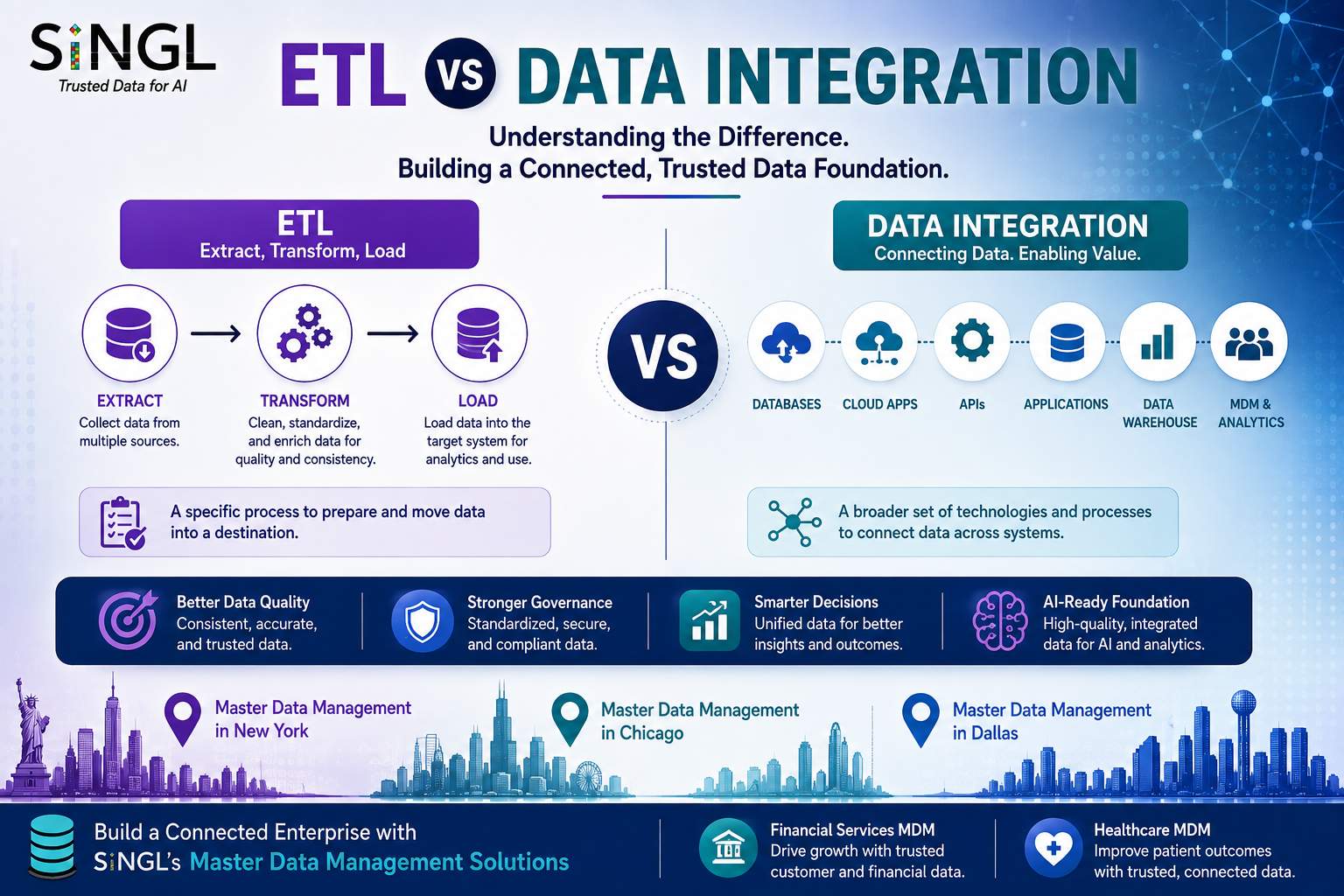
This is where ETL and data integration come into the picture. Although the two terms are closely related, they do not mean exactly the same thing. ETL is a specific approach to processing and moving data, while data integration is the broader practice of connecting data across different systems and environments.
Understanding the difference can help organizations choose the right approach for their data architecture, Master Data Management (MDM), analytics, and AI initiatives.
What Is ETL?
ETL stands for Extract, Transform, and Load.
It is a structured data processing method in which information is:
Extracted from one or more source systems.
Transformed into a usable and consistent format.
Loaded into a target system.
For example, a business may extract customer information from a CRM, standardize names and addresses during the transformation stage, and then load the cleaned data into a data warehouse.
The important point is that ETL describes how data is processed before it reaches its destination.
What Is Data Integration?
Data integration is a broader concept.
It refers to the processes, technologies, and practices used to combine or connect data from different sources so that it can be accessed and used consistently.
Data integration can involve:
Databases
CRM and ERP systems
Cloud applications
APIs
Data warehouses
Data lakes
MDM platforms
Business intelligence systems
SaaS applications
Unlike ETL, data integration does not necessarily require data to follow the exact Extract → Transform → Load sequence.
An organization may use APIs, real-time streaming, replication, synchronization, ETL, ELT, or other technologies to integrate information.
In simple terms: ETL is one method of data integration, while data integration is the larger discipline.
ETL vs. Data Integration: What Is the Difference?
The easiest way to understand the difference is to look at their scope.
ETL
ETL is a specific process for extracting data, transforming it, and loading it into a destination.
It is commonly used when organizations need to prepare data before storing it in a warehouse, MDM platform, analytics environment, or other target system.
The transformation stage may include cleansing, standardization, validation, filtering, enrichment, and formatting.
Data Integration
Data integration covers the broader requirement of making information from different systems work together.
It may include ETL, ELT, APIs, event-driven integrations, data replication, application integration, and real-time synchronization.
Therefore, ETL can be considered a subset or technique within the larger data integration landscape.
ETL and Data Integration Compared
This distinction is important because businesses sometimes use the terms interchangeably even though they describe different levels of the data architecture.
How Does ETL Work?
ETL generally follows three main stages.
1. Extract
The first stage involves collecting information from one or more source systems.
For example, an organization might extract:
Customer records from a CRM
Product information from an ERP
Supplier information from procurement software
Transaction data from databases
Marketing information from cloud applications
The extraction process needs to retrieve the required information without unnecessarily disrupting source systems.
2. Transform
The extracted information is then prepared for its intended use.
Transformation can include:
Removing duplicate records
Standardizing formats
Correcting inconsistent values
Validating fields
Converting data types
Applying business rules
Combining information from multiple sources
For example, one system may store a country as "United States," while another uses "US." A transformation process can standardize these values so they are treated consistently.
3. Load
After transformation, the data is loaded into a target environment.
The destination could be:
A data warehouse
A data lake
An MDM platform
An analytics platform
A cloud database
A reporting system
Once the information reaches the destination, it can support reporting, analytics, operational processes, and other business requirements.
How Does Data Integration Work?
Data integration can follow several different approaches depending on the organization's requirements.
Batch Integration
Data is moved at scheduled intervals, such as every hour, every day, or every week.
This approach is useful when real-time information is not necessary.
Real-Time Integration
Data is transferred between systems as events occur.
For example, a customer update in one application could be immediately reflected in another connected system.
API-Based Integration
APIs allow applications to communicate and exchange information without requiring traditional batch pipelines for every interaction.
ETL and ELT
Organizations can use ETL or ELT pipelines to prepare and move large volumes of data between systems.
Data Replication
Data can also be replicated between databases or platforms to make information available in multiple environments.
Therefore, data integration is not limited to ETL. ETL is simply one of several techniques organizations can use to achieve integration.
ETL and Data Integration in Master Data Management
The difference becomes particularly important when discussing Master Data Management.
MDM focuses on creating and maintaining trusted master data across domains such as customer, product, supplier, location, and financial information.
Data integration helps bring information from different source systems into the MDM environment.
ETL can then be used to extract information from those systems, transform it according to data quality and business rules, and load it into the MDM platform.
For example:
CRM → Extract → Clean & Standardize → MDM → Trusted Master Data
This process can help an organization identify duplicates, standardize information, create Golden Records, and distribute trusted data back to business applications.
Organizations looking for Master Data Management Solutions can therefore benefit from understanding how integration capabilities fit into their overall MDM architecture.
Why Data Integration Matters for MDM
An MDM platform cannot provide a complete view of enterprise data if important information remains isolated in disconnected systems.
Data integration creates the connections needed to bring that information together.
For example, customer information may exist in a CRM, order information in an ERP, and service interactions in a customer support application.
Integration makes it possible to connect these sources, while MDM applies governance, matching, deduplication, and master data management capabilities to create trusted information.
This is particularly important for organizations operating complex enterprise environments across multiple departments and business locations.
ETL vs. Data Integration for Analytics
Analytics also depends on the distinction between the two concepts.
ETL can prepare information for analytical systems by cleaning and transforming source data before loading it into a warehouse.
Data integration, meanwhile, provides the broader connectivity required to bring information from different platforms together.
For example, an organization may combine sales, customer, product, marketing, and financial information to create a more complete analytical view.
Without reliable integration, analytics teams may have to work with incomplete or inconsistent information.
ETL vs. Data Integration for AI
Modern AI initiatives make trusted data even more important.
AI systems depend on data that is sufficiently accurate, complete, consistent, and relevant. If information comes from disconnected systems and contains duplicates or conflicting values, the quality of AI outputs can be affected.
ETL helps prepare data by extracting and transforming it before loading.
Data integration provides the wider framework for connecting the different systems and data environments that supply AI initiatives.
When combined with MDM and data governance, these capabilities can create a stronger foundation for AI and advanced analytics.
The Role of Data Quality
One of the most important connections between ETL and data integration is data quality.
Simply moving information between systems does not automatically make it trustworthy.
Consider a business that has three records for the same customer:
John Smith
J. Smith
John A. Smith
A basic integration process may successfully move all three records from one system to another.
However, ETL transformations and MDM capabilities can help identify inconsistencies and prepare the information for deduplication and master record creation.
This demonstrates why data movement and data quality are related but different responsibilities.
ETL vs. ELT vs. Data Integration
ETL is also frequently compared with ELT.
ETL
Data is extracted from source systems, transformed before loading, and then delivered to the target environment.
This approach can be useful when organizations want strong control over data preparation before information reaches the destination.
ELT
With ELT, data is extracted and loaded into the target platform first. Transformation happens afterward, often using the processing capabilities of modern cloud data platforms.
This approach is particularly useful when organizations need to work with large volumes of raw data and flexible transformation requirements.
Data Integration
Data integration is the broader concept that encompasses these approaches.
An organization may use ETL, ELT, APIs, streaming, replication, or several methods together depending on its architecture.
ETL and Data Integration in Different Industries
Almost every data-intensive industry can benefit from effective integration.
Financial Services
Banks, insurers, and financial institutions manage customer, account, transaction, compliance, and risk information across many systems.
Integration helps connect this information, while MDM can establish trusted master records and consistent governance.
For organizations evaluating Financial Services MDM, reliable data integration is an important part of creating a trusted enterprise data environment.
Healthcare
Healthcare organizations work with patient, provider, facility, insurance, and clinical information across multiple applications.
Connecting these systems can improve data availability and consistency while supporting operational and analytical requirements.
Healthcare MDM can further help organizations manage critical master data and establish trusted relationships between different information sources.
Retail and E-commerce
Retail organizations often manage product, customer, supplier, inventory, order, and location information across many platforms.
Data integration connects these systems, while MDM can help establish consistent product and customer information across sales channels.
Manufacturing
Manufacturers may need to connect product, supplier, material, plant, asset, and customer information.
Effective integration helps information move between operational systems, while MDM provides governance and consistency for critical master data.
Master Data Management in New York, Chicago, and Dallas
Large organizations often operate across multiple offices, business units, applications, and geographic markets.
For businesses evaluating Master Data Management in New York, integration can be especially important when customer, financial, operational, and business data exists across several enterprise platforms.
Similarly, organizations considering Master Data Management in Chicago may need to connect information across departments while maintaining consistent governance and data quality.
For enterprises exploring Master Data Management in Dallas, a scalable data integration and MDM strategy can help bring information together as systems and business operations become more complex.
These locations are not different types of MDM; rather, they represent markets where organizations may have diverse enterprise data requirements.
Common Challenges When Implementing ETL and Data Integration
Although ETL and data integration provide significant benefits, implementation requires careful planning.
Data Silos
Information may remain isolated in legacy applications or departmental systems.
Inconsistent Data Formats
Different applications may use different structures, naming conventions, and data types.
Duplicate Records
The same customer, product, supplier, or location may appear multiple times across systems.
Legacy Systems
Older applications may have limited integration capabilities or outdated interfaces.
Data Governance
Organizations need clear ownership, rules, standards, and processes to maintain data quality.
Scalability
Integration architecture must be able to handle increasing data volumes and new applications as the business grows.
Addressing these challenges requires more than simply selecting an ETL tool. Organizations need a broader data strategy that considers architecture, integration, governance, security, quality, and MDM.
How to Choose Between ETL and Other Integration Approaches
The choice should depend on the business requirement rather than the technology alone.
Consider questions such as:
Does the data need to move in real time?
How much data needs to be processed?
Does the data require significant transformation?
Where will the data be stored?
Are multiple applications involved?
Does the organization need a trusted master record?
What governance and compliance requirements apply?
Will the architecture need to scale in the future?
For large analytical workloads, ETL or ELT may be appropriate.
For application-to-application communication, APIs or event-driven integration may be more suitable.
For master data initiatives, integration often needs to work alongside MDM, data quality, and governance capabilities.
ETL Is Not the Same as Data Integration
The simplest answer to the question "What is the difference between ETL and data integration?" is:
ETL is a specific process for extracting, transforming, and loading data, while data integration is the broader practice of connecting and combining data across different systems.
ETL can be part of a data integration strategy, but data integration includes many other approaches such as APIs, ELT, replication, streaming, and application integration.
Understanding this distinction helps organizations design data architectures that are better aligned with their operational, analytical, MDM, and AI requirements.