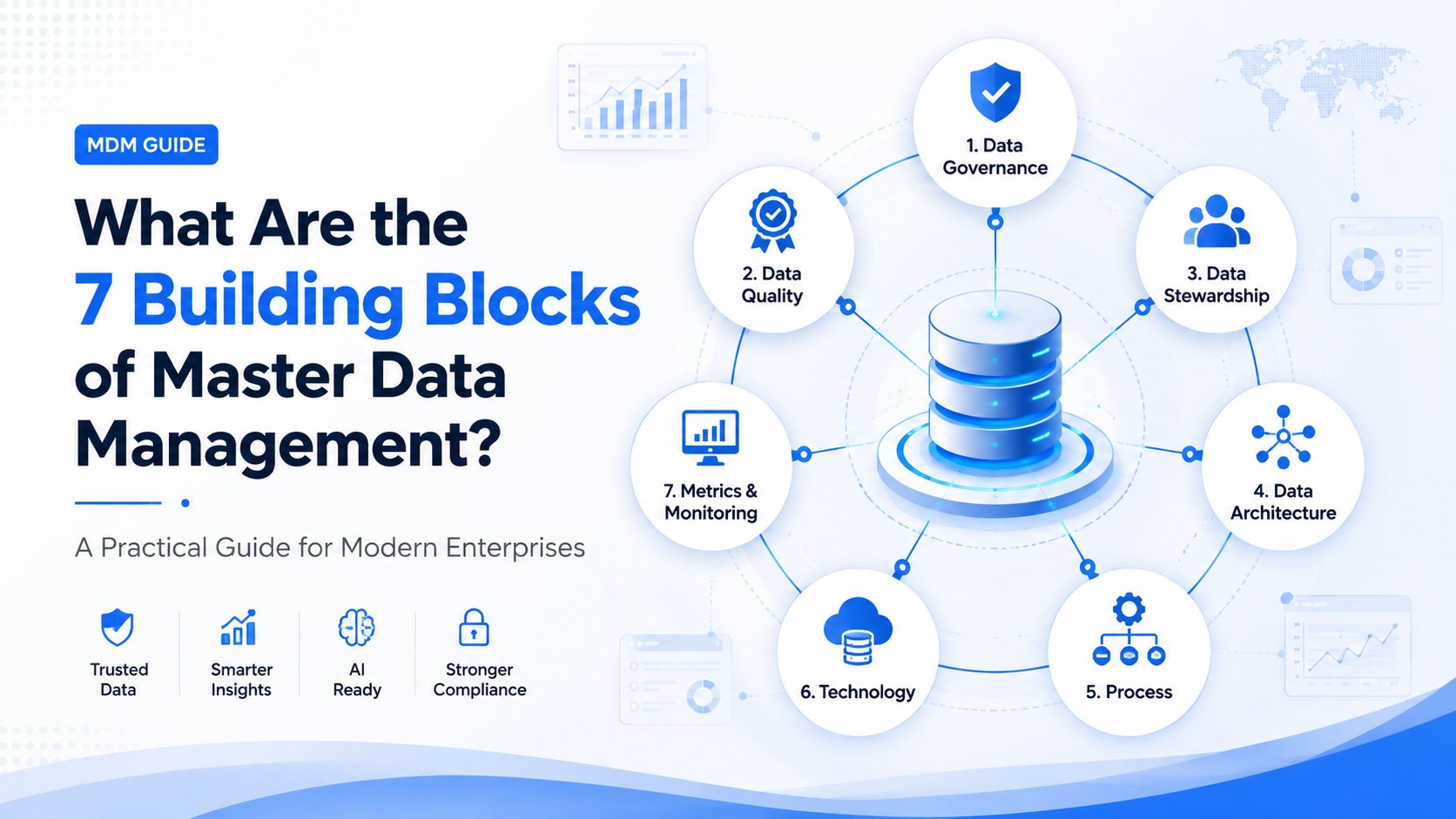
What Are the 7 Building Blocks of Master Data Management (MDM)? A Practical Guide for Modern Enterprises
Discover the seven essential building blocks of Master Data Management (MDM) and learn how governance, data quality, architecture, stewardship, and technology work together to create trusted enterprise data for analytics, AI, and business growth.
Every organization wants better data.
They want accurate reports, better customer experiences, stronger compliance, more reliable analytics, and successful AI initiatives.
Yet most organizations face the same problem.
Customer records exist in multiple systems. Product information differs between departments. Reports show conflicting numbers. Teams spend countless hours manually correcting data that should have been trusted in the first place.
This is why Master Data Management (MDM) has become one of the most important disciplines in modern business.
This is why organizations are increasingly investing in Master Data Management Solutions to create a trusted foundation for AI, analytics, compliance, and digital transformation.
However, one of the biggest misconceptions about MDM is that it is primarily a technology initiative.
It is not.
Many organizations begin by evaluating software platforms, integration tools, and cloud architectures before they have answered a much more important question:
What actually makes an MDM program successful?
More than a decade ago, Gartner introduced what became one of the most influential frameworks in Master Data Management: the Seven Building Blocks of MDM.
While technology has evolved dramatically since then, the framework remains highly relevant because it focuses on something many organizations still overlook.
MDM is a business-driven initiative enabled by technology—not the other way around.
Today, as organizations invest heavily in AI, machine learning, analytics, Customer 360 initiatives, and digital transformation, understanding these seven building blocks has become more important than ever.
Why Most MDM Programs Fail
One of the most common mistakes organizations make is assuming that buying an MDM platform will solve their data problems.
It won't.
A new platform does not automatically create ownership.
It does not create accountability.
It does not create governance.
It does not define business rules.
It does not decide who is responsible for customer data, product data, supplier data, or patient data.
The reality is that most MDM failures happen long before technology becomes the problem.
Organizations often struggle because they focus on software while neglecting governance, stewardship, ownership, and process.
In our experience, one building block stands out above all others.
Governance is the most neglected component of Master Data Management.
Most organizations have people responsible for products, services, operations, finance, and sales.
Very few have someone clearly responsible for the quality, ownership, and governance of master data.
That gap creates the foundation for every data problem that follows.
Building Block #1: Vision
Every successful MDM initiative begins with a clear vision.
Before discussing software, architecture, integrations, or implementation styles, organizations must answer a simple question:
Why are we doing this?
Unfortunately, many companies start MDM projects without a clearly defined outcome.
They say:
"We want better data."
That is not a vision.
A strong MDM vision is tied directly to business goals.
Examples include:
Creating a trusted foundation for AI.
Improving Customer 360 initiatives .
Reducing duplicate customer records.
Improving regulatory compliance.
Supporting digital transformation .
Creating a single source of truth f or product data.
One of the most valuable lessons we have learned is that if an organization only has budget and executive support to focus on one area in the first year, it should focus on vision and strategy.
Without those two components, every other decision becomes reactive instead of intentional.
Building Block #2 : Strategy
Once the vision is established, organizations need a strategy for achieving it.
Strategy answers questions such as :
Which data domains should we prioritize?
What business problems are we solving?
What resources are required?
What level of maturity do we currently have?
How will we scale over time?
The most successful MDM programs do not try to solve every problem simultaneously.
They focus on one high-value domain first:
Customer Data
Product Data
Supplier Data
Patient Data
They prove value.
Then they expand.
Organizations that try to solve every data problem at once often become overwhelmed by complexity before they deliver measurable results.
Building Block #3: Metrics
If success cannot be measured, it cannot be improved.
Every MDM initiative should define success before implementation begins.
Some common metrics are:
Duplicate record reduction
Data quality improvements
Time taken to onboard customers
Accuracy of reports
Compliance improvements
Efficiency improvements
But that’s not all.
CEOs are interested in the outcome of their business.
For example, rather than reporting 40% reduction in duplicate records,show how accuracy of customers contributed to the success of your marketing.
The organizations that secure ongoing executive sponsorship are usually the ones that successfully connect data quality improvements to business performance.
Building Block #4: Governance
This is the building block most organizations underestimate.
Governance is not paperwork.
Governance is decision-making.
Large financial institutions implementing Master Data Management in New York often discover that governance is the most critical factor in long-term MDM success.
It defines:
Who owns the data.
Who can change the data.
Who approves changes.
Who is accountable for quality.
How standards are enforced.
Without governance, MDM becomes another technology platform with cleaner screens but the same underlying data problems.
Many organizations invest heavily in infrastructure while assuming governance will naturally emerge later.
It rarely does.
Governance should exist before large-scale implementation begins.
The most successful MDM programs establish governance early and treat it as a business responsibility rather than an IT responsibility.
Building Block #5: Organization
Technology does not maintain data quality.
People do.
This building block focuses on organizational ownership and stewardship.
Data stewardship is often one of the most overlooked responsibilities inside an organization.
Someone must be accountable for maintaining data quality.
Someone must ensure standards are followed.
Someone must resolve conflicts and exceptions.
This building block also represents one of the largest organizational investments required for MDM success.
Many companies underestimate the cost and effort associated with assigning ownership, creating stewardship responsibilities, and building accountability structures.
Yet without these roles, data quality improvements rarely last.
Building Block #6: Process
If governance defines who is responsible, process defines how work gets done.
Master data moves through business processes every day.
Customers are created.
Products are updated.
Suppliers are onboarded.
Employees are added.
Without clear processes, inconsistencies quickly emerge.
In practice, this is one of the most expensive building blocks to implement because it requires organizations to change the way they operate.
Workflows must be redesigned.
Approval processes must be defined.
Validation rules must be established.
Business users must adopt new ways of working.
Technology alone cannot accomplish this.
Manufacturing and logistics organizations implementing Master Data Management in Chicago frequently focus on process standardization before large-scale MDM deployment.
Process change requires organizational commitment.
Building Block #7: Technology and Infrastructure
Technology is essential.
But it should never be the starting point.
By the time organizations reach this stage, they should already have :
A clear vision
A practical strategy
Defined success metrics
Governance structures
Organizational ownership
Business processes
Only then should they evaluate technology.
The right infrastructure depends on business requirements.
Organizations may choose:
Registry MDM
Consolidation MDM
Coexistence MDM
Centralized MDM
The goal is not to choose the most advanced architecture.
The goal is to choose the architecture that aligns with business objectives, governance maturity, and operational requirements.
How AI Is Changing the Seven Building Blocks
Many organizations assume AI changes the importance of MDM.
In reality, AI reinforces it.
One of the most interesting developments in modern MDM is that none of the seven building blocks have become less important because of AI.
Every single one has become more important.
AI increases the quality threshold for data.
Poor data that once caused reporting issues can now affect:
Machine learning models
Automated workflows
Customer experiences
Strategic decisions
Many enterprises implementing Master Data Management in Dallas are using MDM as a foundation for AI, analytics, and digital transformation initiatives.
As organizations invest in AI, the expectations around governance, stewardship, data quality, metrics, and accountability all increase.
The seven building blocks do not disappear.
They become sharper.
They become more demanding.
And they become more critical to business success.
Why Vision and Strategy Matter More Than Ever
If there is one lesson organizations should take from the seven building blocks, it is this:
Technology should not drive your MDM initiative.
Vision and strategy should.
Organizations that begin with technology often struggle.
Organizations that begin with business objectives tend to succeed.
Before selecting software, ask:
What outcome are we trying to achieve?
How will success be measured?
Who owns the data?
Who is accountable?
How will AI, analytics, and business users benefit?
The answers to those questions are often more important than the platform itself.