
SiNGL BlogJuly 03, 2026SiNGL Team
Is Master Data Management Still Relevant in 2026? A Guide for U.S. Based Enterprises
A 2026 guide explaining why Master Data Management remains critical for U.S. based enterprises as they adopt AI, analytics, cloud platforms, data mesh, and digital transformation initiatives.
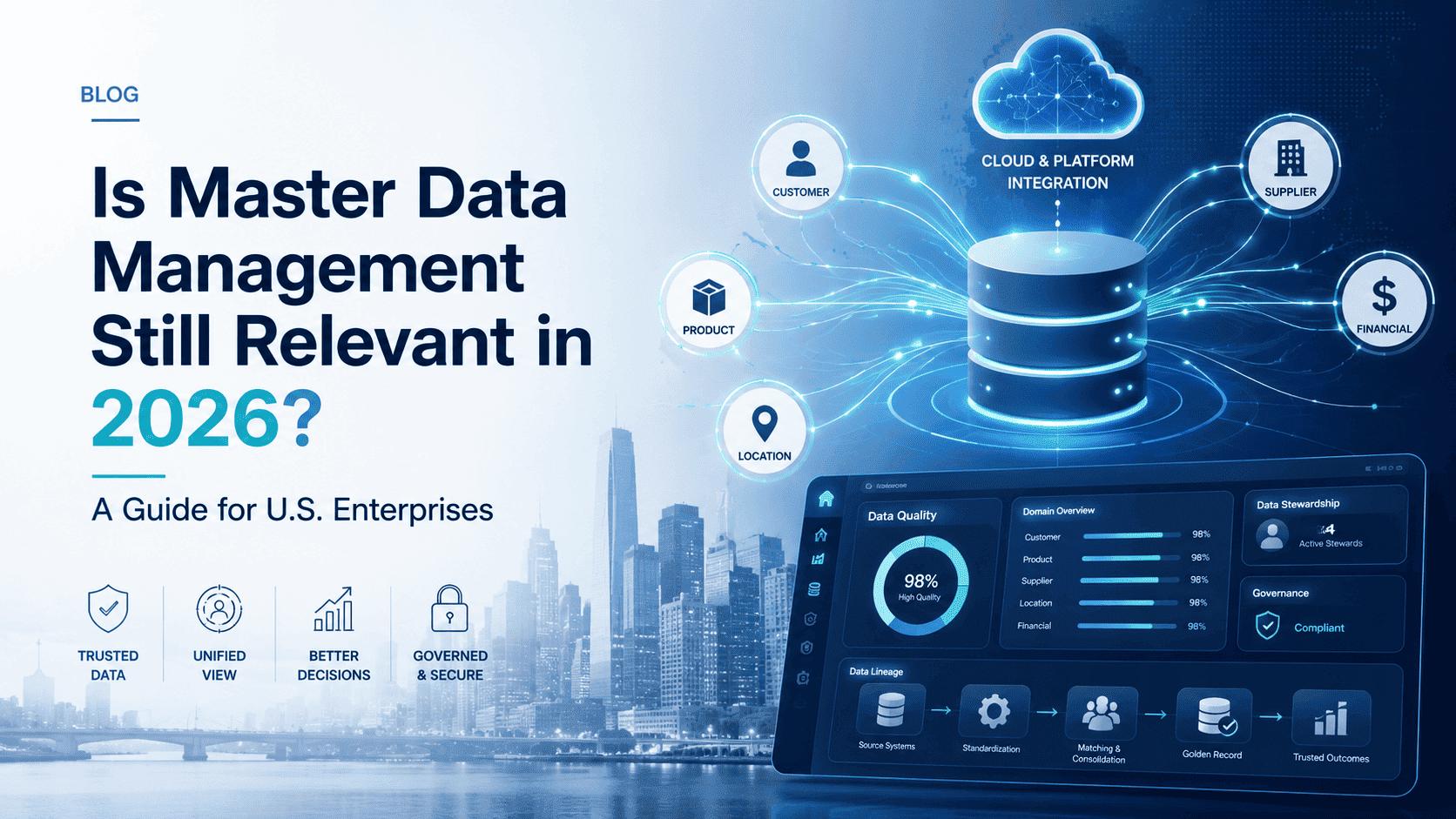
Let’s be honest—this question comes up for a reason.
For years, Master Data Management (MDM) was positioned as the backbone of enterprise data. One system to rule them all. One source of truth. One place where customer, product, supplier, and operational data could finally be trusted.
But today, the landscape looks very different.
Organizations operate across cloud platforms, SaaS applications, data lakes, APIs, and real-time analytics environments. Artificial Intelligence has become a boardroom priority. Data mesh and decentralized architectures have changes how enterprises think about ownership and governance
As a result , many business leaders are asking :
Is Master Data Management still relevant in 2026?
Yes—and not for the reasons you might expect.
Modern MDM has changed from being a back-office data effort into being a key business capability that enables artificial intelligence (AI), analytics, regulatory compliance, customer experiences, and digital transformation efforts.
Firms operating from major business centers like New York, Chicago, and Dallas are more frequently turning toward modern master data management to manage their increasing data complexity and create a solid business foundation for the future.
Why Organizations Believe MDM Is No Longer Relevant
One of the most common misconceptions is that modern technology platforms automatically solve master data problems.
Companies invest in:
- Cloud platforms
- Data lakes
- Data warehouses
- AI and machine learning platforms
- Data mesh architectures
and assume those technologies will somehow fix fragmented customer records, duplicate suppliers, inconsistent product information, and disconnected business entities.
Unfortunately, that assumption is wrong.
These technologies are excellent at storing, processing, and analyzing information.
They do not determine:
- Which customer record is correct
- Which product version is accurate
- Which supplier profile should be trusted
- Which business entity should be considered the golden record
That responsibility still belongs to Master Data Management.
Without MDM, organizations simply process larger volumes of inconsistent data faster.
What Master Data Management Actually Does
Master Data Management is not merely a software platform.
It is a business discipline supported by technology.
The goal of MDM is simple:
Create a trusted, governed, and consistent view of critical business entities across the enterprise.
These entities typically include :
- Customers
- Products
- Suppliers
- Employees
- Patients
- Vendors
- Partners
MDM establishes a single source of truth that can be shared across systems , departments and business processes
When implmented correctly ,MDM becomes the foundation for :
- Customer 360 initiatives Customer 360 initiatives
- AI and analytics programs AI and analytics programs
- Regulatory compliance
- Digital transformation
- Operational efficiency
This is the reason why firms looking for current Master Data Management solutions do not give up on MDM because of emerging technologies.
What Happens When Organizations Ignore MDM?
The consequences are rarely visible on day one.
The problems accumulate over time.
Customer records become duplicated.
Product information differs between systems.
Departments provide conflicting figures.
Employees waste time trying to reconcile information.
Finally, trust is lost.
Some of the most frequent business blunders are:
Duplicate Customer Records
Marketing, sales, and customer service teams deal with multiple customer records.
This results in :
- Poor personalization
- Wasted marketing spend
- Lower customer satisfaction
Reporting Inconsistencies
Finance, operations, and analytics teams produce different answers to the same question because each system uses different data.
Compliance Risks
Industries such as BFSI and Healthcare face increasing pressure around:
- KYC
- AML
- Privacy regulations
- Auditability
Master data that is not well-organized makes it difficult to be compliant.
When companies are working within a regulated sector, industry-oriented tools like BFSI Master Data Management and Healthcare Master Data Management are employed.
Failed Analytics Initiatives
Analytics teams spend more time fixing data than generating insights.
At that point, the issue is no longer reporting.
It becomes a business problem.
Why Modern Architectures Still Need MDM
Many organizations believe concepts like data mesh eliminate the need for MDM.
The reality is the opposite.
Modern architectures increase the need for trusted master data.
In a data mesh environment, teams own their own data domains.
That creates flexibility.
But it also creates risk.
Without common definitions and governance standards:
- Customers become inconsistent across domains
- Product definitions drift
- Supplier records become fragmented
Modern MDM acts as a coordination layer .
It enables decentralization while preserving consistency.
Instead of controlling every dataset, MDM governs critical business entities across the ecosystem.
Why AI Makes MDM More Important Than Ever
The rise of AI has fundamentally changed the MDM conversation.
For years, organizations invested in MDM to improve reporting, governance, and operational efficiency.
Today, they are investing in MDM because AI depends on trusted data.
Artificial Intelligence cannot fix poor master data.
It amplifies it. IBM AI and Data Strategy Resources agree,
If customer records are duplicated, AI models learn from duplicated records.
If product information is inconsistent, recommendations become inaccurate.
If supplier data is fragmented, automation workflows make incorrect decisions.
The blunt truth is simple:
Advanced AI built on poor master data simply makes bad decisions faster.
Modern MDM provides:
- Identity resolution
- Data quality management
- Golden record creation
- Governance controls
- Business context
All of which are necessary for successful AI initiatives.
The Biggest Misunderstanding About MDM
Perhaps the biggest misconception is that MDM is simply a technology implementation.
Many organizations believe they can purchase a platform and immediately solve their data problems.
That never works.
As stated by DAMA International Data Management Framework, successful MDM requires:
Business Ownership
Someone must own the data.
Governance
Standards must be defined and enforced.
Stewardship
Data quality requires ongoing accountability.
Technology
The platform supports the process.
Not the other way around.
The most successful organizations understand that MDM is a business transformation initiative supported by technology.
What a Successful MDM Program Looks Like in 2026
The best modern MDM implementations share several characteristics.
Start with a High-Value Domain
Most organizations begin with:
- Customer Data
- Product Data
- Supplier Data
rather than attempting to govern everything simultaneously.
Ensure Quick Wins
The more quickly an organization demonstrates its value, the more successful it will be.
Facilitate Real-Time Data Collaboration
Businesses today need APIs and real-time synchronization; they don’t have time for batch processing overnight.
Enable AI and Analytics
The MDM solution needs to work for operational applications, for analytics, and for AI.
Scale Across the Enterprise
If the first domain works out, governance and stewardship practices can move on to other domains.
This practice has become increasingly common with enterprises that implement master data management solutions in cities such as New York, Chicago, and Dallas, where digital transformation and AI projects are rapidly growing.
How to Know If Your Organization Needs MDM
Here are some red flags.
Your organization needs MDM if:
- Departments trust their own reports
- Duplicate customer records are growing steadily
- Reconciliation has become a standard practice
- The customer experience varies
- Reporting on regulations is hard
- Analytics projects have failed repeatedly
- AI projects suffer from poor quality