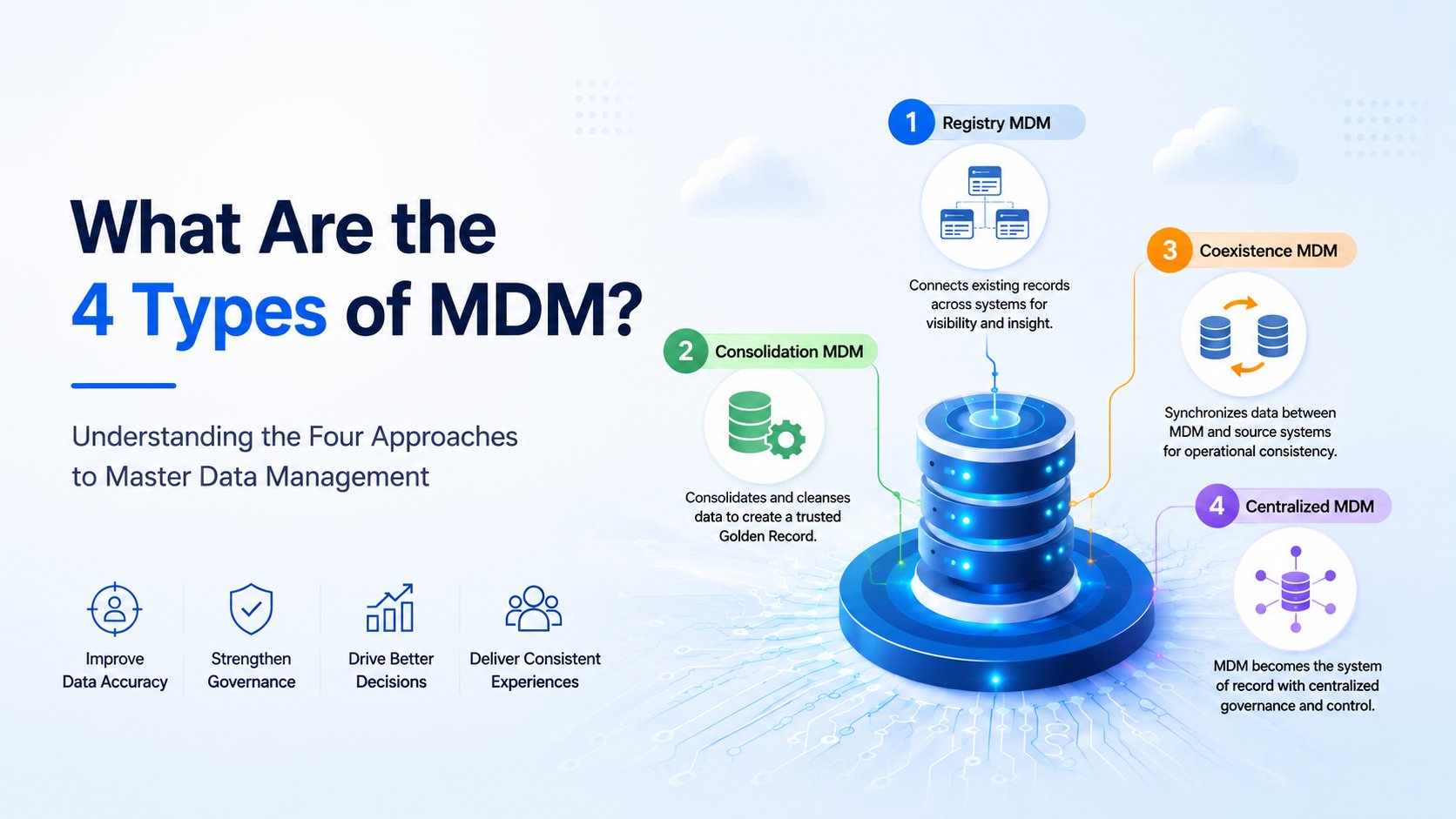
What Are the 4 Types of MDM?
Learn about the four types of Master Data Management (MDM)—Registry, Consolidation, Coexistence, and Centralized MDM. Understand how each approach works, its advantages, and how to choose the right MDM strategy for better data quality, governance, analytics, and AI readiness.
A Practical Guide to Choosing the Right Master Data Management Strategy in 2026
Every organization reaches the same point eventually.
At first, data problems seem manageable. A duplicate customer here. A reporting discrepancy there. Maybe finance has one version of a customer while sales has another. Product information doesn't quite match across systems, but people find workarounds.
Then the business grows.
New applications get added. Teams adopt new SaaS tools. A merger introduces another CRM Analytics initiatives expand. AI projects begin. Suddenly, the organization isn’t dealing with a few isolated data issues anymore
It's dealing with dozens of systems, thousands of duplicate records, conflicting reports, and growing distrust in the data itself.
This is the moment many organizations begin exploring Master Data Management (MDM).
Organizations evaluating Master Data Management Solutions often discover that choosing the right implementation model is just as important as selecting the right technology platform.
The challenge is that there isn't one type of MDM.
There are four primary implementation styles, and choosing the wrong one can add years of complexity, unnecessary cost, and organizational resistance.
Choosing the right one can accelerate analytics , improve customer experience , strengthen compliance ,and create the trusted data foundation required for AI and digital transformation.
Before evaluating any technology , its important to understand how the four major MDM models actually work and why organizations typically evolve between them over time
Why Most Organizations Choose the Wrong MDM Strategy
One of the biggest misconceptions about MDM is that it is primarily a technology decision.
It isn't.
The most common mistake organizations make is selecting an MDM architecture based on vendor recommendations, industry trends, or technical preferences instead of actual business requirements.
A company hears that centralized MDM provides the highest level of control and immediately decides that's the direction they should take.
Six months later they discover:
Business users don't want to change their processes.
Data ownership hasn't been defined.
Source systems aren't ready.
Governance processes don't exist.
Adoption is poor.
The technology isn't the problem.
The implementation approach is.
The best MDM programs start with a simple question:
What business problem are we trying to solve?
The answer determines which MDM model makes sense.
Why There Are Four Different Types of MDM
Every organization has a different relationship with data.
Some organizations operate highly regulated environments where control and governance are critical.
Others are trying to improve reporting without disrupting existing operations.
Some need real-time customer data synchronization.
Others simply need visibility into duplicate records spread across multiple systems.
Because of these differences, four primary MDM architectures emerged:
Registry MDM
Consolidation MDM
Coexistence MDM
Centralized MDM
Each represents a different balance between visibility, governance, control, cost, and organizational change.
Understanding those tradeoffs is far more important than understanding the technology itself.
Registry MDM: Visibility Without Disruption
Registry MDM is often the first step organizations take on their data management journey.
Instead of moving data or changing source systems, Registry MDM creates connections between records that already exist across the enterprise.
Imagine a bank with customer information spread across :
Core banking systems
Loan management systems
Credit card systems
CRM platforms
These systems each have unique representations of the same customer.
Registry MDM builds a common identity layer which connects these representations.
These systems stay intact.
The company gains visibility without disturbing anything.
This is precisely why Registry MDM is so widely used in sectors like banking and healthcare, where it is costly to disrupt operations by changing existing systems.Large financial institutions implementing Master Data Management in New York frequently begin with registry architectures because replacing legacy systems can be costly and disruptive.
Advantages
•Fast implementation
•Low cost
•Little disruption to the systems
•Instantaneous visibility of duplicates
Disadvantages
Registry MDM detects issues, but doesn’t solve them.
The duplicate customer records still exist.
The poor data quality still exists.
The inconsistencies remain inside the source systems.
Registry MDM helps organizations see the problem clearly.
It does not solve it completely.
Consolidation MDM: Creating a Trusted Golden Record
Many organizations quickly discover that visibility alone is not enough.
They need trusted data for analytics, reporting, forecasting, and decision-making.
This is where Consolidation MDM becomes valuable.
Rather than simply linking records together , Consolidation MDM copies information from multiple systems into a central repository .
The data is then :
Cleansed
Standardized
Matched
Merged
The result is a trusted Golden Record.
A single, accurate version of the customer , supplier , product or business entity
For organizations struggling with inconsistent reporting, Consolidation MDM can be transformative.
Suddenly:
Executives see consistent metrics.
Analysts trust the data.
Business intelligence becomes more accurate.
AI models receive cleaner inputs.
Manufacturing and logistics organizations implementing Master Data Management in Chicago commonly use consolidation MDM to create trusted reporting and analytics environments.
However, there is an important limitation.
The improvements remain inside the MDM platform.
The source systems continue operating as they always have.
Poor data can still enter those systems tomorrow.
This is why many organizations eventually move beyond consolidation.
Coexistence MDM: The Bridge Between Control and Flexibility
This is where MDM starts becoming operational rather than analytical.
With Coexistence MDM, data exists both inside the MDM platform and within source systems.
Unlike Consolidation MDM, however, updates flow between environments.
Changes made within MDM can synchronize back to operational systems.
Changes in operational systems can flow into MDM .
This create a dynamic ecosystem where information remains consistent across the enterprise.
For organizations pursuing Customer 369 initiatives , digital tranformation programs or enterprise wide governance initiatives , coexistence often becomes the preferred model.
It provides :
Real time synchronization
Improved governance
Better customer experiences
Operational consistency
Enterprises pursuing digital transformation initiatives often deploy Master Data Management in Dallas using coexistence architectures to balance governance with operational flexibility.
But it also introduces complexity .
Multiple systems can now update the same information.
Organizations must establish:
Ownership rules
Stewardship workflows
Governance processes
Conflict resolution procedures
Without strong governance, coexistence can quickly become chaotic.
With strong governance, it becomes incredibly powerful.
Centralized MDM : Maximum Control and Governance
Centralized MDM represents the highest level of maturity.
In this model, the MDM platform becomes the primary system of record.
All master data creation, maintenance, and governance happens centrally.
Operational systems consume master data from the MDM platform rather than creating it independently.
This provides the highest levels of:
Data Quality
Governance
Consistency
Compilance
Industries facing strict regulatory requirements often pursue centralized MDM because they need complete confidence in their data.
However, this model also requires the greatest organizational commitment.
Processes change.
Ownership changes.
Systems change.
User behavior changes.
The benefits are substantial.
So are the implementation requirements.
This is why relatively few organizations start with centralized MDM.
Most evolve toward it over time.
The MDM Maturity Journey
One of the biggest mistakes people make is assuming organizations choose one MDM style forever.
In reality, most organizations evolve.
A typical journey looks like this:
Stage 1: Registry
Gain visibility into data problems.
Stage 2: Consolidation
Create trusted golden records.
Stage 3: Coexistence
Synchronize data across systems .
Stage 4: Centralized
Establish enterprise-wide control.
The progression mirrors organizational maturity.
As governance improves and business users become more engaged, more advanced MDM models become practical.
How AI Is Changing MDM
The rise of AI has fundamentally changed the business case for Master Data Management.
Historically, organizations invested in MDM to improve reporting and operational efficiency.
Today, many are investing because AI requires trusted data.
Artificial intelligence cannot determine whether five customer records represent the same person.
It cannot automatically understand which supplier record is correct.
It cannot fix poor governance.
What AI does exceptionally well is amplify whatever data it receives.
If the data is trusted, AI becomes more powerful.
If the data is poor, AI produces poor outcomes faster.
This is why MDM has become one of the most important foundations for AI readiness.
Organizations implementing AI without trusted master data often discover that the real problem isn't the AI model.
It's the underlying data.
Which MDM Style Is Right for Your Organization?
There is no universally correct answer.
The right choice depends on:
Business goals
Data maturity
Governance capabilities
Regulatory requirements
Existing architecture
If visibility is the goal, Registry MDM may be sufficient.
If trusted analytics matter most, Consolidation MDM is often ideal.
If operational consistency is required, Coexistence becomes attractive.
If governance and compliance are top priorities, Centralized MDM may be the destination.
The key is not choosing the most sophisticated model.
The key is choosing the model that solves today's business problem while supporting tomorrow's growth.
Final Thoughts
The four types of MDM are not simply technology architectures.
They represent different approaches to trust, governance, control, and business transformation.
Registry helps organizations see.
Consolidation helps organizations understand.
Coexistence helps organizations coordinate.
Centralized MDM helps organizations govern.
The most successful organizations are not the ones that implement the most advanced model.
They are the ones that implement the right model at the right time.
As data volumes continue growing, AI adoption accelerates, and regulatory requirements become more demanding, choosing the right MDM strategy will increasingly become a competitive advantage rather than simply an IT decision.