Benefits of Master Data Management (MDM): How Trusted Data Drives Business Growth
Discover the benefits of Master Data Management (MDM), including improved data quality, operational efficiency, stronger governance, better analytics, reduced costs, and AI readiness.
Data plays a critical role in almost every business decision. From understanding customer behavior and managing suppliers to improving financial reporting and developing AI-driven strategies, organizations depend on accurate and consistent information to operate effectively.
However, as businesses adopt more applications, cloud platforms, and digital tools, maintaining reliable data becomes increasingly challenging. Customer information may be duplicated across CRM systems, product details may differ between departments, and reports may show conflicting figures. These problems can slow down operations, affect customer experiences, and reduce confidence in business decisions.
This is where Master Data Management (MDM) becomes important.
Master Data Management helps organizations create, maintain, and govern trusted records for essential business information. By connecting data across systems and establishing consistent standards, MDM enables teams to work with more reliable information.
Understanding the benefits of MDM is essential for organizations that want to improve data quality, strengthen governance, streamline operations, and prepare for advanced analytics and artificial intelligence.
What Is Master Data Management?
Master Data Management is a business discipline that manages an organization's core data entities, including customers, products, suppliers, employees, locations, and other important records.
These entities are often stored across multiple business applications. Without a consistent management strategy, the same customer or supplier may appear differently in different systems.
MDM addresses this challenge by identifying, matching, standardizing, governing, and connecting records. Depending on the chosen architecture, it can create a trusted master record, link related records, or distribute approved information to connected systems.
The resulting trusted record is often called a golden record. It represents the most reliable version of an entity based on defined business rules, source priorities, and data-quality requirements.
Organizations evaluating Master Data Management Solutions can use MDM to establish a stronger foundation for enterprise reporting, customer experience, operational efficiency, compliance, and AI initiatives.
Why Is Master Data Management Important for Modern Businesses?
Businesses generate data through sales platforms, ERP systems, customer service tools, financial applications, e-commerce channels, and operational databases. As the number of systems increases, so does the risk of inconsistent information.
For example, a customer may have different addresses in the billing and CRM systems. A supplier may be registered multiple times in procurement software, or a product may have conflicting descriptions across sales channels.
These issues can create several business problems:
Inaccurate reporting and inconsistent metrics.
Duplicate customer, supplier, or product records.
Delays caused by manual data correction.
Poor coordination between departments.
Inconsistent customer experiences.
Difficulties maintaining governance and compliance.
Unreliable analytics and AI outputs.
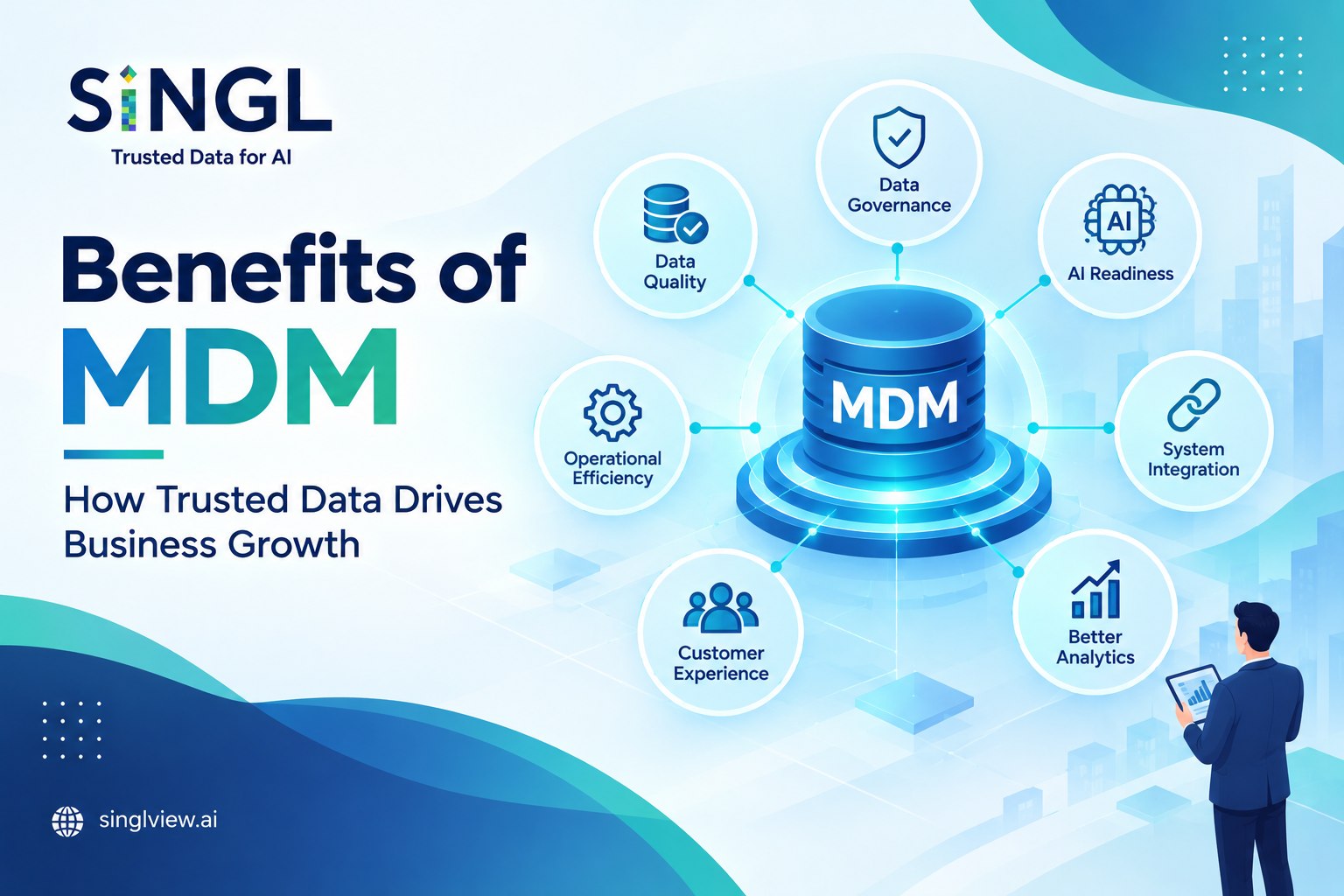
MDM helps organizations address these problems through standardized data management processes, clear ownership, and consistent rules. The following benefits explain how this approach can create measurable business value.
1. Improved Data Quality and Accuracy
One of the most important benefits of Master Data Management is improved data quality.
When information comes from multiple sources, it can contain missing fields, formatting differences, outdated details, and duplicate entries. These inconsistencies can affect everything from customer communications to financial reporting.
MDM introduces processes for validating, standardizing, matching, and maintaining master data. Organizations can establish rules for required fields, acceptable formats, unique identifiers, and conflict resolution.
For example, a company may maintain customer records in its CRM, billing platform, and support system. MDM can help identify duplicate entries and establish a consistent customer record for use across connected applications.
Business benefits include:
Fewer duplicate records.
More consistent customer and supplier information.
Better completeness and accuracy of critical fields.
Less manual data cleansing.
Greater confidence in enterprise information.
Data quality still requires ongoing monitoring. MDM provides the framework for maintaining reliable data rather than treating cleansing as a one-time activity.
2. A Single Source of Truth Across the Enterprise
Different departments often maintain separate versions of the same information. Sales may use one customer record, finance another, and customer support a third.
When these records conflict, teams may disagree about basic business facts, making coordination and decision-making more difficult.
MDM helps create a consistent, trusted view of important business entities across the organization. Depending on the implementation model, this may involve a centralized master record, a linked registry of source records, or synchronized data across multiple systems.
For example, a manufacturer can use MDM to maintain standardized product and supplier information across procurement, inventory, finance, and sales applications.
A shared source of trusted data helps teams:
Work with consistent information.
Reduce disagreements between reports.
Improve collaboration across departments.
Maintain standardized business definitions.
Simplify data reconciliation.
A single source of truth does not necessarily mean storing every piece of data in one database. It means establishing trusted records, clear ownership, and consistent access to the information that business processes need.
3. Better Business Decisions and More Reliable Analytics
Business leaders rely on dashboards, reports, forecasts, and performance metrics to make strategic decisions. However, when the underlying data is inconsistent, these insights can become misleading.
MDM improves the reliability of analytics by connecting and standardizing key data entities. When customer, product, supplier, and location information is consistent, analysts can compare performance more confidently across departments and time periods.
For example, a retail company may struggle to calculate accurate customer lifetime value if the same customer appears under several identities. By improving customer identity resolution, MDM can help analytics teams create a more complete view of customer relationships.
This supports:
More consistent management reports.
Better customer and product analysis.
Improved forecasting inputs.
More reliable performance comparisons.
Greater confidence in strategic planning.
MDM does not replace business intelligence tools or analytical models. Instead, it strengthens the master data those tools depend on.
4. Increased Operational Efficiency and Productivity
Poor data quality often creates hidden operational costs. Employees may spend hours searching for records, correcting duplicates, reconciling reports, or confirming information with other departments.
MDM helps reduce this repetitive work by introducing consistent records, data validation, and governed workflows.
For example, when supplier information is standardized across procurement and finance systems, teams may spend less time resolving duplicate vendor profiles or correcting inconsistent contact details.
Operational improvements can include:
Reduced manual data entry and correction.
Faster access to trusted business information.
Fewer delays caused by inconsistent records.
More standardized workflows.
Better coordination between teams.
The overall impact depends on the quality of the implementation, the number of connected systems, and how consistently employees follow the data-management processes.
5. Enhanced Customer Experience and Personalization
Customers expect organizations to understand their preferences, purchase history, service requests, and interactions. When customer information is fragmented across systems, delivering a consistent experience becomes difficult.
MDM can help businesses create a more complete customer view by resolving duplicate identities and standardizing important customer attributes.
For example, a customer who interacts with a company's website, sales team, and customer support department should not have to repeat the same information unnecessarily because each system maintains a different profile.
A trusted customer record can support:
More consistent customer communication.
Better personalization across channels.
Improved service continuity.
More relevant product recommendations.
Better visibility into customer relationships.
For organizations with complex customer journeys, MDM can support Customer 360 initiatives by connecting master data with information held in operational systems.
Personalization must still respect customer preferences, consent requirements, privacy rules, and appropriate access controls.
6. Stronger Data Governance and Regulatory Compliance
Data governance defines how information is managed, who is responsible for it, and which rules apply to its creation, use, and maintenance.
Without clear governance, departments may use different definitions, update records without appropriate review, or struggle to identify the source of conflicting information.
MDM supports governance by establishing data ownership, stewardship responsibilities, validation rules, approval workflows, and change-management processes.
These capabilities can help organizations:
Define clear accountability for master data.
Standardize data policies across departments.
Track relevant record changes.
Improve consistency in regulated reporting.
Strengthen oversight of critical business information.
Support audit and review processes.
For example, financial institutions can use governed customer and account master data to support KYC processes, reporting, and risk-management workflows. Healthcare organizations can apply governance to patient, provider, and facility data.
MDM can contribute to compliance initiatives, but it does not guarantee regulatory compliance on its own. Organizations must also implement the relevant legal, security, privacy, and operational controls.
7. Reduced Operational Costs and Data Duplication
Duplicate records and inconsistent information can create avoidable costs across an enterprise.
A business may maintain several records for the same supplier, issue duplicate customer communications, or spend time reconciling product information between systems. These activities consume resources without necessarily creating additional value.
MDM can reduce some of these costs by improving data quality and establishing consistent master records.
Potential cost-saving areas include:
Less manual data correction.
Reduced duplication across business systems.
More efficient supplier management.
Fewer data-related operational errors.
Lower effort required for reporting reconciliation.
Better reuse of existing data-management processes.
Organizations should measure these benefits against a baseline. Useful indicators include duplicate-record rates, time spent correcting data, exception volumes, and the cost of maintaining inconsistent records.
The return on investment depends on the organization's data complexity, implementation costs, governance maturity, and the business processes affected.
8. Better Integration Across Business Systems
Modern enterprises use a combination of CRM, ERP, HR, procurement, finance, e-commerce, cloud, and analytics platforms. Each application may maintain its own version of important business data.
MDM helps these systems work with consistent master records by standardizing key entities and establishing rules for data exchange.
For example, a product manufacturer may use one system for product development, another for inventory, and another for online sales. MDM can help maintain consistent product identifiers and attributes across these applications.
Benefits include:
More consistent information across connected platforms.
Easier reconciliation between applications.
Improved visibility into relationships between business entities.
Better support for enterprise modernization.
A stronger foundation for data integration initiatives.
MDM works alongside integration tools, APIs, and data pipelines. It focuses on trusted master data, while integration technologies handle the movement and transformation of information between systems.
9. Improved Supplier and Product Management
Supplier and product data affects procurement, inventory, logistics, sales, and finance. Inconsistent records can cause confusion over supplier identities, product descriptions, pricing attributes, or organizational relationships.
MDM helps businesses standardize these records and maintain consistent identifiers and attributes.
Supplier data management
Organizations can use MDM to identify duplicate suppliers, standardize company information, and improve visibility across procurement and finance.
This may support more consistent supplier reporting, better procurement coordination, and stronger oversight of vendor information.
Product data management
MDM can help maintain consistent product names, identifiers, categories, and selected attributes across enterprise systems.
For example, a retailer may need the same product identifier and category information across its e-commerce platform, inventory application, and reporting tools.
Consistent product data can reduce catalog discrepancies, improve reporting, and support more reliable product operations.
10. Greater Scalability as the Business Grows
As organizations expand into new markets, acquire companies, introduce additional products, or adopt new technologies, their data environments become more complex.
Without a scalable data-management strategy, every new system can introduce additional records, formats, and inconsistencies.
MDM provides a structured approach to managing master data as the organization grows. A well-designed implementation can support additional systems, data domains, business units, and governance requirements over time.
This helps organizations:
Manage growing volumes of master data.
Standardize information across business units.
Integrate newly acquired systems more effectively.
Support expansion into new markets.
Establish reusable data-management processes.
Scalability depends on the selected architecture, data volumes, integration design, performance requirements, and the organization's ability to maintain governance as it expands.
11. A Stronger Foundation for Artificial Intelligence
Artificial intelligence and machine learning initiatives depend on reliable data. If customer identities are duplicated, product attributes are inconsistent, or supplier records are incomplete, these problems can affect downstream analytics and AI applications.
MDM helps prepare critical enterprise data by improving consistency, identity resolution, governance, and record quality.
For example, an AI-powered customer service application may need to connect a customer's interactions across several systems. Reliable master data can help the application identify the correct customer record and retrieve relevant information from authorized sources.
MDM can support AI initiatives through:
More consistent data for model inputs.
Improved entity resolution.
Better traceability of master-data changes.
Stronger governance over critical data.
More reliable enterprise analytics.
Improved consistency across AI-enabled workflows.
MDM is not a substitute for AI model validation, data privacy safeguards, security testing, or human oversight. It provides an important part of the data foundation needed to develop and operate trustworthy AI systems.
12. Industry-Specific Benefits of MDM
Although the core principles of MDM remain similar across industries, its business value depends on the data entities and operational challenges involved.
Financial Services MDM
Financial institutions manage complex relationships among customers, accounts, products, counterparties, and legal entities. Inconsistent records can affect onboarding, reporting, risk assessment, and compliance workflows.
Financial Services MDM helps organizations create more consistent financial master data, improve customer identity resolution, and support governed reporting.
Potential benefits include:
More reliable customer and account information.
Better customer relationship visibility.
Improved consistency for KYC-related workflows.
Stronger data governance and stewardship.
More dependable analytics and reporting.
Healthcare MDM
Healthcare providers rely on accurate patient, physician, provider, and facility information. Duplicate patient identities or inconsistent provider details can create administrative difficulties and affect information exchange between systems.
Healthcare MDM supports patient identity resolution, provider data management, facility standardization, and trusted data across connected healthcare applications.
Potential benefits include:
Reduced duplicate patient records.
More consistent provider and facility data.
Better support for connected patient information.
Improved healthcare reporting.
A stronger foundation for governed analytics and AI.
These benefits depend on accurate matching, suitable clinical workflows, and appropriate privacy and security controls.
13. Benefits of Master Data Management in Major US Business Markets
Organizations in different regions may have different technology environments, industry priorities, and data-governance requirements. However, the need for accurate and consistent master data is common across industries.
Master Data Management in New York
Businesses exploring Master Data Management in New York may include financial services firms, insurance providers, healthcare organizations, and large enterprises managing complex customer and organizational data.
MDM can help these organizations improve customer identity consistency, support reporting, and strengthen governance across connected systems.
Master Data Management in Chicago
Organizations considering Master Data Management in Chicago may prioritize supplier information, customer data, product records, and operational reporting across multiple business units.
A structured MDM approach can help reduce data inconsistencies, standardize shared records, and improve collaboration between operational and analytical systems.
Master Data Management in Dallas
Companies researching Master Data Management in Dallas may need to manage expanding operations, growing customer databases, supplier networks, or cloud-based business applications.
MDM can provide a foundation for trusted enterprise data, consistent reporting, and scalable data-management processes as these organizations evolve.
The most appropriate MDM strategy depends on each organization's business objectives, systems, data complexity, and governance needs—not simply its location.
14. How to Maximize the Benefits of MDM
Implementing an MDM platform does not automatically deliver every potential benefit. Organizations need a clear strategy, suitable technology, accountable data owners, and ongoing measurement.
The following practices can help maximize results.
Define measurable business objectives
Start by identifying the problem MDM should solve. This might include reducing duplicate customer records, improving supplier-data quality, or standardizing product information.
Prioritize the right data domains
Begin with the customer, product, supplier, patient, or other data domain that has the greatest business impact. Expand as the organization develops its MDM capabilities.
Establish data governance
Assign data owners and stewards, define approval responsibilities, and document the rules used to validate and maintain master records.
Integrate existing systems carefully
Map data sources, understand dependencies, and plan how trusted master records will be shared with connected applications.
Track performance over time
Measure data accuracy, duplicate-record rates, unresolved exceptions, processing time, user adoption, and business outcomes.
Improve continuously
Review data-quality rules, resolve recurring issues, and update governance processes as business requirements change.
These practices help ensure that MDM remains an ongoing business capability rather than a one-time technology project.
How SiNGL Helps Organizations Unlock the Benefits of MDM
Organizations looking to improve data quality and establish trusted master records need an approach that fits their existing technology environment and business priorities.
SiNGL's Master Data Management Solutions help organizations unify, standardize, and govern important enterprise data across connected systems.
Depending on the use case and implementation, MDM capabilities can support:
Data consolidation and deduplication.
Golden record management.
Customer 360 initiatives.
Supplier and product data management.
Healthcare patient and provider data management.
Financial services customer and entity data.
Data governance and stewardship.
Enterprise analytics and AI readiness.
A successful MDM strategy combines technology with clear business ownership, data-quality processes, and ongoing monitoring. Organizations should evaluate solution capabilities, integration requirements, security controls, scalability, and implementation needs before choosing an approach.